No Longer in Glimpses: In Memory of My Mother Joan F. Decker

Touched by the Hand of God by Jayt74

Touched by the Hand of God by Jayt74

Richard Decker is a second-year English master’s student at Liberty University. His eulogy for his mother, on her recent passing, speaks to God’s transforming grace and the hope we have as Christians that God’s love will fully restore us to our true selves, made in his image and for eternal communion with him and our fellow creatures.


When I think back to the good that my mother did during her lifetime, what comes to mind is a person who, despite everything, made it clear that she loved me and was on my side—no matter what. My mother showed me how important it was for me to stay strong and to break the cycle. She gave me a love for music and for people. She taught me the importance of being down-to-earth and open with one’s thoughts and feelings, and she always made it clear to me that I could tell her anything. I believe what I am trying to say is that through all the cloudiness, I was still able to see glimpses of a person who loved and cared so much for me and for others and did her best to show that love. But as I said, these were glimpses.

Joan and Richard Decker

Joan and Richard Decker

 For when I would look at old pictures and hear stories of my mother when she was young, I must admit it was always a surreal experience for me. Because the young woman in those pictures and in those stories—the young woman that many of you knew and loved so well—I knew only in photo albums—in glimpses.

As my mother and I would tell jokes with one another, I would see glimpses of that young woman who walked the hallways of Cider Ridge High School, laughing and having a good time with her friends. As I read my mother’s cursive on my Christmas and birthday cards, I would see glimpses of that young woman who loved sending similar cards and letters to her friends and relatives. As I would see my mother dressed up for a get-together with family, I would see glimpses of that young woman who aspired to be a model—and had her aunts and uncles drive her to modeling classes. As I would watch my mother tidying up the house, I would see glimpses of that young woman who would babysit her cousins and clean up their house solely for the sheer joy of seeing things tidy. As my mother showed me the ills of addiction, I would see glimpses of that young woman who wanted so much to be a nurse so that she could care for and look after others. I would see that young woman, every now and then, through these small actions that my mother would take—and I loved her for that.

And above all, my mother knew Christ and trusted in Him. And I know that she is now with Him in a state of peace—no longer afflicted by the demons of this world—no longer consumed by its cloudiness. You know, I heard once—mostly through rumors—that when people enter heaven, they tend to look like their younger selves. I do not know how much I trust such an idea, but I believe I do trust the symbolism behind it: a symbol of purity and innocence that reveals that we as believers are able to see each other as our greatest selves when we are once again with our Heavenly Father.

I believe that such an idea is close to the truth because I also believe that when my time comes—when I, too, am with my Savior—I will also be with my mother again, and I will be able to not only see her but also that loving and caring young woman—no longer in glimpses, but in a full, bright, and beautiful image—to whom I will say, “Joanie! Mom! There you are! I knew you were there that whole time—and I love you for that.”

Editor's Recommendation: Cultural Apologetics by Paul Gould

Editor's Recommendation: Cultural Apologetics

by Paul Gould

Recommended by David Baggett

Reading this book is a pure joy. A breath of fresh air, Cultural Apologetics is one of the best books I’ve read in years. Paul Gould was meant to write it. His ideas having marinated, his prodigious teaching skills honed, his reading wide and deep, he was able to write with the fertile mind of a philosopher, capacious heart of a poet, vivid imagination of an artist, and the nimble hands of a passionate practitioner. This is essential reading for every actual or budding apologist; in fact, the book deserves a very wide readership among believers and skeptics alike. Not a book to be read quickly, but digested and savored. Read, relish, and reread it; use it in class; give it away as a gift. Culturally informed and sensitive, embodying what it extolls, eclectic in numerous respects, and punctuated with clever and telling illustrations—both verbal and visual—this remarkable book makes a powerful case for an expansive apologetic true to a good anthropology. Just the corrective to reawaken the imagination of a disenchanted age. Every page crackles with insight and erudition. At moments it’s veritably sublime and enchanting; as inspiring, persuasive, and moving as it is eminently practical. I simply can’t recommend it enough.


LBTS_david_baggett.jpg

With his co-author, Jerry Walls, Dr. Baggett authored Good God: The Theistic Foundations of Morality. The book won Christianity Today’s 2012 apologetics book of the year of the award. He developed two subsequent books with Walls. The second book, God and Cosmos: Moral Truth and Human Meaning, critiques naturalistic ethics. The third book, The Moral Argument: A History, chronicles the history of moral arguments for God’s existence. It releases October 1, 2019. Dr. Baggett has also co-edited a collection of essays exploring the philosophy of C.S. Lewis, and edited the third debate between Gary Habermas and Antony Flew on the resurrection of Jesus. Dr. Baggett currently is a professor at the Rawlings School of Divinity in Lynchburg, VA.


More Recommendations

The Early Years, From Gutter Sandpile to First Grade: Twilight Musings Autobiography (Part 3)

The Early Years, From Gutter Sandpile to First Grade

A Twilight Musing by Elton Higgs

If we stay long enough in one place, our personalities are affected by where we have lived.  I spent my first 24 years in Texas, and Texans absorb certain outlooks and perspectives.  For example, we smarted from Alaska’s joining the Union and becoming technically the largest state.  After all, one can travel 1,000 miles from border to border and still be in Texas.  The sky itself is bigger in Texas.  Everybody’s your neighbor in Texas, and we are a generally friendly bunch in casual interactions with each other.  Texas is so big, it has at least four distinctive topographies within its boundaries: “piney” forest in the east; flat, semiarid plains in the west and north; “hill country” in the central part, and hot, humid coastland in the south.  I grew up in the part of the plains called West Texas, mainly in a town called Abilene (named after the one in Kansas), in a region of cattle ranching and oil production. 

I lived with my family in Abilene the first four or five years of my life  My earliest memories (late 1930s, early ‘40s) are connected with the little house my family owned on Locust St. in Abilene.  A couple of them were traumatic, like getting into a red ant bed, or waking one morning to find that the city had cleaned the gutter outside our house, thus depriving me of the sand pile I had delighted playing in.  I was greatly offended by the maintenance workers’ arbitrary decision to take away my sand pile!  I flew in to tell my mother, with indignant tears, about this abuse of municipal power.  But in a happier vein are pictures of me in my overalls playing outside the house, or sometimes posing with my brothers.  One showed me in a little cart pulled by a goat, so there must have been enough money to give me a treat once in a while.

A couple of vivid memories from the house on Locust St. had to do with my paternal grandmother.  She was a wizened little lady who sat in her chair chewing snuff and spitting nastily into a receptacle at her feet.  When she died sometime around 1940, we went to the funeral and burial in Nugent, TX, a little town north of Abilene close to the family farm where my father had worked until he got married.  It had rained heavily the day before, and we had to drive carefully through a creek flowing high enough to cover the running board in order to get to the burial site.  As we sat in the car at the graveyard, my father wept freely, the only time I ever saw him do so.  

While we were at Locust St., my mother suffered a complete psychological meltdown (what was then described as a “nervous breakdown”).  I remember her spending whole days in bed, unable to get up and function normally.  I was sent to stay with my uncle Oby and Aunt Sarah, out in the country in the little village of Nugent.  This was rather fun for me, a change of pace from town life.  I enjoyed my aunt Sarah’s home cooked meals and going with my uncle on his rounds in a pickup to check on the large oil pumps that took the crude oil from the ground and pumped it into big tanks nearby.  I remember the cigar that he kept in his mouth most of the time; he must have put it out when he went to check the oil pumps, since we never experienced a conflagration on those trips.

As I look back on these earliest remembered experiences, I realize that in the midst of feeling secure with my family and feeling that I belonged, I was also being forced to deal with the realities of pain and loss.  Indeed, introduction to that mix of pleasure and unpleasantness is typical of our early years, and the places we have lived form a significant context for that stage of our education, both informal and academic.

We moved to Stamford, TX, when I was about 5 or 6, because of my mother’s felt need for some change in our situation.  My dad hoped that moving to Stamford would help her, and he was able to continue his bread delivery route from there.  Mother was a lifelong hypochondriac and was much pampered by my father, according to my brothers.  She was certainly focused on her illnesses and seemed always to be under physical and psychological stress. 

My earliest memories in Stamford were associated with the fact that my brother Otho had joined the Army Air Force and was stationed in Delaware, with the result that his wife, Lucille, came to live with us while he was away.  While there she gave birth to my oldest niece, Linda, and I had my first opportunity to observe an infant first hand.  That was my introduction to the anatomical differences between the sexes and my first lesson in sex education.  I knew nothing, of course, of the implications of those differences, but it made a deep impression on me nevertheless.  Socially, I was informed that I was now an uncle, and I was told later that I was very proud of the fact.  At some point we went to an event involving the Red Cross (related to war time, I imagine), and I was given one of their little pins.  So now I bragged that I was an uncle and a member of the Red Cross!  My sister-in-law was much amused.

Lucille was attended by a Dr. Metz, who sported a little mustache (rather resembling Hitler’s), and she drew a caricature of him on one of my Tinker Toy pieces (all wooden, no plastic) that gave us both a chuckle.  Lucille took a special interest in me at that time, and we continued to have a special relationship until she died many years later.  I was to her like an adopted son.

My memories of those early days in Stamford include playing on the sidewalk outside our house (a quite safe thing to do in those days) and encountering a girl with golden curls as she walked home from school with her mother.  Her name was Gwendolyn Rogers, and she was the object of my first crush.  I evidently had an early attraction for older women!  To her I was no more than a little boy on his tricycle whom she walked past on her way home, but she was my chosen one.  The attachment must have come to an end when I started to school, but I remember no trauma attached to the separation.

I have other memories of Stamford during my pre-school years.  We were within walking distance of the town square, and my brother Thavis took me sometimes to the drugstore, where we would drink a limeade at the fountain.  On the way there and back, I remember going by a shop that had a partially assembled small airplane, probably a military one, visible through a big window..  I don’t know the function of the shop, but the image of the plane stuck with me.  The town was evidently safe for kids to play in, even a little way from home.  I remember going down to the railroad tracks to watch the engines go back and forth, switching cars.  I have a vague recollection of meeting another little boy in that area, because he allowed me to read his Captain Marvel comic books, and I tried to see if the magic word that turned little Billy Batson into Captain Marvel (“Shazam!”) would work for me, but it never did.

On perhaps my fifth or sixth birthday, my mother made me a cake that lasted a few days after the party.  On the day when only one piece was left, my dad wanted to share it with me, but I said I wanted it all for myself.  That little act of selfishness haunted me for years afterward.  I’m not sure when the guilt faded, but the memory has stayed with me all this time.

I have vivid memories of playing indoors at our house in Stamford during my pre-school years.  My toys reflected the context of wartime.  I had a bomber model that dropped marbles, with which I destroyed imagined enemy installations.  One Christmas I was given a model electric train by Otho and Lucille, and it engaged me many hours with its electric engine and circular track.  It was operated by a transformer box with a lever that made the engine go backward or forward, and I often derailed it with my rapid changes in direction and speed.  I can still smell the oil with which I lubricated the wheels of the train.

Most of our news came from the radio, supplemented by the newspaper, and though I don’t remember listening to any of President Roosevelt’s Fireside Chats, the family must have listened to some of them.  One program that I do remember my mother listening to faithfully was the commentary of Gabriel Heater.  I can hear even now his soft but confident voice, delivering his opinions on the news of the day, particularly of the war.

My first-grade experiences in Stamford were dominated by respiratory illness.  I was sick so much during my initial enrollment that my parents decided just to pull me out so that I could concentrate on getting well.  Consequently, I started again from scratch the next school year.  Since I had learned the basics of reading in my first enrollment (including phonics, an exercise in audial perception that has helped me throughout life), I spent much of my convalescence time developing my reading skills, and consequently, when I went back to school, I had a head start on the other students.  In fact, I read so well that the teacher asked me to listen sometimes to students reading and to correct them, while she worked with still another group. That spotlight on my advantage was, I fear, unhealthy food for my ego—I enjoyed it overmuch.  However, being one of the oldest in all my classes thereafter contributed materially to my academic successes.  Being held back in early primary school is often a good strategy for an initially struggling child.

I should note several other memories of my first-grade years.  My family bought a milk goat because someone had said that drinking fresh goat’s milk is good for ailing children.  The nanny goat my father milked became a pet, and it was great fun to play with her baby when he was born.  We took the goat with us when we moved back to Abilene around 1944 and created a shed and pen in back of the house.  I remember going out with my dad to milk the goat, and he taught me how to do it, though I never became really proficient at it.

I had significant interactions with my brother Thavis (eight years older than I) during our stay in Stamford.  He was a builder of model airplanes, and he spent hours meticulously cutting out parts of the plane from sheets of balsa wood and gluing them precisely together.  His room was off-limits to me, but I sneaked in when he wasn’t home and looked over his work.  I don’t remember seriously disturbing anything, but when he caught me in his room, his displeasure was strongly expressed.

Another of his wartime activities was to collect tin foil from chewing gum wrappers and roll them into a ball to convey to a recycling center for the war effort.  I can still see and feel the process of starting at the corner and carefully peeling back the foil from its wax paper base. I helped with building some of the balls of foil, and they became rather large, say about the size of a hardball or larger.

While we were in Stamford, Thavis got a job at a little grocery store owned by a man named Earl Stagner.  He and Thavis became good friends and remained so for years after we moved back to Abilene.  Another of his jobs in Stamford was working at a little café, where he learned to cook some of the dishes he served.  As a result, he introduced me to an egg and jelly sandwich which was made with three pieces of bread, with a hole cut in the middle of the middle slice to fit over the fried egg resting on the bottom slice.  Jelly was added to make it a memorable taste experience.

My most traumatic experience with Thavis was his trying to teach me to swim.  After a few rudimentary instructions, he decided that it was time literally to let me sink or swim, and I sank.  I was very frightened and swallowed some water, I think.  The swimming lesson failed, and much to his disgust, I refused to try any more.  It wasn’t until I was a teenager that I made any progress in learning to swim.

Thavis decided to run away from home after we moved back to Abilene, in order to finish his senior year in high school at Stamford.  Our time together in Stamford created a bond between us, and he continued to be a special big brother to me even after we were separated.

These scattered memories attached to places lived make me aware of how important seemingly insignificant details of experience can be.   Being stung by the red ants and being deprived of my gutter sandpile were my introduction to loss, but it took the brief, isolated event of watching my father weep at his mother’s death for me to have my first limited understanding of the grief attached to death.  I had the dawning of conscience in the small incident of not sharing my birthday cake.  Early experiences with my sister-in-law and my brother Thavis were not dramatic, but they were the foundation for more mature relationships later on.  My illness as a little boy actually resulted in my having an advantage when I finally started school.  So it was that my early years in Abilene and Stamford contributed significantly to who God has enabled me to become.    



Elton_Higgs (1).jpg


Dr. Elton Higgs was a faculty member in the English department of the University of Michigan-Dearborn from 1965-2001. Having retired from UM-D as Prof. of English in 2001, he now lives with his wife and adult daughter in Jackson, MI.. He has published scholarly articles on Chaucer, Langland, the Pearl Poet, Shakespeare, and Milton. His self-published Collected Poems is online at Lulu.com. He also published a couple dozen short articles in religious journals. (Ed.: Dr. Higgs was the most important mentor during undergrad for the creator of this website, and his influence was inestimable; it's thrilling to welcome this dear friend onboard.)


Elton Higgs

Dr. Elton Higgs was a faculty member in the English department of the University of Michigan-Dearborn from 1965-2001. Having retired from UM-D as Prof. of English in 2001, he now lives with his wife and adult daughter in Jackson, MI.. He has published scholarly articles on Chaucer, Langland, the Pearl Poet, Shakespeare, and Milton. His self-published Collected Poems is online at Lulu.com. He also published a couple dozen short articles in religious journals. (Ed.: Dr. Higgs was the most important mentor during undergrad for the creator of this website, and his influence was inestimable; it's thrilling to welcome this dear friend onboard.)

Adoption, the Children of God, and the Spirit of Supererogation

Adoption, the Children of God, and the Spirit of Supererogation

Jeffrey R. Dickson

The Bible illustrates the wonder of redemption in many captivating ways—all of which demonstrate the goodness of a loving God. One analogy that has become especially meaningful to my family is that of adoption. The apostle Paul writes,

But when the fullness of the time came, God sent forth His son, born of a woman, born under the Law, so that He might redeem those who were under the Law, that we might receive the adoption as sons. Because you are sons, God has sent for the Spirit of His Son into our hearts, crying, ‘Abba! Father!’ Therefore you are no longer a slave, but a son; and if a son, then an heir through God. (Gal. 4:4-7)

Recently our family adopted a beautiful little girl and this process has provided us with a new appreciation for what God has accomplished for sinners. This growing admiration for what Christ has completed for the lost has come by means of several parallels that might be drawn between our family’s personal adoption story and Jesus’ program of redemption. To be sure, any comparison between Christ’s salvific work and my family’s experience should not be taken as a suggestion of congruency between the two. However, several similarities do exist that elucidate the heart of spiritual adoption, something of the abundance of God’s grace, and its implications for the believer.

First, my wife and I were under no obligation to adopt. In fact, prior to our newest addition we already had three children of our own. Though we tragically lost our third child (a son) a couple years ago, the only motivating factor behind our desire to adopt a new baby stemmed from a deep and mysterious yearning to show love to another child. Similarly, God was not obligated to redeem lost sinners in a way that would bring them into his family. As God is perfect and (as the passage above intimates) exists in triune community, there is no insufficiency, loneliness, or incompleteness that adopting sinners could possibly satisfy. Instead, it is his mysterious desire to share love, particularly for his Son, with others that motivates him to grow his family. If supererogation is defined as the performance of a work or activity that transcends what duty or obligation requires, God’s spiritual adoption of the sinner is supererogatory in excelsis and par excellence. (Admittedly, some would argue that God himself has no duties, in which case he can’t go beyond his duties, since he doesn’t have any; even if so, though, there’s something of the spirit of the supererogatory at play here in God’s unspeakable grace. Language of duties alone is inadequate to the task of capturing God’s great love.)

That God’s grace is beyond explication in terms of duties alone in adopting anyone manifests in several additional parallels that can be drawn between our family’s experience and the experience of redeemed sinners everywhere. For instance, the offer of adoption is not always reciprocated. For my wife and me, the process of being matched with a birth mother involved sharing our carefully crafted profile with several potential women. Five of these women passed us over for someone else in spite of what we believed was a fairly attractive and convincing presentation. Though we thought we had produced a convincing appeal to raise their biological children, they decided to choose another family. In the same way, Christ’s offer of adoption into the family of God is not always accepted either. This is especially curious given all the convincing proofs of his ministry (as witnessed, for instance, in the compelling case for the historicity of his resurrection), his glory (as seen in the beauty and design found in creation), and his goodness (as evidenced in common grace throughout the world and moral tendencies within the human person). In fact, God’s case for adoption includes the most compelling profile of all, rendering the proposition of passing it over for something/someone else especially grievous and tragic.

Adoption also comes at an unusually high price, often requiring great sacrifice. This was true in the life of our family as we counted the cost and sacrificed plans and pleasures to satisfy what was required to bring our girl home. Added to legal costs were traveling fees and other accommodations as we were made to go a long distance and remain a couple of weeks before being reunited with our older children. Even further, there were multiple hoops through which we were made to jump in order to bring our adoption to finalization. However, what was true in a financial, emotional, geographic, and legal sense for our family is even truer of Christ who, in providing for the adoption of sinners, was required to pay the ultimate price—his life. Not only that, but Christ traveled much farther in his efforts to arrange for sinners to be invited into the family of God and ripped through far more red tape.

. . .although He existed in the form of God, did not regard equality with God a thing to be grasped, but emptied Himself, taking the form of a bond-servant, and being made in the likeness of men. Being found in appearance as a man, He humbled Himself by becoming obedient to the point of death, even death on a cross. (Philippians 2:5b-8)

This passage highlights not only the special and sacrificial barriers Jesus crossed, but also demonstrates the myriad of hoops he jumped through, as it were, in order to pave the way for the spiritual adoption of the redeemed.

Finally, for our family (and most others who adopt children), our new baby girl will not be considered a second-class child nor will she even be introduced as “my adopted daughter.” We consider her as much ours as our other children and her status as one of ours will never change. She has become another member of our family in every way for as long as God leaves us on the earth. In fact, she stands to inherit a portion of what little my wife and I may leave behind along with our other kids. Similarly, God’s adopted children are called “sons and daughters of God” in every meaningful sense. Their legitimacy as children in God’s family is further confirmed by the inheritance they will one day share—“therefore, you are no longer a slave, but a son; and if a son, then an heir through God” (Gal. 4:7). This would have proven especially meaningful to the first century reader as most adoptees were adult males and the reason for adoption was usually to pass on one’s inheritance [Hugh Lindsey, Adoption in the Roman World (Cambridge: Cambridge University Press, 2009), 25, 28]. Finally, their status as one of God’s children is permanent as Jesus says, “and I give eternal life to them, and they will never perish; and no one will snatch them out of My hand. My Father, who has given them to Me, is greater than all; and no one is able to snatch them out of the Father’s hand” (John 10:28-29). Again, first century readers would have no doubt appreciated the connotation of permanence associated with adoption as under Roman law a man could never disinherit an adopted son but could more easily put away a naturally-born child [Ramsay, A Historical Commentary on St. Paul’s Epistle to the Galatians (Grand Rapids, MI: Baker, 1979), 353)].  

Perhaps this is why the adoption image is utilized in the scriptures to speak of Christ’s redemptive work, for, in it, the unspeakably gracious nature of God is on full display, the high cost of Christ is in full view, and something of the permanence of the familial relationship that is forged as a result is adequately celebrated. All of these considerations demonstrate, among other things, the desperately helpless state of the adoptee (lost sinners) and something of the overwhelming benevolence of the adopter (the Lord God). Much as our little girl was helpless, if left unto herself, to enter a good home, so too are lost sinners without a relationship with Christ. That said, praise be to God that he arranged a program for adoption, provided for its cost in the giving of his Son, and paved the way for full and final inclusion in the family of God.


Jeff Dickson.JPG

Jeffrey Dickson, PhD studied Theology and Apologetics at Liberty University where he now serves as an adjunct professor of Bible and theology. Dr. Dickson is also the senior pastor of Crystal Spring Baptist Church in Roanoke VA where he lives with his wife Brianna and their children.


Assessing One’s Parents: Twilight Musings Autobiography (Part 2)

Assessing One’s Parents

Twilight Musings Autobiography (Part 2)


          Not all people have siblings, but we all have parents, and their presence (or absence) in our lives exerts an irradicable influence on who we turn out to be. I once heard of a college counselor who regularly told his undergraduate counselees that “We all have to come to the point of forgiving our parents.”  That is to say, whatever our relationship to our parents, to some degree or other, usually by the time we become adolescents, our parents’ faults will have become obvious to us, and we have to deal with our perception of their failures. 

            That may seem an ungenerous introduction to talking about my relationship with my parents, and I must make clear at the beginning that I suffered no abuse at their hands, and indeed they loved me and provided for me as they were able.  But their age when they were raising me, the last of their brood, meant that they did not have the energy or the health to be very actively involved with me.  Nevertheless, I received some significant guidance and nurture from them.  Sorting through this mixture of influences from my parents challenges me to honestly identify and evaluate their effect on me, being thankful for the good things they gave me and gracious about any deficiencies I thought they had.  It takes God’s help to review one’s upbringing clearly and to take responsibility for what we have become, whatever the advantages and disadvantages of our early home life.

I remember my father as a generally kind man.  He certainly went extra miles trying to make my mother happy, and he seemed to be well liked by his customers and fellow workers during his long employment as a bread delivery man.  Women responded well to his gentleness, and one of my sisters-in-law adored him as a surrogate father, having lost her father early in her life.  Dad was a Bible-reading man and a steady Christian, qualities that led to his appointment as an elder in our congregation of the Church of Christ we attended in Abilene.  He had strong convictions.  I remember that when the Revised Standard Version of the Bible came out in the 1950s, he was adamant in upholding the greater authority of the King James Version because the RSV rendered the quotation of Isaiah that “a virgin shall conceive” a child (Jesus) as “a young woman shall conceive.”  To him, that was changing the very Word of God; he had no conception of such a rendering being justified by a scholarly appeal to the meaning of the original Hebrew.  Neither he nor my mother went past the 8th grade in formal schooling, and neither of them had traveled beyond Texas, so they had no experience that exposed them to any culture except what they had grown up with.

My father and I didn’t share much at a deeply personal level.  When I was small he took me along with him on his bread route sometimes in the summer, but I don’t remember hanging out with him just to engage in some mutually satisfying activity, like attending sporting events or making visits to a park.  He was a hard-working man, and our only regular family activity was going to church and having an occasional extended family meal with my brother Otho and his wife and children.  Things were financially tough for my father and mother and me after he became ill with throat cancer.  After his employment with Mead’s Bakery came to an end, he took up selling Watkins Products from door to door, and I would sometimes go with him on his deliveries and his trips to the warehouse to purchase products to sell.  That ceased when I began to have jobs of my own to pay for my personal purchases and to add to the household income. 

My mother’s health was always precarious, and she had several operations to correct internal problems, including a hysterectomy.  Sometime during my early childhood, she had an emotional meltdown, or what was then referred to as a “nervous breakdown.”  For a period of weeks, she was unable to take care of household chores; I think I was sometimes taken care of by some of my aunts and uncles during this period.  She frequently felt bad, and though there were some real physical problems, my brothers and I, and several of our close relatives, I think, considered her to be a hypochondriac.  From the time I was aware enough to make an evaluation, I responded to her perpetual health problems by wishing that she could be more stoic in enduring them.  I can remember overhearing her telephone conversations with her female friends discussing clinical details of her ailments and medical treatments.

Merely by token of my being at home alone with her after she had sufficiently recovered from her meltdown to be active again, she exerted a kind of environmental influence on me.  I was a rather sickly child up through my primary school years, often having to stay home from school.  Indeed, I had to drop out of school during first grade, starting again the next year.  (Incidentally, this gave me an ongoing advantage in my subsequent years in school, always being a year or so older than my classmates.)  My mother took good care of me when I was ill and was very solicitous of me when I was well, insisting that I always wear a cap in cold weather.  I have some very vivid memories of being treated when I was ill.  As I recovered from upper-gastral problems, I was fed mashed banana and saltine crackers as soft food to re-accommodate my stomach to eating solid food again.  When the problem was constipation, the remedies were always unpleasant and awkward, involving either milk of magnesia or non-orally administered water to loosen things up.

All of this care could have established a close emotional bond, but my mother’s wearing her emotions on her sleeve actually effected a determination in me to repress my emotions, and that early development has been manifested in my adult life.  It took me years to learn to share emotionally with others, including my wife.  Even now, I remain governed more by rationality than by emotion.  That has probably been good for my scholarly pursuits, but less so for my personal life.  I was especially turned off by my mother’s frequent appeals in my teen years for me to tell her that I loved her.  The more she appealed, the less inclined I was to respond in the way that she wanted.  I loved her dutifully, but not fervently or deeply.  I honored my mother according to the commandment, and I saw to her needs to the end, but I did not weep when she died.  Indeed, I rarely weep at all, which is probably a deficiency in my life.

I remember being envious of one of my closest friends during my post-high school years.  His mother had heroically continued as mother to her two sons and a daughter as the family tried to make a go of their farm after the father had left them.  She was a warm, affectionate woman, who welcomed guests and always had a treat ready when her children’s friends visited.  I admired her for her combination of strength and warmth, and I wondered why my mother was so different from her.  I can’t remember my mother ever acting with that kind of spontaneous hospitality toward my friends.

More than balancing out any deficiencies in what my parents gave me was our religious life together.  We went to church three times a week and took it for granted that all of us would be there if not hindered by illness.  We lived close enough to the church building to walk there, which took about 15-20 minutes.  The routines of our household also reflected commitment to serving God.  I remember vividly our custom of praying together every night before retiring.  My father and I would kneel, and he would lead the prayer.  This time was called the “family altar,” and my parents told me that it had been their custom to do this from the beginning of their marriage.  Prayer came naturally in our family.  We gave thanks at every meal, and that’s where I first learned to pray aloud.  My mother was especially dedicated to prayer and had great faith that prayer was a spiritual privilege that produced results.  Her great faith and readiness to pray anytime conditioned me to see prayer as a natural part of everyday Christian living.

My Christian walk, then, was undergirded by the example and teaching of my parents.  Their lack of bitterness and their strong faith in the face of my father’s illness and loss of income encouraged me to work alongside them to supply the family’s needs.  I might not have learned the value of hard, honest work if we had been better off financially.  Their faithfulness to one another during over 35 years of marriage was another powerful working out of their desire to honor God and one another.

On the other hand, my lack of strong personal connection with my father and reaction against my mother’s excessive emotionality resulted in my taking a long time as an adult to learn emotional sensitivity to others, particularly my wife.  I am by temperament strongly inclined toward a rational outlook, and my upbringing did not contribute to tempering that inclination with appropriate emotional expression.

In sum, God gave me parents with both virtues and flaws, like most people.  I thank God that the benefits I received from them outweigh in significance those things I wish they had been able to give me.  I can’t blame any of my deficiencies on them, for I am responsible before God for what I have made of their gifts and how I have compensated for any disadvantages they might have passed on to me.  I must be as charitable and merciful toward them as I hope my children will be toward me.


Elton_Higgs.jpg

Dr. Elton Higgs was a faculty member in the English department of the University of Michigan-Dearborn from 1965-2001. Having retired from UM-D as Prof. of English in 2001, he now lives with his wife and adult daughter in Jackson, MI.. He has published scholarly articles on Chaucer, Langland, the Pearl Poet, Shakespeare, and Milton. His self-published Collected Poems is online at Lulu.com. He also published a couple dozen short articles in religious journals. (Ed.: Dr. Higgs was the most important mentor during undergrad for the creator of this website, and his influence was inestimable; it's thrilling to welcome this dear friend onboard.)


Elton Higgs

Dr. Elton Higgs was a faculty member in the English department of the University of Michigan-Dearborn from 1965-2001. Having retired from UM-D as Prof. of English in 2001, he now lives with his wife and adult daughter in Jackson, MI.. He has published scholarly articles on Chaucer, Langland, the Pearl Poet, Shakespeare, and Milton. His self-published Collected Poems is online at Lulu.com. He also published a couple dozen short articles in religious journals. (Ed.: Dr. Higgs was the most important mentor during undergrad for the creator of this website, and his influence was inestimable; it's thrilling to welcome this dear friend onboard.)

My Family: Twilight Musings Autobiography (Part 1)

My Family

Twilight Musings Autobiography (Part 1)

Elton Higgs

Prologue

          In February of this year, I did a Musing justifying writing an autobiography.  My reasons were that every life has a story that will be interesting to somebody; that if one has lived as a Christian, his or her life will reveal what God has done in that process; and that people should have access to a record of their forebears’ lives.  My own notes for an autobiography were experiencing a long pause when I had a lengthy conversation with the manager of this site, David Baggett.  He encouraged me to get back to the notes and the drafting of the treatise because (bless his heart!) he wanted to see it come to completion.  And he had the concrete suggestion that I use material from the autobiography to do my Friday Twilight Musings.

          I will try to comply, but I don’t want these very personal Musings to be the undisciplined ramblings of a garrulous old man, and I want them to have something of take-away value.  I trust that my wife and David and his wife Marybeth will prevent my using this venue for mere self-referential satisfaction.


My Family

          My life began with my being different from my three older brothers.  I was born in Hendrick Memorial Hospital, Abilene, Texas, on June 14, 1937, the youngest of four sons and the only one to be born in a hospital; the other three were all born at home. There were eight years between me and my closest sibling, so I was raised pretty much by myself, and some of my brothers saw me as rather pampered, which may have been true.  At any rate, I avoided the kinds of problematic development that made things difficult for my brothers.  I believe that God’s hand was in my being born the youngest of the four and in my coming as late in my parents’ lives as I did (I doubt that my arrival was expected).  Let me expand on how my life was significantly formed by my being last in the birth order.

The oldest son, Ordis, was born with cataracts on both eyes and was sent off at an early age to a school for the blind to learn how to make his way in the world.  He engaged in some rebellious behavior at the school, resulting in his being sent home before he graduated.  In spite of that rocky beginning, he eventually married, had children, and became a responsible Christian citizen. Although he was designated as legally blind, he was able to transcend his limitations through learning braille (which he used mostly to read the Bible) and taking advantage of jobs for the blind supplied by the state he lived in.  For many years he operated a stand selling newspapers, snacks, and other items in the state capitol building, and he was able to take up a similar job when he moved to another state. 

The two middle brothers were also rebellious. The second in line, Otho, got married before he was out of his teens, and he and his wife had to live with our family for a while—a complicated beginning to an enduring but troubled marriage.  However, he managed to achieve some stability by joining the military during WWII, gaining enough G. I. benefits to fund some training in watch repair and electronics.  He eventually had his own store selling home electronic devices and repairing watches.

The third son, Thavis, ran away from home when the family moved back to Abilene from Stamford, because he wanted to finish high school in Stamford.  He ended up joining the army so he could finance his college education after he finished his army stint.  Having played an instrument in an Army band, he determined to get a degree in music education. He was ambitious and determined to have a life with more opportunity than had been available to him at home, and he wanted the same for me.  He had a variety of music-based jobs after he graduated: teaching band at the high school level, being a traveling sales representative for a band instrument company, and owning a music store.  He earned extra money during most of his life playing the saxophone for dance bands.  His vocational life was rounded out by a decidedly non-musical job, doing rural mail delivery.  That gave him some retirement benefits, along with a bit of social security income.  

All my brothers, then, worked at a number of jobs, and the middle two were very entrepreneurial. I was the only one of the four who led a fairly normal and conformist life.  I was a “good” boy and unduly proud of it, I fear.  Perhaps the lack of adventuresome activity in my early life was attributable in part to my parents’ being already in their decline by that time; they were less restrictive with me and and I was less dependent on them than my older siblings had been  It was also true, however, that my temperament was more sanguine than that of my older siblings, particularly the middle two.  Whatever was the cause, my upbringing was more peaceful than that of my brothers.

The lesson that I draw from these circumstances in my childhood and teens is that they laid the groundwork for my later life going in more conventional directions than my brothers had.  I also had the advantage of being encouraged in my development by the two closest to me in age: Thavis urged me to equip myself intellectually and socially to have a better life than my parents had, and he furnished me with the model of completing a college education.  And during my senior year, Otho gave me some hands-on instruction in basic service to electronic devices.  However, after seeing my ineptitude for applying what he had taught me, and seeing that I excelled in academics, he gave me the memorable advice to “stick with your books.”

So it was that God helped me to avoid the difficulty of a rebellious early life and provided a push toward my pursuing an academic career.  But more about that in another Musing.


Elton_Higgs (1).jpg

 Dr. Elton Higgs was a faculty member in the English department of the University of Michigan-Dearborn from 1965-2001. Having retired from UM-D as Prof. of English in 2001, he now lives with his wife and adult daughter in Jackson, MI.. He has published scholarly articles on Chaucer, Langland, the Pearl Poet, Shakespeare, and Milton. His self-published Collected Poems is online at Lulu.com. He also published a couple dozen short articles in religious journals. (Ed.: Dr. Higgs was the most important mentor during undergrad for the creator of this website, and his influence was inestimable; it's thrilling to welcome this dear friend onboard.)


Elton Higgs

Dr. Elton Higgs was a faculty member in the English department of the University of Michigan-Dearborn from 1965-2001. Having retired from UM-D as Prof. of English in 2001, he now lives with his wife and adult daughter in Jackson, MI.. He has published scholarly articles on Chaucer, Langland, the Pearl Poet, Shakespeare, and Milton. His self-published Collected Poems is online at Lulu.com. He also published a couple dozen short articles in religious journals. (Ed.: Dr. Higgs was the most important mentor during undergrad for the creator of this website, and his influence was inestimable; it's thrilling to welcome this dear friend onboard.)

Can We Know Anything about the Historical Jesus?

Can We Know Anything about the Historical Jesus?

Yes, and It’s Much More Than You Think

Brian G. Chilton

In 2000, I made the difficult decision to step away from my faith. I entered into what I call theistic-leaning agnosticism, one step removed from pantheism. I believed that some kind of God could possibly exist. However, I didn’t know that a person could know if that God really did exist and most certainly could not know anything about the historical Jesus of Nazareth. These doubts were brought on the claims of the Jesus Seminar who held that less than 14% of the sayings attributed to Jesus were actually his own. The Seminar claimed that the rest of the sayings were inventions from the apostles. Couple the Seminar with PBS’s show From Jesus to Christ which claimed that the Christ of faith evolved over time from the Jesus of history, then one could see why I needed some serious answers. When I asked Christian leaders about how I could know if Jesus was accurately portrayed in the Gospels, I was met with scorn and hostility. Add to that the nepotistic hypocrisy I often saw, then stepping away from the faith was pretty easy.

            However, everything changed in 2005. I was introduced to the writings of Lee Strobel, Josh McDowell, William Lane Craig, and Gary Habermas. This past week, my journey came full circle. I had the honor to have one of my apologetic heroes, Gary Habermas, once again as a professor. The class investigated the New Testament creeds which is the material in the New Testament that predates the New Testament writings. It is thought even by skeptical scholars that many of these creeds date to no later than 35 AD when Paul met Peter and James in Jerusalem (Gal. 1:18-20). The NT creeds tell us much about the historical Jesus because this information is located at ground zero. The creeds tell us about the message of the earliest church which in turn came from the historical Jesus of Nazareth. So, what can we know about the historical Jesus of Nazareth from these creeds?


Creeds Tell Us about the Nature of the Historical Jesus. As fascinating as it is, the creeds provide us with high Christology. In fact, the earliest church had the highest Christology. This decimates the claims that the church evolved the nature of Jesus from a prophet to a divine God-man over time. For instance, consider the Philippians hymn. The Philippians hymn notes that Christ Jesus “existing in the form of God, did not consider equality with God as something to be exploited. Instead he emptied himself by assuming the form of a servant, taking on the likeness of humanity” (Php. 2:6-7a, CSB). The sermon summaries of Acts, all thought to be extremely early, denote the deity of Jesus as one who “has been exalted to the right hand of God” (Acts 2:33, CSB). Don’t forget about the Colossians creed where Christ is said to be the “invisible God, the firstborn over all creation” (Col. 1:15, CSB and see following Col. 1:16-20). One may say, “Okay, but this shows the church’s theology, not the historical Jesus of Nazareth.” In response, one must note that there is no historical presence of evolutionary development, not even legendary development. The earliest church held an extremely high view of Jesus. Therefore, Jesus of Nazareth must have taught something about his divine nature, backing them up with miraculous works.


Creeds Tell Us about the Life of the Historical Jesus. While the majority of the creeds focus on the death, burial, and resurrection of Jesus, the creeds do provide details pertaining to the life and ministry of Jesus of Nazareth. The creeds note that Jesus was born a descendent of David (Acts 13:23; Rom. 1:3). Jesus was noted to have been a Nazarene (Acts 2:22; 4:10; 5:38). Jesus of Nazareth performed numerous miracles (Acts 2:22; 10:38) and fulfilled several Messianic prophecies (Acts 2:25-31; 3:21-25; 4:11; 10:43). From the creeds, the researcher begins to see a similar pattern of Jesus of Nazareth’s life that is portrayed in the biblical narratives concerning him.


Creeds Tell Us about the Death and Resurrection of the Historical Jesus. The majority of the creeds are based around the earliest kerygma of the church—that is, the death, burial, and resurrection of Jesus. Most notably, 1 Corinthians 15:3-7 denotes the resurrection appearances of Jesus, even stating that 500 people witnessed the risen Jesus at one time (1 Cor. 15:6). The sermon summaries of Acts also provide the same formula in that Jesus lived, died, and rose again. The Acts 13 sermon summary even gives a nod to the empty tomb. For Paul’s early message stated that “When they had carried out all that had been written about him, they took him down from the tree and put him in a tomb. But God raised him from the dead, and he appeared for many days to those who came up with him from Galilee to Jerusalem, who are now his witnesses to the people” (Acts 13:29-31, CSB). The creeds denote the numerous witnesses who saw the risen Jesus. They sometimes provide details that other sources do not, such as Simon Peter’s private interaction with the risen Jesus (Lk. 24:34; 1 Cor. 15:5) and James’ private meeting with the risen Jesus (1 Cor. 15:7).


The early creeds are impressive in what they tell us about the historical Jesus of Nazareth. Some will skeptically hold that since the creeds speak of the miraculous and the divine that they must be thrown out. However, such attitudes show more of an anti-supernatural bias than they do a quest for historical truth. At the very least, these early creeds tell us what the earliest church believed about Jesus. At the most, the early creeds give a fascinating description of whom Jesus was, is, and forever will be. The creeds tell the life-changing truth that Jesus is risen. Will you allow this truth to transform you?


Brian G. Chilton is the founder of BellatorChristi.com and is the host of The Bellator Christi Podcast. He received his Master of Divinity in Theology from Liberty University (with high distinction); his Bachelor of Science in Religious Studies and Philosophy from Gardner-Webb University (with honors); and received certification in Christian Apologetics from Biola University. Brian is currently enrolled in the Ph.D. program in Theology and Apologetics at Liberty University and is a member of the Evangelical Theological Society and the Evangelical Philosophical Society. Brian has been in the ministry for close to 20 years and serves as the Senior Pastor of Westfield Baptist Church in northwestern North Carolina.


© 2019. BellatorChristi.com.

Be a Zombie for Christ!

Be a Zombie for Christ!

A Twilight Musing

By Elton Higgs


          O. K., I have your attention.  What could the guy be thinking.?  Isn’t a zombie a dead person inhabited by some alien life form?  Well, the idea of a Christian application of this bizarre concept came right from the Apostle Paul: “I have been crucified with Christ.  It is no longer I who live, but Christ who lives in me” (Gal. 2:20).  And further, “. . .  if Christ is in you, although the body is dead because of sin, the Spirit is life because of righteousness.  If the Spirit of him who raised Jesus from the dead dwells in you, he who raised Christ Jesus from the dead will also give life to your mortal bodies through his Spirit who dwells in you” (Rom. 8:10-11).

          Let’s think a few minutes about the implications of this jarring metaphor of Christian “zombies.”  None of us would desire to become like the zombies in movies, who move about mindlessly, controlled by an inhabiting animation or by some magical power.  But in reality, unless we have accepted Christ as Lord, we are in a similar state of being, for we are governed by what Paul calls “the flesh,” by which he means not just the meat that covers our bones, but our fatal attraction to putting our slowly dying bodies in the driver’s seat of our lives.  We are urged by Jesus not to invest in that which is temporary, but in that which is eternal (see Matt. 6:25-34).  If we hold on inordinately to these decaying bodies we live in, we submit to a truly terrifying kind of zombieism, which Paul describes in more detail. 

In our natural condition, Paul says, we are “dead in [our] trespasses” (Col. 2:13).  “For while we [are] living in the flesh, our sinful passions, aroused by the law, [are] at work in our members to bear fruit for death” (Rom. 5:5).  But does not God’s law direct us how to live for Him in moral perfection?   How then can it be the source of our being controlled by sin?  Because in trying to keep that Law perfectly, we find ourselves in a battle that is unwinnable using only our natural resources:

Did that which is good, then, bring death to me? By no means! It was sin, producing death in me through what is good, in order that sin might be shown to be sin, and through the commandment might become sinful beyond measure.  For we know that the law is spiritual, but I am of the flesh, sold under sin.  I do not understand my own actions. For I do not do what I want, but I do the very thing I hate. 16 Now if I do what I do not want, I agree with the law, that it is good.  So now it is no longer I who do it, but sin that dwells within me.  (Rom. 7:13-17)

We are not fully aware of the horrors of this captivity until we have been “crucified with Christ” and thereby delivered from our sinful slavery to these dying carcasses.  “We know that our old self was crucified with him in order that the body of sin might be brought to nothing, so that we would no longer be enslaved to sin.  For one who has died has been set free from sin” (Rom. 6:6-7).   

Here is a kind of take-over of our bodies that we can embrace just as a captive rejoices at being delivered from prison.  What a scandal it would be if we were to act as if we were still incarcerated after being freed from jail.  Rather, we are told,

Let not sin therefore reign in your mortal bodies, to make you obey their passions.  Do not present your members to sin as instruments for unrighteousness, but present yourselves to God as those who have been brought from death to life, and your members to God as instruments for righteousness.  For sin will have no dominion over you, since you are not under law but under grace.  (Rom 6:12-14)

Or, as Paul sums it up in Romans 8:2, “the law of the Spirit of life has set you free in Christ Jesus from the law of sin and death.”

          Far from being a threat to our welfare, being a “zombie” for Christ offers us freedom from the “death in life” that we are born into as fallen creatures.  If we are to be taken over by an outside force, much better to be inhabited by the Holy Spirit than by the decaying spirit of the flesh.


Elton Higgs

Dr. Elton Higgs was a faculty member in the English department of the University of Michigan-Dearborn from 1965-2001. Having retired from UM-D as Prof. of English in 2001, he now lives with his wife and adult daughter in Jackson, MI.. He has published scholarly articles on Chaucer, Langland, the Pearl Poet, Shakespeare, and Milton. His self-published Collected Poems is online at Lulu.com. He also published a couple dozen short articles in religious journals. (Ed.: Dr. Higgs was the most important mentor during undergrad for the creator of this website, and his influence was inestimable; it's thrilling to welcome this dear friend onboard.)

On Sin as a Corruption of Language

On Sin as a Corruption of Language

A Twilight Musing

By Elton Higgs


          From the beginning of creation, God manifested Himself as a user of language, One Who spoke things into being and then named them.  Each act of creation was a result of His Word: “And God said, ‘Let there be light,’ and there was light” (Gen. 1:3).  His next act was to separate the light from the darkness, and to name them, Night and Day (1:4-5).  God continued this process for the next five days of creation, speaking into existence the Heavens, the Earth, and the Seas and giving them their generic names.  In the process of creating plant and animal life, God designed each species to reproduce “according to their kind,” thus giving each of them unique characteristics that enabled them to be identified by name.  Finally, on the sixth day of creation, God had a conversation with Himself (i.e., between Father, Son, and Holy Spirit): “Let us make man in our image, after our likeness” (Gen. 1:26).  Thereby, the pinnacle of creation, human beings, were to be sentient, aware of themselves and of God, and, unlike the beasts of the field, capable of speech.

          The first man, Adam, was given mastery over all the rest of God’s creation, and a part of that responsibility was to name the various animals (Gen. 2:19-20).  In doing so, he manifested a key characteristic of his bearing the image of God; that is, he used language to define what had already been created, as God did for the Earth and the Seas and the Heavens.  It was also by verbal commands that God informed Adam of his responsibilities and warned him against eating of the Tree of the Knowledge of Good and Evil (Gen. 2:16-17).  In the unfallen state of the original creation, language was an emanation of the nature of God, with a direct, unambiguous, perfect relationship between speech and the referents of speech.  There was no need for symbol or metaphor.  God spoke and material things came forth exactly as He spoke them.  Adam named the animals and that was their distinctive nomination.  God gave His commands to Adam and Eve, and His words were fully comprehended and happily followed.  Truth reigned in creation and gave perfect balance and coherence to the new world that God had pronounced good (Gen. 1:31).

          All was well until by Satan’s power a lying serpent was introduced into the Garden of Eden.  With his deceptive speech, he tempted Eve.  “He said to the woman, ’Did God actually say, “You shall not eat of any tree in the Garden”?’” (Gen. 3:1b).  When the woman replied that God forbade only eating from the Tree of the Knowledge of Good and Evil, the Serpent made a direct assault on the veracity of the Word of God, so that the woman accepted the Serpent’s word rather than God’s Word.  Satan used corrupted, lying speech to sow doubt about God’s perfectly truthful speech.  After she had eaten the forbidden fruit, Eve in turn persuaded Adam to partake of the fruit as well.  As Eve was condemned for listening to the Serpent rather than to God, so was Adam condemned for listening to his wife rather than to God (Gen. 3:17).  As a result, humankind’s communion with God was broken because they accepted the perverted language of their evil Adversary rather than God’s truth.

          It is significant that from then on, sin was compounded by the failing of humans to listen to, believe, and obey the Word of God, and by the continued corruption of language through lying.  Cain ended up slaying his brother Abel because he would not listen to God’s warning against being angry with him (Gen. 4:6-7).  Cain “spoke to his brother Abel (Gen. 4:8) and lured him into the isolation of the field so that he could kill him there.  Mankind became increasingly evil afterward, leading to God’s sending a flood to drown all the sentient life He had created except for Noah, his family, and selected animals.  Several generations after Noah, mankind pridefully used their unity of language to raise an idolatrous tower to “make a name for ourselves” (Gen. 11:4).  In response, God went down and confused their language, “so that they may not understand one another’s speech” (11:7).

          What follows in the Old Testament is the sordid account of God’s Word being rejected, even when He issued it in great detail in the form of the Law issued to Moses on Mt. Sinai.  It is significant that two of the Ten Commandments explicitly address sins of the tongue (taking the Lord’s name in vain and bearing false witness); in addition, implicit in honoring one’s parents is the obligation to listen respectfully to their words and not to speak ill of them (see Mark 7:10). Throughout the O. T. books of poetry and the Prophets, false speech is at the root of people’s rebellion against God.

A good number of the Proverbs inveigh against sins of the tongue, such as “crooked speech,” and “devious talk” (Prov. 4:23-24).  Another proverb points out that

“Death and life are in the power of the tongue, and those who love it will eat its fruits” (Prov. 18:19-21).  The prophets also regularly detail sins of speech among the wicked acts of the people.  Isaiah excoriates those who tell such blatant lies that it’s like turning things on their head and despising the Word of God.


Woe to those who call evil good and good evil, who put darkness for light and light for darkness, who put bitter for sweet and sweet for bitter!  Woe to those who are wise in their own eyes, and shrewd in their own sight! . . .  Therefore, as the tongue of fire devours the stubble, and as dry grass sinks down in the flame, so their root will be as rottenness, and their blossom go up like dust; for they have rejected the law of the Lord of hosts, and have despised the word of the Holy One of Israel.  (Isaiah 5:20-24)


          Jesus warned in his teaching that sinful speech is at the root of alienation from God and is subject to His judgment.          

You brood of vipers! How can you speak good, when you are evil? For out of the abundance of the heart the mouth speaks. The good person out of his good treasure brings forth good, and the evil person out of his evil treasure brings forth evil. I tell you, on the day of judgment people will give account for every careless word they speak, for by your words you will be justified, and by your words you will be condemned.   (Matt. 12:34-37)

The epistle of James makes even more graphic the peril of the tongue as an untamable source of evil:

6 And the tongue is a fire, a world of unrighteousness. The tongue is set among our members, staining the whole body, setting on fire the entire course of life, and set on fire by hell.  7 For every kind of beast and bird, of reptile and sea creature, can be tamed and has been tamed by mankind, 8 but no human being can tame the tongue. It is a restless evil, full of deadly poison. 9 With it we bless our Lord and Father, and with it we curse people who are made in the likeness of God. 10 From the same mouth come blessing and cursing. My brothers, these things ought not to be so.


When God finally sent the remedy for all of this sinful disease into the world, His Son Jesus Christ, He was described as the Word.

In the beginning was the Word, and the Word was with God, and the Word was God. He was in the beginning with God. All things were made through him, and without him was not anything made that was made. In him was life, and the life was the light of men. The light shines in the darkness, and the darkness has not overcome it. . . .  And the Word became flesh and dwelt among us, and we have seen his glory, glory as of the only Son from the Father, full of grace and truth.  

(Jn. 1:1-4, 14)


“The Word became flesh.”  The Word that created the world in the first place--the essential and pure language of God if you will—brought light and salvation to the fallen creation that was corrupted by humans listening to the wrong word.  Only by this supreme and ultimate sacrifice could the consequences of thousands of years of corrupted hearing and perverted speech be eradicated.

          The book of Revelation presents a picture of perfectly restored language in the Kingdom of God.  The book begins with messages from God the Spirit to seven churches (chapters 2 and 3); each message is introduced by the phrase “the words of” and ends with “hear what the Spirit says to the churches.”  Chapters 4 and 5 depict the words and songs of praises to “him who is seated on the throne” (4:9) and to “the Lamb who was slain” (5:12).  After a cascade of catastrophes to be brought by God on a wicked earth (chapters 6-18), we are ushered into the concluding chapters of Revelation in which God’s original purposes for the world He created are finally brought to fruition.  Chapter 19 begins with more words of praise to God and preparation for the great wedding feast between the Lamb and His bride, the Church, those have been faithful to their redemption by the blood of the Lamb.  But the Lamb of God is also a conqueror, and He is depicted in Rev. 19:11ff as the righteous Judge who makes war.  We know this is the Son of God who lived, died, and conquered death, because His unique name is “the Word of God” (19:13).

          We do well to remember the power of words for good and ill, and to realize that the gift of language we take for granted is God’s tool for communicating His will and our tool for spreading His Word about that will.  We even have the power to share in God’s creative power of words by shaping language into beautiful poetry or narratives of history or imaginative fiction.  In a practical way, we use language to share our understanding of God and the world He created.  But like all gifts from God, language can be used responsibly only when sanctified by His Spirit.  Like Isaiah when he saw God and heard His command to speak to the people (Is. 6:1-7), we are “of unclean lips” and are in need of an application of God’s purifying fire to our lips so that we may speak not merely our words, but His.  Our enablement is incomplete now, but we have the hope of being eternally in the presence of the Very Word Himself.


Elton_Higgs.jpg

Dr. Elton Higgs was a faculty member in the English department of the University of Michigan-Dearborn from 1965-2001. Having retired from UM-D as Prof. of English in 2001, he now lives with his wife and adult daughter in Jackson, MI.. He has published scholarly articles on Chaucer, Langland, the Pearl Poet, Shakespeare, and Milton. His self-published Collected Poems is online at Lulu.com. He also published a couple dozen short articles in religious journals. (Ed.: Dr. Higgs was the most important mentor during undergrad for the creator of this website, and his influence was inestimable; it's thrilling to welcome this dear friend onboard.)


Elton Higgs

Dr. Elton Higgs was a faculty member in the English department of the University of Michigan-Dearborn from 1965-2001. Having retired from UM-D as Prof. of English in 2001, he now lives with his wife and adult daughter in Jackson, MI.. He has published scholarly articles on Chaucer, Langland, the Pearl Poet, Shakespeare, and Milton. His self-published Collected Poems is online at Lulu.com. He also published a couple dozen short articles in religious journals. (Ed.: Dr. Higgs was the most important mentor during undergrad for the creator of this website, and his influence was inestimable; it's thrilling to welcome this dear friend onboard.)

Holy Fear

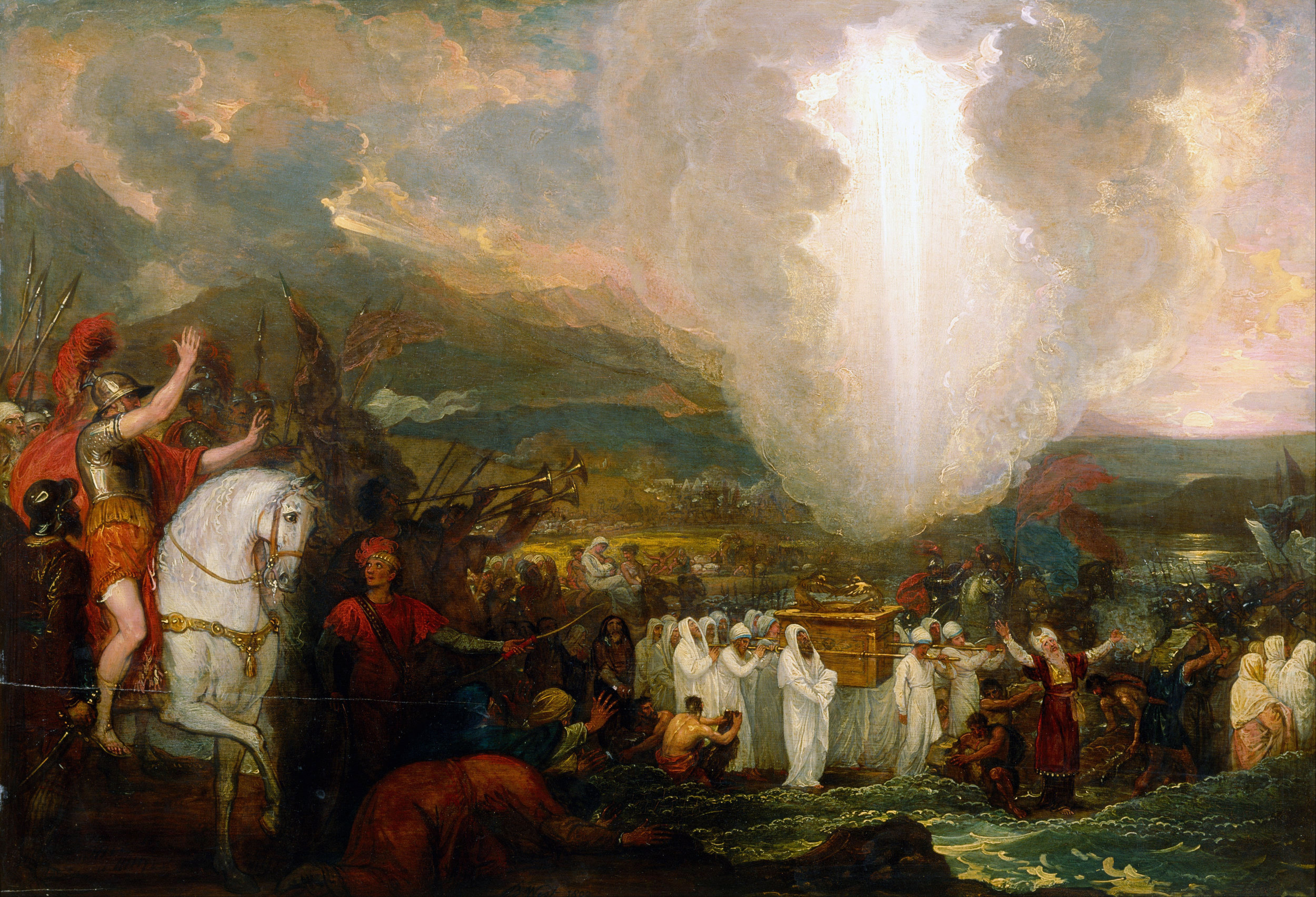
Joshua passing the River Jordan with the Ark of the Covenant by Benjamin West, 1800

Joshua passing the River Jordan with the Ark of the Covenant by Benjamin West, 1800

In Christian Bible classes we sometimes hear people discuss the meaning of the biblical admonition, predominantly found in the Old Testament, to “fear God.”  Does not the New Testament present God as our loving Father, whom we are privileged to address familiarly as “Papa”?  But the Old Testament clearly sees fearing God in a different light.  The “Preacher” of Ecclesiastes, for example, sums up his treatise by asserting that we are to “fear God and keep his commandments, for this is the whole duty of man.  For God will bring every deed into judgment, with every secret thing, whether good or evil” (Eccl. 12:13-14 [ESV]).  But in the New Testament, disciples are frequently told not to fear, and in I John 4:18 we have a radical negation of fear: “There is no fear in love, but perfect love casts out fear. For fear has to do with punishment, and whoever fears has not been perfected in love.”  How do we get from the O.T. fear based on God’s judgment to the N.T. saying that Christians (the new Israel) should have no fear of judgment?  The fear of God still has its place in the N.T., but it is a fear embedded in the fact that Jesus Christ has bridged the gap for us between the austere fear of God and the joyful trembling that comes from being in the Presence of an awesome, loving, and gentle Father who accepts us as brothers and sisters of Christ Jesus.

Those under the Old Covenant were acutely aware that to be in God’s Presence was dangerous because of His perfect holiness and His fearsome judgment on human sin.  Three passages from chapters 6 and 8 of Isaiah and chapter 33 of Exodus illustrate this reaction, even in men who were being called by God.  In Isaiah’s vision of God “high and lifted up” in all His glory and holiness; the prophet’s immediate reaction is fear that he is going to die because he has “seen the King, the Lord of Hosts” (Is. 6:5).  Even though he is a prophet of God, he is terrifyingly aware of his sinfulness, and in order for his life to be preserved and for the conversation with God to continue, Isaiah has to be purified (depicted figuratively by the application of a burning coal from the Temple altar to his lips), so that his “guilt is taken away, and [his] sin atoned for” (v.7).  Moses has a similar experience (Ex. 33:18-23) when he asks God, “Show me your glory” (v. 18); whereupon God allows him only a glimpse of His back, and even that could be granted only with God’s protective hand covering Moses, for “man shall not see me and live.”  Human beings do well to fear the Presence of God, for the fiery holiness of that Presence will consume them unless God Himself offers protection.

          The transition between the O.T. fear of God’s judgment and the N.T. casting out of fear by Love is provided by the visitation upon the sinless Lamb of God of all the wrath of the Father deserved by rebellious mankind.  With God’s judgment satisfied, we can be empowered to serve and obey Him without the fear engendered by our sinfulness.   As Paul expresses it, when we accepted the liberating blood of Christ, we “did not receive the spirit of slavery to fall back into fear, but . . . received the Spirit of adoption as sons, by whom we cry, "Abba! Father!"  Thereby we have the liberty to “work out [our] own salvation with fear and trembling, for it is God who works in [us], both to will and to work for his good pleasure” (Phil. 2:12-13).  As Paul points out in Gal. 3, the final deliverance of mankind from sin was not to be accomplished through obedience to the Law, as necessary as that obedience was.  As he concludes in that chapter, “the law was our guardian until Christ came, in order that we might be justified by faith.  But now that faith has come, we are no longer under a guardian, for in Christ Jesus you are all sons of God, through faith” (Gal. 3:24-26).  God’s love, fully manifested toward humankind by the sacrifice of His Son, is the instrument for transmuting human fear into effective fear of God. 

And so we come back to the statement in I John that “perfect love casts out fear. For fear has to do with punishment, and whoever fears has not been perfected in love” (I Jn. 4:18).  What a glorious privilege is granted to us who live under the New Covenant, that we may glory in standing before God without fear of punishment for our sins.  Although we no longer tremble in physical terror as Moses and the people did when they encountered the fiery Presence of God at Mt. Sinai, we are nevertheless admonished to approach Him in Mt. Zion, the Heavenly Jerusalem, “with holy fear and awe, for our God is a consuming fire” (Heb.12:28-29, NLT).  We still need the protective covering of the blood of Jesus to keep from being consumed by the Fire of God’s judgment.  Thus we are able under the New Covenant to fear God perfectly and joyfully.


Elton_Higgs (1).jpg

Dr. Elton Higgs was a faculty member in the English department of the University of Michigan-Dearborn from 1965-2001. Having retired from UM-D as Prof. of English in 2001, he now lives with his wife and adult daughter in Jackson, MI.. He has published scholarly articles on Chaucer, Langland, the Pearl Poet, Shakespeare, and Milton. His self-published Collected Poems is online at Lulu.com. He also published a couple dozen short articles in religious journals. (Ed.: Dr. Higgs was the most important mentor during undergrad for the creator of this website, and his influence was inestimable; it's thrilling to welcome this dear friend onboard.)


Elton Higgs

Dr. Elton Higgs was a faculty member in the English department of the University of Michigan-Dearborn from 1965-2001. Having retired from UM-D as Prof. of English in 2001, he now lives with his wife and adult daughter in Jackson, MI.. He has published scholarly articles on Chaucer, Langland, the Pearl Poet, Shakespeare, and Milton. His self-published Collected Poems is online at Lulu.com. He also published a couple dozen short articles in religious journals. (Ed.: Dr. Higgs was the most important mentor during undergrad for the creator of this website, and his influence was inestimable; it's thrilling to welcome this dear friend onboard.)

Book Review: What is Marriage? Man and Woman: A Defense

Introduction

In this review I summarize and engage What is Marriage? Man and Woman: A Defense (hereafter, WIM) by Sherif Girgis, Ryan T. Anderson, and Robert P. George.[1] Here are a few general comments before I present a more focused discussion below. First, I found the book immensely helpful as a logical argument in service of an apologetic for the traditional view of marriage (hereafter, TVM), even though it was tough reading at times simply because of the design of the work as a legal brief. The challenge was not that the book is unnavigable due to a lack of clarity or poor writing quality, but that I had to stretch my mind to think in the closely argued and sometimes tedious manner of legal parlance, though I did find the stretch quite enjoyable once I adjusted my expectations. Further, I had to remind myself (and a classmate!) that this book was not intended to provide a biblical or theological argument in favor of TVM, at least not explicitly, though the authors certainly provide implicit arguments for the value of general revelation and natural theology, which are both part of the Christian message. So, the apologetic benefit was primarily the role it serves in bolstering the traditional view of marriage through philosophical argumentation without appeals to special revelation. The book is nothing short of impressive simply as an example of the giftedness of the authors, especially Girgis, whose work on the book and in other contexts related to the TVM discussion reminds me that apologists come from varied backgrounds and sometimes appear in cultural and intellectual contexts that some in the church are tempted to conclude are territories long ago lost to the enemy. I have in mind here Girgis’ academic circumstances at Yale and Princeton, neither one a bastion of Christian orthodoxy or cultural conservatism, and yet, there he is defending the TVM.

Summary and Engagement

The authors begin by stating that, “What we have come to call the gay marriage debate is not directly about homosexuality, but about marriage. It is not about whom to let marry, but about what marriage is.”[2] Given the timing of the book’s release (pre-2015 and the legalization of same-sex marriage in the United States), I find something poignant about these words, especially since most of my experience as a pastor regarding the TVM debate has centered more on homosexuality and less on marriage. Only now have I and other Christian leaders realized we may have had our guns trained on the wrong target, missing the opportunity to focus on marriage and make a positive apologetic argument about it because it was too easy to pick-off the low-hanging fruit of homosexuality through a negative apologetic engagement with the more extreme advocates of same-sex relationships. It appears the enemy’s diversion was somewhat successful, especially as the Christian army now scrambles to reorient itself to the new realities it faces amid its waning influence on Western culture. Not that I have lost hope, but the task before us is daunting and fraught with difficulty, which makes WIM’s insight about the need to focus on the nature of marriage all the more pertinent.

            Thus, to help focus the discussion on marriage, the authors distinguish between two views of marriage: the conjugal view and the revisionist view. The conjugal view “is a vision of marriage as a bodily as well as an emotional and spiritual bond, distinguished thus by its comprehensiveness, which is, like all love, effusive: flowing out into the wide sharing of family life and ahead to lifelong fidelity.”[3] The revisionist view offers “a vision of marriage as, in essence, a loving emotional bond, one distinguished by its intensity—a bond that needn’t point beyond the partners, in which fidelity is ultimately subject to one’s own desires. In marriage, so understood, partners seek emotional fulfillment, and remain as long as they find it.”[4]

            There are at least two striking differences between these views. First, the revisionist approach to marriage—though sharing with the conjugal view an emphasis on the place of a loving bond within marriage—reduces to something that is ultimately subjective and impermanent, based on an emotional fulfillment that is sometimes ephemeral and at least given to wax and wane according to the challenges faced by the couple. Second, whereas the conjugal view implicitly entails a heterosexual understanding of marriage based on its emphasis on bodily union and family sharing, the revisionist view does not require any specific expression of human sexuality since the focus of the marriage becomes emotional fulfillment and nothing specifically procreative.

            These differences in understanding what marriage is provide the opening that advocates of same-sex relationships took advantage of in making their case for gay marriage by reducing the discussion to something that is both real and helpful for a relationship, i.e., the emotional bond, and around which a rallying cry was easy to develop: Who are you to tell me who I can and cannot love? The approach worked and an entire cultural norm has been changed, making sexuality and gender fluid constructs of little consequence in the rush to defend the value of emotional bonds as the locus of the marriage definition. As the authors of WIM labor to make clear, the problem is that the revisionist view introduces an intractable instability into its new definition of marriage. When emotional fulfillment becomes the determiner of permanence there is nothing permanent about marriage—feelings change, and relationships begin and end accordingly.

            The outcome, and one that becomes more obvious as the societal implications of the revisionist view work their way into everyday life, is that “any remaining restrictions on marriage [become] arbitrary” and “genuine marital union” is lost along with the culture dependent upon it.[5] At this intersection of culture and the revisionist view of marriage there are a number of pernicious implications, and this is where I find what I think is one of the most compelling aspects of WIM’s argument. The authors identify several outcomes from the revisionist view of marriage: spousal well-being declines; child well-being declines; the possibility diminishes for substantive friendships between those of the same gender; religious liberty is infringed for those holding the conjugal view of marriage; and the state’s role expands to intrusive levels.[6]

            There is a sense of clarity and foreboding that build as the authors make their case across the seven chapters of WIM: clarity regarding exactly what marriage is and what the revisionist view entails, and foreboding regarding the seeds of destruction sown by the revisionist redefinition of marriage adopted by the Supreme Court in the years following the publication of WIM. The authors make a penetrating and prescient statement in their concluding chapter, explaining that “there is no neutral marriage policy.”[7] Nor is there anything neutral about the conjugal and revisionist views of marriage, and this is the point of WIM—marriage is not some inconsequential ad hoc societal construct that one may take or leave based on preferences. “Almost every culture in every time and place has had some institution that resembles what we know as marriage…. Marriage understood as the conjugal union of husband and wife really serves the good of children, the good of spouses, and the common good of society.”[8]

Relevance for Apologetics

At this point I would like to highlight that the Christian apologist can learn a few valuable lessons about apologetics from WIM’s approach. First, regarding apologetic methodology, what WIM’s authors provide is a cumulative case approach to the discussion of same-sex marriage. Notice how their case builds based on clear definitions, well-thought out implications, and appeals derived from the positive and negative conclusions warranted by the discussion. Rather than a merely deductive approach, there is a certain appeal in the abductive build-out of the argument for the conjugal view of marriage; a certain let-this-sink-in-for-a-moment momentum that has a potentially powerful epistemic effect on all sides of the discussion. Christians concerned about this topic would do well to follow this pattern, especially in our increasingly affect-driven, truth-claim-suspicious culture.

            Second, by delineating the negative effects resulting from the revisionist view, the authors of WIM heed the biblical command to “answer a fool according to his folly” (Prov. 26:5) as they expose the unavoidable outcome of redefining marriage according to emotional fulfillment.[9] This aspect of the argument pairs nicely with WIM’s positive articulation of the conjugal view and its definition of marriage as “a comprehensive union of persons.”[10] In this regard the authors of WIM also obey the Bible’s command “do not answer a fool according to his folly” (Prov. 26:4), as they make their strong case for the conjugal view. Thus, there is a certain apologetic flow to the presentation in WIM, moving from challenging the revisionist view by articulating the conjugal view, and then teasing out the implication of the revisionist view for individuals and culture.

             Third, and this is more of an ecclesial and less apologetic observation, as Girgis explains in a presentation to church leaders about the topic of same-sex marriage, the church has the answer that the revisionist definition seeks to address.[11] The church is the community in which meaningful emotional bonds can and should be formed, and the church has a special calling to those who think they can only find this type of relationship in same-sex marriage. It is the church that gives special significance to the ultimate and mystical meaning of marriage as an eternal bond between Christ and his bride, and it is within the context of the church that all other relationships have a place that is also ultimate and mystical, though marriage need not be redefined for these relationships to be enjoyed.

Conclusion

Sadly, since the publication of WIM, the revisionist view of marriage has won the day in the United States and the implications are staggering. Ironically, the very ones most concerned to see their welfare affirmed and their relationship freedoms enshrined will only continue to find that they are attempting to fetch water from a dried-up well. Thus, the views of the authors of WIM are as important now as ever, and the conjugal view of marriage can and should be explained, defended, and sought to be restored to the culture so dependent upon it. God, help us.


WIN_20180516_09_43_40_Pro (2).jpg

T. J. shares a passion for the moral argument(s) and brings much to his new post. He is, in his own words, a “mere Christian with genuine fascination and awe for the breadth and depth of God’s gracious kingdom.” He became a Christian in 1978, and began pastoral ministry in 1984. He has worked as a youth pastor, senior pastor, church planter, church-based seminary professor, a chaplain assistant in the Army, and a chaplain in the Army National Guard. A southern Illinois native, T. J. is a graduate of Southern Illinois University-Carbondale with a BA in Political Science; Liberty University with an MAR in Church Ministries, an MDiv in Chaplaincy, and a ThM in Theology; Luther Rice College and Seminary with an MA in Apologetics; and Piedmont International University with a DMin in Pastoral Counseling. He is currently writing his dissertation on crisis leadership in the epistle of Jude for the PhD in Leadership at Piedmont, as well as pursuing a PhD in Theology and Apologetics at Liberty, hoping to write his dissertation on some aspect of the intersection of moral apologetics and the pastorate. He is the author of several books, including God Help Us: Encouragement for Evangelism, and Thinking of Worship: A Liturgical Miscellany, as well as journal articles on liturgics, pastoral counseling, homiletics, and apologetics. He and his wife have five children. T. J.’s preaching may be heard at www.sermonaudio.com/fellowshipinchrist.


Notes


[1] Sherif Girgis, Ryan T. Anderson, and Robert P. George, What is Marriage? Man and Woman: A Defense (New York, NY: Encounter Books, 2012), Kindle.

[2] Girgis, Anderson, and George, Kindle location 70.

[3] Ibid.

[4] Girgis, Anderson, and George, Kindle location 78.

[5] Girgis, Anderson, and George, Kindle location 162-169.

[6] Ibid., Kindle location 162-193.

[7] Ibid., Kindle location 1369.

[8] Girgis, Anderson, and George, Kindle location 1411-1419.

[9] Unless otherwise noted, all biblical quotations are taken from The Holy Bible: New King James Version (Nashville, TN: Thomas Nelson, 1982).

[10] Girgis, Anderson, and George, Kindle location 371.

[11] Sherif Girgis, “Better together: Marriage and the Common Good,” Ethics and Religious Liberty Commission, podcast audio, August 23, 2016, https://erlc.com/resource-library/erlc-podcast-episodes/better-together-marriage-and-the-common-good.

Cardio-Circumcision

          We are used to seeing various kinds of body piercings and skin adornments displayed in public, but have you ever seen anyone with circumcised lips?  Or circumcised ears?  Probably not, since we have trouble even visualizing what such physical alterations would look like.  The source of this terminology comes from Scripture (Ex. 6:12; Jer. 6:10), but it is obviously intended to be interpreted metaphorically, along with the often-repeated references to circumcision of the heart (e.g., Deut. 5:16).   This turning of circumcision into metaphor is bold, even a bit shocking, but it is a revealing instance of using physical reality as a bridge to spiritual truth. 

Like any metaphor, figurative circumcision is rooted in physical circumcision.  Although the practice of excising the male foreskin, particularly for newborn infants, is now a common medical procedure, its religious significance has its origin in God’s Covenant with the Jewish people, first instituted by God as a sign of His Covenant with Abraham (Gen. 17:9-14) and later reinforced under Mosaic Law (Josh. 5:2-6). Since the ritual inherently applies only to males, the question arises as to how it signifies God’s Covenant with all His people, male and female.  I would suggest that seating this procedure in the male reproductive organ carries significance in two ways.  First, in the patriarchal society of ancient Jews, men bore the primary responsibility for seeing that the meaning of the Covenant was passed on to the next generation; the circumcision of their male sons at eight days old was a commitment to teach those sons what it means to serve God.  Second, circumcision of the foreskin betokens a dedicated channeling of male libido under the Lord’s discipline.  The man is not free merely to pursue his own lust, but is to dedicate this intimate part of himself to honoring God, through marital fidelity and self-control, thus assuring the perpetuation of a pure line of God’s Chosen People.  So we see that the rite of circumcision betokened much more than the physical marking that took place in infancy.

Scripture actually places more emphasis on circumcision of the heart than on physical circumcision.  Even in the Old Testament, where physical circumcision is required, there are more references to inner circumcision than to physical circumcision.  Circumcision of the heart, as presented to the children of Abraham, involves above all submission to God’s will and obedience to His commandments.  “Circumcise therefore the foreskin of your heart, and be no longer stubborn,” Moses tells the Israelites in Deut. 10:16.  He also tells them that “God will circumcise your heart and the heart of your offspring, so that you will love the Lord your God with all your heart and with all your soul, that you may live” (Deut. 30:6).  What begins as a command for outward obedience to God’s law ends up as a challenge to go beyond the outward process of being physically marked for the Covenant to being spiritually marked by the Covenant.

Under the New Covenant instituted by Jesus’ death and resurrection, the requirement of circumcision was laid aside, along with the rest of the ritual laws about animal sacrifice and Temple worship.  Nevertheless, some Jewish Christians from among the Pharisees insisted that circumcision was still necessary for those accepting Christ and the New Covenant.  This issue came to a head in the Jerusalem Conference of all the Apostles and leaders of the church (see Acts 15:1 ff.), at which it was determined not only that circumcision was not required of uncircumcised Gentiles who became Christians, but that the core of the New Covenant was salvation by grace, not by meritorious works of law-keeping.  Peter testified how God had shown him that the Good News was as much for the Gentiles as for the Jews, and God “made no distinction between us and them, having cleansed their hearts by faith.  Now, therefore, why are you putting God to the test by placing a yoke on the neck of the disciples that neither our fathers nor we have been able to bear?  But we believe that we will be saved through the grace of the Lord Jesus, just as they will" (Acts 15: 9-11).

Thus, under the New Covenant of salvation by grace, not only was circumcision not required, but it actually became a stumbling block to new Christians, for it came to represent a dangerous emphasis on salvation by works.  Paul thundered against this heresy in his writings, as in Gal. 5:1-6:

For freedom Christ has set us free; stand firm therefore, and do not submit again to a yoke of slavery.  Look: I, Paul, say to you that if you accept circumcision, Christ will be of no advantage to you.  I testify again to every man who accepts circumcision that he is obligated to keep the whole law.  You are severed from Christ, you who would be justified by the law; you have fallen away from grace.  For through the Spirit, by faith, we ourselves eagerly wait for the hope of righteousness.  For in Christ Jesus neither circumcision nor uncircumcision counts for anything, but only faith working through love. 

Nevertheless, the figurative, deeper meaning of circumcision is still very much in evidence in the New Testament, as in Col. 2:11-15:

In him also you were circumcised with a circumcision made without hands, by putting off the body of the flesh, by the circumcision of Christ, having been buried with him in baptism, in which you were also raised with him through faith in the powerful working of God, who raised him from the dead. And you, who were dead in your trespasses and the uncircumcision of your flesh, God made alive together with him, having forgiven us all our trespasses, by canceling the record of debt that stood against us with its legal demands. This he set aside, nailing it to the cross.


In this passage, baptism, like circumcision under the Old Covenant, marks one as a participant in the New Covenant; and though it is a physical act, it signifies and expects an inner change that equates to “circumcision of the heart.”

          We conclude, then, that even a God-ordered ritual has no spiritual value within itself; it becomes significant only when it represents, and results in, an ongoing ordering of the mind and heart toward God.  The Lord wants to make His mark not just in our bodies, but in our souls.  The command to “circumcise the foreskin of your heart” is still relevant.


Elton_Higgs (1).jpg

Dr. Elton Higgs was a faculty member in the English department of the University of Michigan-Dearborn from 1965-2001. Having retired from UM-D as Prof. of English in 2001, he now lives with his wife and adult daughter in Jackson, MI.. He has published scholarly articles on Chaucer, Langland, the Pearl Poet, Shakespeare, and Milton. His self-published Collected Poems is online at Lulu.com. He also published a couple dozen short articles in religious journals. (Ed.: Dr. Higgs was the most important mentor during undergrad for the creator of this website, and his influence was inestimable; it's thrilling to welcome this dear friend onboard.)


Elton Higgs

Dr. Elton Higgs was a faculty member in the English department of the University of Michigan-Dearborn from 1965-2001. Having retired from UM-D as Prof. of English in 2001, he now lives with his wife and adult daughter in Jackson, MI.. He has published scholarly articles on Chaucer, Langland, the Pearl Poet, Shakespeare, and Milton. His self-published Collected Poems is online at Lulu.com. He also published a couple dozen short articles in religious journals. (Ed.: Dr. Higgs was the most important mentor during undergrad for the creator of this website, and his influence was inestimable; it's thrilling to welcome this dear friend onboard.)

Take Heart, Be of Good Courage

Take Heart, Be of Good Courage

A Twilight Musing


          A while back a friend who spends part of each year in France responded to some great difficulties I was having with the French word of encouragement, “Courage” (pronounced “koorage,” as in “garage,” accent on the last syllable).  Recently I found that a similar sentiment (“take heart,” or “be of good courage”) is prominent in the Bible, and I would like to consider the theological significance of the idea behind those phrases.

          In the Old Testament we find exhortations to the people to “Be strong and courageous” (Deut. 31:6, Josh. 1:8) and to “take courage” (II Chron. 15:7-8) in going about what God has told them to do.  In the New Testament, Jesus Himself several times encouraged those to whom He was ministering to “take heart” because He was going to meet their need for healing or for the forgiveness of sins (or both).  In the case of the man let down through the roof by his friends (Matt. 9:2-3; see also Mk. 2 & Lk. 5), Jesus said, “Take heart, my son; your sins are forgiven.”  When blind Bartimaeus cried out for help to the Master and Jesus responded, the blind man was told by the disciples to “take heart.  Get up; He is calling you” (Mark 10:49).  To the woman who timidly touched His garment in order to be healed, He said, “Take heart, daughter; your faith has made you well” (Matt. 9:22).  The point of a parable told by Jesus about a persistent widow asking a judge for justice is that his disciples “ought always to pray and not lose heart” (Luke 18:1).

 Jesus established the principle that “taking heart” is an attitude of trust that God is willing and able to strengthen us and to meet our needs.  Such encouragement (you see “courage” embedded in that word?) urges boldness to replace reticence and assurance to replace doubt.  When Paul is threatened with assassination, God assures him that he will be protected: “Take courage, for as you have testified to the facts about me in Jerusalem, so you must testify also in Rome" (Acts 23:11).  

Paul, in turn, assures the Corinthians that we can be buoyed up even when we are experiencing bodily suffering.  His own suffering is mitigated by the assurance that “he who raised the Lord Jesus will raise us also with Jesus and bring us with you into his presence” (II Cor. 4:14).  Consequently, “We do not lose heart.  Though our outer nature is wasting away, our inner nature is being renewed day by day” (4:16).  Moreover, God has “given us the Spirit as a guarantee.  So we are always of good courage. . . , for we walk by faith, not by sight” (II Cor. 5:5-7).

We may wonder when we suffer hardship if we are loved by God, but the writer of Hebrews tells us (quoting from Proverbs), “Do not make light of the Lord’s discipline, and do not lose heart when he rebukes you,  because the Lord disciplines those he loves, and he punishes everyone he accepts as a son.  Endure hardship as discipline; God is treating you as sons” (Heb. 12:5-7).   

          We can draw some helpful conclusions from all of this for our daily living. 

1.    God knows and empathizes with our struggles, and He wants to encourage us not to give up, but to persevere and be strengthened by the experience.


2.    God has not engineered us for failure, but for success in spiritual growth.  He calls us to Himself to experience healing and forgiveness.


3.    Taking heart and being of good courage consists of consciously choosing the way of faith—complete trust in the goodness of God and confidence in the future if we leave it in His hands.


So when we are under stress and feeling discouraged (again, that embedded word), we can remember that God admonished the fearful Israelites to be bold in going in to conquer the promised land: “Be strong and courageous. Do not be frightened, and do not be dismayed, for the Lord your God is with you wherever you go" (Josh. 1:9).  And we can recall that Jesus tenderly raised a man paralyzed by his sins by saying, “Take heart, my son; your sins are forgiven” (Matt. 9:2).  Strength and healing come from the courage God gives us when we need it most.


Elton_Higgs (1).jpg

Dr. Elton Higgs was a faculty member in the English department of the University of Michigan-Dearborn from 1965-2001. Having retired from UM-D as Prof. of English in 2001, he now lives with his wife and adult daughter in Jackson, MI.. He has published scholarly articles on Chaucer, Langland, the Pearl Poet, Shakespeare, and Milton. His self-published Collected Poems is online at Lulu.com. He also published a couple dozen short articles in religious journals. (Ed.: Dr. Higgs was the most important mentor during undergrad for the creator of this website, and his influence was inestimable; it's thrilling to welcome this dear friend onboard.)

Elton Higgs

Dr. Elton Higgs was a faculty member in the English department of the University of Michigan-Dearborn from 1965-2001. Having retired from UM-D as Prof. of English in 2001, he now lives with his wife and adult daughter in Jackson, MI.. He has published scholarly articles on Chaucer, Langland, the Pearl Poet, Shakespeare, and Milton. His self-published Collected Poems is online at Lulu.com. He also published a couple dozen short articles in religious journals. (Ed.: Dr. Higgs was the most important mentor during undergrad for the creator of this website, and his influence was inestimable; it's thrilling to welcome this dear friend onboard.)

Urban Legends of the Old Testament: God Created Evil

God Created Evil

Isaiah 45:7

Editor’s note: This piece comes from an upcoming book by Gary Yates and David Croteau, Urban Legends of the Old Testament, a sequel to Urban Legends of the New Testament.

The Legendary Teaching on Isaiah 45:7

Isaiah 45:7 teaches that God is the cause of moral evil in our world. The KJV of Isaiah 45:7 reads: “I form light and create darkness, I make well-being and create evil, I am the Lord who does all these things.” On his blog “Daylight Atheism,” Adam Lee refers to Isaiah 45:7 as one of “the most shocking” passages in the Bible because it reminds us that, “Evil exists because God created it.”[1] Theologians attempting to resolve the dilemma of how and why evil exists in a world under the control of an all-loving, omnipotent, and omniscient deity “can pack it in and go home now,” because this text (and others like it) inform us that evil comes directly from God.[2] Christians mistakenly believe that God is pure and holy when their own Scriptures teach the opposite.


Introduction and Countering the Legend

A rather simple matter of translation corrects the mistaken idea that Isaiah 45:7 views God as the source and creator of evil in the world. The majority of modern translations do not follow the KJV in translating the Hebrew word ra`ah in verse 7 as “evil” but instead offer the translation “calamity” (ESV, NAS, NET, NKJV) or “disaster” (CSB, NIV). The point of the passage then is that God brings or causes “disaster” when he acts in judgment. The blog mentioned above accuses the modern translations of attempting to soften the actual teaching of Isaiah 45:7, but the fact that the Hebrew word ra`ah can refer both to moral “evil” and “disaster/calamity” is recognized in all Hebrew lexicons and easily demonstrated from the biblical text.[3] John Oswalt notes that the range of meaning for the Hebrew word ra`ah  is similar to that of the English word “bad” in that it can refer to moral evil, misfortune, or that which does not conform to a real or imagined standard.[4]      

The Old Testament prophets often made word plays based on the semantic range of ra`ah. On more than one occasion, the Lord commands the people through the prophet Jeremiah to turn from their “evil” (ra`ah) way so that he might relent from bringing upon them the “disaster” (ra`ah) he had planned for them (cf. Jer 26:3; 36:3, 7). The word play effectively communicated how the Lord’s punishments would fit their crimes and justly correspond to the people’s actions. The same idea is found in Jonah 3:10, which states that when God saw that the Ninevites had turned from their “evil” (ra`ah) ways, he did not bring upon them the “disaster” (ra`ah) he had threatened to bring against their city.

              The translation of ra`ah as “calamity” or “disaster” in Isaiah 45:7 also makes sense in light of the message of the entire oracle found in 45:1–7. In verses 1–4, the Lord promises to raise up the pagan ruler Cyrus, the future king of Persia, and to enable him to subdue nations as a means of gaining Israel’s release from exile in Babylon. The Lord would remove every obstacle that stood in the way of Cyrus and would give to him the treasures of the peoples he conquered. Cyrus conquered Babylon in 539 B.C. and issued a decree allowing the Jews to return to their homeland in 538 B.C. The Lord would accomplish his purposes through Cyrus because he is the one true God over all of history (v. 5). Yahweh’s ability to announce his plans in advance and then to carry them out would demonstrate his sovereignty and incomparability to all peoples (vv. 6-7). Verse 7 concludes the oracle with a powerful assertion of the Lord’s control over both nature and history. He is the one who created the light and darkness, and as the creator, he is also the one who uses both “success” (shalom) and “disaster” (ra`ah) in the working out of his plans within history.

The fact that ra`ah carries the meaning of “disaster” or “calamity” is further reflected by how it is contrasted here to shalom, which means “peace, health, or well-being.” As Ben Witherington explains, the text is not saying that God created good and evil, but rather that “he brings both blessing and curse, even on his own people.” [5] The Lord had brought “disaster” on his people in the judgment of exile, but he would also bring the shalom of restoration and return. Israel’s shalom would also mean “disaster” for Babylon. This understanding of Isaiah 45:7 also accords with the clear teaching of James 1:13–17 that God is not the author of evil.

Rather than attributing the origin of moral evil to God, Isaiah 45:7 instead offers a strong affirmation of God’s sovereignty. Gary Smith comments, “Everything that happens in the world is connected to God’s activity, whether it appears to be good or bad. It all works together to fulfill God’s purposes, even if people do not understand or accept these things as the work of God.”[6] God is sovereign over all things but not in a mechanistic way that removes human ethical choices and responsibility. Even when the Lord “raises” or “stirs up” kings and armies to carry out his divine judgments (cf. Isa 9:11; Jer 51:1), these entities acted because of their own evil desires rather than divine compulsion and were fully culpable for their crimes (cf. Isa 10:5–14; Jer 50:29; 51:7, 33–39). In Zechariah 1:15, the Lord states that he is “fiercely angry” at the nations who had gone too far in executing punishment on his own people with whom he was only “a little angry.” The fact that God holds these nations responsible for their actions reflects that they acted on their own accord and that they exceeded God’s intentions. Terence Fretheim comments, “The exercise of divine wrath against their excessiveness shows that the nations were not puppets in the hand of God. They retained their power to make decisions and execute policies that flew in the face of the will of God.”[7]


By David A. Croteau, Gary Yates

Proverbs 16:4: Has God Created Wicked People to Destroy Them?

              The fact that the Hebrew word ra`ah can be translated both as “evil” and “disaster” is not only the key to a proper understanding of Isaiah 45:7, but also helps to clarify the meaning of Proverbs 16:4, another passage dealing with God’s sovereignty over humans and the world he has created. The verse reads, “The Lord has prepared everything for his purpose—even the wicked for the day of ‘disaster’ (ra`ah).” The verse does not mean that God causes wicked people to do evil things, and it is not teaching that God creates the wicked to accomplish his purposes or that he predestines them to do evil so that he might glorify himself by their destruction, as some have claimed.[8] The verse does not explain why God creates wicked people but rather states that God governs his world by making sure that deeds and consequences correspond.[9] The verb “to do” (pa`al) means “to work out, bring about, accomplish,” and most English translations reflect the idea of God working out everything “for its purpose” or “for his purpose.” The word “purpose” (ma`aneh) actually means “answer” (cf. “answer [ma`aneh] of the tongue” in v. 1), and “for its answer” actually refers to how God causes every action to the appropriate consequence as its “answer” or counterpart. God operates his world so that the wicked will ultimately experience their “day of disaster” as punishment for their deeds.[10] Even when judgment is delayed, this ultimate time or reckoning is inevitable and unavoidable. No one is exempt from judgment or accountability to God.             

              This interpretation of Proverbs 16:4 fits with the larger message of Proverbs that the path of wisdom and righteousness leads to life and blessing, while the path of folly and wickedness leads to cursing and death. This understanding also fits with the contextual focus in Proverbs 16:1–7 on how God administers justice to the righteous and the wicked. The Lord “weighs motives” to determine a person’s true nature (16:2), he will not allow the arrogant to go unpunished (16:5), and he causes others to be at peace with a righteous man (16:7).


Application

God’s people can trust that even when evil appears to be winning the day, the Lord remains in control and directs the course of history. If God used the Assyrians, Babylonians, and Persians to accomplish his purposes in the ancient world, we can rest assured that God remains sovereign over the chaotic world that we live in today. Injustice, violence, terrorism, and even the threat of nuclear war will not prevent God from bringing history to its desired end when he rules over all in the new heavens and new earth. God’s sovereignty is such that he uses even the evil plans and actions of sinful humans to accomplish his purposes without in any way being the cause or source of that evil. God is not only all-powerful; he is also perfectly good and holy with no taint of evil in his character. Believers can trust that the one in charge of human history is “too pure” to even look at evil (Hab 1:13).


Bibliography


Commentaries

Oswalt, John N., The Book of Isaiah, Chapters 40-66. NICOT. Grand Rapids: Eerdmans, 1998. Scholarly evangelical commentary with clear explanation of meaning of Isaiah 45:7 and why this verse does not teach that God is the creator of moral evil.


Websites

Witherington, Ben. “Mistranslated and Misquoted Verses-Isaiah 45:7.” February 20, 2016. http://www.patheos.com/blogs/bibleandculture/2016/02/20/mistranslated-and-misquoted-verses-isaiah-45-7/. Accessed December 20, 2016. Evangelical NT scholar provides brief explanation refuting idea that Isaiah 45:7 presents God as the creator of evil.


[1] Adam Lee, “Little-Bible Verses V: God Creates Evil,” January 21, 2007. Accessed December 20, 2016. http://www.patheos.com/blogs/daylightatheism/2007/01/little-known-bible-verses-v-god-creates-evil/


[2] Ibid.

[3] See the entries on ra`ah in BDB, 949 (categories 2 and 3); and HALOT Study Edition, 2:1262–64 (categories 4 and 5).


[4] John Oswalt, The Book of Isaiah, Chapters 40–66, NICOT (Grand Rapids: Eerdmans, 1998), 204–5.

[5] Ben Witherington, “Mistranslated and Misquoted Verses—Isaiah 45:7,” February 20, 2016. http://www.patheos.com/blogs/bibleandculture/2016/02/20/mistranslated-and-misquoted-verses-isaiah-45-7/.. Accessed December 20, 2016.


[6] Gary V. Smith, Isaiah 40–66, NAC 15B (Nashville: B&H Academic, 2009), 258.


[7] Terence E. Fretheim, “’I Was Only a Little Angry’: Divine Violence in the Prophets,” in What Kind of God? Collected Essays of Terence E. Fretheim, Siphrut 14, ed. M. J. Chan and B. A. Strawn (Winona Lake, Ind: Eisenbrauns, 2015), 173–74.


[8] John Calvin (Calvin’s New Testament Commentaries: The Epistles of Paul the Apostle to the Romans and the Thessalonians, trans. Ross Mackenzie [Grand Rapids: Eerdmans, 1960, 1995], 207–8] writes on this verse: “Solomon also teaches us that not only was the destruction of the ungodly foreknown, but the ungodly themselves have been created for the specific purpose of perishing.”


[9] Allen P. Ross, “Proverbs,” in The Expositor’s Bible Commentary, vol. 6, rev. ed., ed. T. Longman and D. E. Garland (Grand Rapids: Zondervan, 2008), 144.


[10] Ibid.

Interview with Paul Gould

Paul Gould is the author of the recently released Cultural Apologetics. See our recommendation here.

1.     Paul, what is the problem you are addressing in your book Cultural Apologetics?

I want the gospel to get a fair hearing. The problem is that for many today the gospel is viewed as either implausible or undesirable or both. So, Christianity suffers from an image problem. Because many today no longer see the relevance of Jesus to all aspects of life, the Christian voice has become muted. We can add to this the fact that many of us are just as fragmented as our nonbelieving neighbors, and so the Christian conscience is muted. Moreover, many today fail to see the world in its proper light. Instead of perceiving the world as created and sustained by a loving God, we think that the world is ordinary and mundane. As a result, the Christian imagination is muted too. Add all of these factors together and the prospect for a genuine missionary encounter is significantly diminished.

2.     How would you characterize cultural apologetics

In the book, I defined cultural apologetics as the work of renewing the Christian voice, conscience, and imagination so that Christianity will be seen as true and satisfying. There is a global and local component to cultural apologetics. Globally, the cultural apologist works “upstream,” within the culture-shaping institutions of the world (the university regarding truth, the arts regarding beauty, and the city and cultural innovators regarding goodness) so that Christianity is seen as reasonable and desirable. Locally, the cultural apologist works “downstream” and is concerned with how the gospel is being received and understood at the level of individual lives. In all cases, the cultural apologist’s posture toward culture is one of creating and cultivating the good, true, and beautiful.

3.      Any surprises for you as you did research for this book?

One of the biggest surprises was the realization that we live in an unprecedented time. Every other culture in the history of the world prior to modernity believed there was a tight connection between the social order and the sacred order. Reading Philip Rieff’s book, My Life Among the Deathworks, helped me understand how urgent the need for cultural apologetics is today. Reading C. S. Lewis’s essay “Talking about Bicycles” was also a fun surprise. In many ways, that essay, which is not well-known, unlocked Lewis for me. He talks about four stages we go through regarding just about anything, and he illustrates using a bicycle. Those four stages—unenchanted, enchanted, disenchanted, and re-enchanted—organized a major theme in my book—the idea that re-enchantment is possible if we join with God and others. This shouldn’t have been such a surprise, but I was also blown away at the Apostle Paul’s brilliant speech in Athens. My whole approach to cultural apologetics is built out of Paul’s example on Mars Hill.

4.     Any suggestions about ways that apologists can expand on some of the suggestions you make in your book?

I’d love to see apologists pick up some of the themes of the book and fill in the details. We’ve done a ton of work establishing the reasonableness of Christianity, and that work must continue. I’d love to see apologists grow in two areas (at least), however. First, as we develop our arguments for God (in general) or Christian theism (in particular), I’d like to see more “imaginative reasoning.” In other words, let’s make our arguments, but do in such a way that those in our culture can understand. That will require us understanding culture and imaginatively helping others understand the gospel. Second, I’d like to see more work done on how we can walk the “planks” of the conscience and the imagination in our case-making (I see the work you are doing at MoralApologetics.com as helping us learn to walk the “plank” of the conscience in our quest for goodness). The means that we need to learn to use the aesthetic currency of our lives (music, story, dance, painting, cooking, tweeting (!!), and so on) in our apologetic efforts. There are a daily million signposts for God—all we need to do is learn to see them ourselves and then point them out in creative ways to others.

5.     Why do suggest that we need to cultivate a long-term mentality in apologetics?

We tend to focus on the short-term as evangelicals. And we tend to be very pragmatic. If we don’t see an immediate pay-off in terms of well-known metrics (such as gospel conversions or baptisms), we are quick to judge something as a failure. But when we incorporate a long-term vision and begin to think about the conditions of the soil (the culture) in which we hope to plant the seed of the gospel, our metrics shift to a more long-term horizon. The work of establishing the reasonableness and desirability of Jesus and the gospel in a disenchanted culture is going to take time. It is going to take fully committed believers faithfully present within all spheres of culture for the gospel to be viewed as viable. As I describe in the book, we must begin to think of ministry four-dimensionally instead of two-dimensionally. The idea, which I learned from my friend Greg Ganssle, is this. We typically think of ministry in two-dimensions. We look at a map and say, “how can we get the gospel to every point on the map—length and height?” But, there are other dimensions. There is the third dimension, depth, and the fourth dimension, time. I write this book because I’m not just concerned with the state of the gospel today, but I’m concerned with where our culture is heading and the state of the gospel in the future. 

6.     Can you say more about the way moral apologetics, in particular, occupies an important role in cultural apologetics as you envision it?

I think that the work you are doing at moralapologetics.com is crucial to a more robust case for Christianity in at least two ways. First, by helping others see how impressive the moral argument for God is, we awaken others’ rational faculties and set them on a journey that if faithfully followed culminates with Christ. As C. S. Lewis colorfully put it in the opening chapters of Mere Christianity, every human, if they think about it, is aware of two uncomfortable facts: there is a moral law and we fall woefully short of it. By helping others attend to the rich contours of the human experience of morality, the moral apologist can set others on the path toward Jesus. Second, as we work to right wrongs, live for a story bigger than self, and become whole, we help others see and understand the good life. We make the world a little bit better, and that is no small thing, and we encourage others to follow our example. This is especially important today. If we know anything at all, we know that the world is not right. We are outraged at injustice. This presents us with a genuine opportunity to be the hands and feet of Jesus to others. 

7.      Do you see any indications that there’s forming a recognition in the apologetic community for a broader approach of the type you’re endorsing?

I do. For one thing, I’m encouraged by the initial positive reception to my book. I think that many are looking for an approach that is more faithful to the actual contours of the human heart and the actual objections to the faith that people might have. I’m encouraged by those such as Holly Ordway and Michael Ward who are helping us understand the importance of beauty and the imagination for faith, and those such as Baggett and Walls, who are helping us see the strength of the moral argument. I’m encouraged by those who are wanting to utilize all the good gifts from God to show others the brilliance and beauty of the gospel (including many artists, storytellers, and filmmakers). Just to be clear, none of this minimizes the need for traditional apologetics—arguments for God, the deity of Christ, etc. But, importantly, I want us to continue to develop these arguments and do so in a way that might be understood or found appealing to those who might not have a PhD in philosophy. I think this is one way we can show love to our neighbor (I say this as someone who does have a PhD in philosophy and loves to give formal arguments for the faith).

8.     I know you enjoyed Eleonore Stump’s Wandering in Darkness, in which she uses a lot of insights from the field of literature. Would you say more about how and why literature, which you adduce quite a bit in your book, can be used in evangelism and apologetics?

One of Stump’s central insights in Wandering in Darkness is the idea that stories can provide for us a kind of lived-experience of others which in turn helps us to see and understand the world better. Her book explores key biblical narratives (of Abraham, Job, Samson, and Mary of Bethany) and applies them to the question of suffering. As we walk along the lived-experience of Job or Abraham, we begin to see and understand God’s loving care even in the face of suffering. More generally, as we read about the hero—or the villain—of a story, we learn from the inside what it feels like to be the hero or villain of a story. Moreover, stories awaken us. They remind us that we were created to live a dramatic life. Stories move us and invite our participation. This is important too because the gospel is a story—the true story of the world. Not only is it the true story of the world, but it is the best story, the best possible story in the world. It is a story that is alive and inviting and that understands us. So, as we awaken others—through stories—I believe we set them on a path that can lead, with some help along the way, to the true story of the world (the gospel).  

9.     Do you think that a cultural apologetic approach can break through the darkest and hardest of hearts—Mike Austin’s, for example?

Ha! Just as your question—and your friendly feud on Facebook—makes me and many of us who know you both laugh, it reminds us that there is comedy in the gospel story too. The truly comic is unforeseen. Who would have foreseen that God’s answer to man’s tragedy of sin is Jesus? And who would have foreseen that God’s answer to the tragedy of the Cross is the Resurrection? Yes, the beauty of the gospel story is that it’s freely offered to all and can break through the hardest of hearts—even Austin’s.


9 Evidences for the Resurrection of Jesus

9 Evidences.jpg

Christianity begins with Easter. Without the resurrection, there is no Easter. According to the apostle Paul, “If Christ has not been raised, then our preaching is in vain and our faith is in vain,” meaning that if the resurrection of Jesus never happened, then Christianity as a whole crumbles (1 Cor. 15:14).

How can we know that the resurrection of Jesus actually happened? Is our faith in Christ firmly placed and supported by evidence, or is our faith misplaced and in vain? In an effort to demonstrate that our faith is well-placed in Christ, I will share nine brief evidences for the resurrection of Jesus, each of which begins with the letter “E.”


1)     Early accounts.

The majority of scholars believe that the crucifixion of Jesus took place in 30 A.D. The four Gospels were written within just a few decades of the death of Jesus (70-95 A.D. according to critical scholars). Most of Paul’s letters were written prior to 60 A.D. Additionally, Paul records an ancient creed in 1 Corinthians 15:3-8, which notes the appearances of Jesus to individuals and groups; this creed can be traced all the way back to within a few years of the resurrection itself (this creed dates to 30-35 A.D.).[1]


The sources for Jesus are remarkably early, especially in comparison to sources for other ancient historical figures. For example, consider Alexander the Great, one of the greatest leaders and military minds in ancient history. The earliest sources for Alexander are nearly 300 years after his life; the best sources (Arrian and Plutarch) are even later (400+ years after his life), yet they are still considered trustworthy. With Jesus, we have sources within 10 years of his life, and a number of other sources within 20-70 years.


2)     Eyewitness accounts.

According to 1 Corinthians 15:3-8, over 500 people saw Jesus alive, in addition to Peter, James, Paul, and the rest of the disciples. At the time Paul reported these events around 55 A.D., many of the individuals Jesus appeared to were still alive and could be interviewed (this was roughly 25 years after Jesus’ death and resurrection).


In addition to the people who saw Jesus alive after his crucifixion, eyewitness testimony is foundational for the New Testament as a whole, with every book either being written by an eyewitness or by someone under the direction of an eyewitness. One of the greatest examples of this is 2 Peter 1:16, which reads, “For we did not follow cleverly devised myths when we made known to you the power and coming of our Lord Jesus Christ, but we were eyewitnesses of his majesty.”[2] In other words, Peter wasn’t just reporting news that he heard, but rather something he saw with his own eyes.


3)     Extra-biblical accounts.

The events surrounding the resurrection of Jesus are mentioned by numerous individuals (Christians and non-Christians) from outside the New Testament. For example, the crucifixion of Jesus is referenced by more than ten ancient sources (Tacitus, Josephus, Mara-Bar-Serapion, Lucian, Talmud, Clement of Rome, Ignatius, Polycarp, Barnabas, Justin Martyr, etc.). The disciples’ experiences with the risen Jesus are reported by several extra-biblical sources as well (Josephus, Ignatius, Justin Martyr, etc.).


4)     Embarrassing details.

When dealing with historical events, one piece of evidence that lends credibility to an account’s authenticity is the inclusion of embarrassing details. All four Gospels mention that several women were the first to find the tomb empty, which makes them the primary eyewitnesses (Mt. 28:1-8; Mk. 16:1-8; Lk. 24:1-10; Jn. 20:1-2). This is significant because in first century Jewish and Roman cultures, women were looked down upon by men and their testimony was frequently regarded as untrustworthy. If the writers of the Gospels were making up a story that they wanted people to believe, they would have stated that men were the first to find the tomb empty. Why didn’t they do that? Because they wanted to tell the truth (women were really the first to find the tomb empty).


5)     Enemy attestation.

Even Jesus’ enemies didn’t deny that the tomb was empty. They had an alternative explanation for how the tomb became empty (the disciples stole Jesus’ body; Mt. 28:11-15), but they acknowledged that the tomb was empty nonetheless.[3]


Enemy attestation is a powerful form of testimony that involves an enemy stating something in favor of the opposing view. Enemies have nothing to gain when they do this. In the case of Jesus, the enemies of Jesus certainly didn’t have anything to gain by reporting that the tomb was empty – but they did so anyway.


6)     Empty tomb.

There are a number of reasons to believe that the tomb was empty,[4] one of which involves its location in Jerusalem. The Romans, Jews, and Christians knew where Jesus was buried; the location of his tomb was no secret. When Christians began spreading the news (in Jerusalem) that Jesus had risen from the dead, the Romans and/or Jews could have simply removed the body of Jesus from the tomb and displayed it in order to shatter the “hoax.” However, Jesus’ body was never produced; if it was we would have certainly heard about it from the critics of Christianity, particularly the second century skeptic, Celsus, who wrote against the resurrection.


7)     Emergence of the church.

No historian would deny that thousands of people began following the life and teachings of Jesus in the first century shortly after his “alleged resurrection” (Acts 2:41). This number continued to grow rapidly throughout the remainder of the first century (Acts 2:47). There are several extra-biblical accounts to verify the emergence of the early church (Tacitus, Pliny the Younger, Trajan, Suetonius, etc.). How can the sudden emergence of Christianity be explained apart from the resurrection of Jesus?


8)     Entirely changed lives.

Prior to Jesus’ death, and for three days while he was in the grave, the disciples were skeptical and afraid (Lk. 24:21; Jn. 20:19).[5] However, after Jesus’ resurrection, the lives of the disciples were entirely different; all of them were persecuted and many were martyred as a result of their belief in the risen Christ. James (the brother of Jesus) and the apostle Paul experienced radical conversions as well. Like the disciples, James and Paul also subjected themselves to persecution and martyrdom because they were convinced that Jesus had risen from the dead.[6]


Skeptics may comment that the transformation of these individuals (the disciples, James, and Paul) is insignificant, since it is normal for people to convert from one set of beliefs to another. However, the cause of these conversions is different. People usually convert to a particular religion because they hear the message of that religion from a secondary source and believe the message. The reason for the transformations of the disciples, James, and Paul is quite different; they are the result of what they actually saw with their own eyes: the risen Jesus.


9)     Expected event.

On numerous occasions throughout his ministry, Jesus predicted that he would die and rise again (Mt. 12:39-40; 16:21; Mk. 8:31; Lk. 9:22; Jn. 2:18-22; 10:17-18). In fact, Jesus predicted these events so frequently that his predictions actually became common knowledge (Mt. 27:62-64; 28:6). It’s one thing to make a prediction; it’s another thing to predict something that actually happens. Jesus’ predictions regarding his own death and resurrection suggest that he really is the Son of God and risen Lord.


Despite the amount of evidence provided above, let’s remember that the resurrection is more than a fact to be proven; it’s the culminating event in God’s redemptive plan on behalf of mankind – and it has incredible implications for our lives today. The shed blood of Jesus and his resurrection from the dead are not distant events in history, they are present realities that make it possible for us to be forgiven of our sins (Heb. 9:22), experience and enjoy an intimate relationship with God (1 Pet. 3:18), undergo radical transformation (Gal. 1:23), and carry out all that God has called us to do in our lives (Mt. 28:20). The resurrection of Jesus also gives us hope for the future – since death was not the end for Christ, we have hope that it won’t be the end for us either (1 Cor. 15:22, 35-58).


Happy Easter! Enjoy celebrating the risen Jesus this weekend, knowing that your faith in him is well-placed and supported by a vast amount of evidence.

“He is not here, for he has risen, as he said” (Matthew 28:6).


Resurrection_Pilon_Louvre_RF2292_MR1592_MR1593.jpg


Stephen S. Jordan currently serves as a high school Bible teacher at Liberty Christian Academy in Lynchburg, Virginia. He is also a Bible teacher, curriculum developer, and curriculum editor at Liberty University Online Academy, as well as a PhD student at Liberty University. Prior to his current positions, Stephen served as youth pastor at Pleasant Ridge Baptist Church in State Road, North Carolina. He and his wife, along with their two children and German shepherd, reside in Goode, Virginia.


 *Note: This article was a community effort; it would not appear as it currently does without the thoughtful help of several of my apologetics students at Liberty Christian Academy, including: Kaadia Preston, Drew Thomas, Olivia Jerominek, Gillian Howell, Savannah Summers, Keana Starbird, Sarah Nelson, Jackson Downey, and Hunter Krycinski.


Notes:

[1] A New Testament creed is a statement of faith that was often recited verbally by groups of early Christians, most likely when they gathered for worship in house churches. Here are a couple of modern day examples of “creeds” or statements that we are well aware of due to the number of times we have heard and repeated them ourselves: (1) secular “creed” – “Humpty Dumpty sat on a wall… (Can you finish the rest of this statement?); and (2) Christian “creed” – “Amazing grace, how sweet the sound…” (Can you finish the rest of this statement?). In 1 Corinthians 15:3-8, Paul records a creed like this – it was one that was very familiar to early Christians due to the number of times they heard and repeated it themselves. What is interesting about this creed is that it predates, or comes before, Paul recording it in 1 Corinthians in 55 A.D. Scholars actually trace this creed to 30-35 A.D.

[2] Also consider these verses, which further support the claim that eyewitness testimony is foundational to the New Testament as a whole: Luke 1:1-4; 24:44-49; John 1:6-7; 21:24-25; Acts 1:6-8; 2:23-24, 32; 3:15; 4:20, 33; 10:39-42; 1 Corinthians 15:3-8; 1 Peter 5:1; 1 John 1:1-3.

[3] This is also referenced by the second century Christian apologist, Justin Martyr.

[4] Here are a few additional reasons to believe the tomb was empty: (1) several women found the tomb empty and told others about it – this is an embarrassing detail (see evidence 4); (2) the enemies of Jesus verified the tomb was empty and spread the news that the disciples stole his body in order to explain its emptiness (see evidence 5); (3) if the tomb wasn’t empty, then no one would have believed the disciples when they claimed the tomb was empty (see evidence 7); and (4) if the tomb wasn’t empty, the lives of the disciples wouldn’t have been transformed (see evidence 8).

[5] This is another embarrassing detail. The fact that the disciples doubted and denied Jesus is a detail that doesn’t paint the disciples in a positive light. Embarrassing details usually increase the perceived credibility of a historical source.

[6] The transformation of the disciples is referenced in several extra-biblical sources, including: Tacitus, Suetonius, Josephus, Clement of Rome, and Pliny the Younger.

Help is Come!

Rembrandt van Rijn - Christ and St Mary Magdalen at the Tomb

Rembrandt van Rijn - Christ and St Mary Magdalen at the Tomb

Reliable rumors circulate a dark lord has arisen.  He is seeking to strengthen his power.  He is annexing peaceful lands; building large armies; and manufacturing weapons at breakneck speed.  His ultimate prize is the last gold ring.  With the last gold ring his dominion will be complete.

By torturing a captive, the dark lord Sauron learns of the ring’s whereabouts.  It’s in the possession of a hobbit, Bilbo Baggins.  A hobbit is a hafling – a little person of small stature and large feet.  Hobbit Bilbo Baggins dwells in a rural Shire in Middle Earth.  The dark lord Sauron dispatches wraith-riders to the Shire to seize the ring.  Oblivious to it all, the rural dwellers of Hobbiton throw a great birthday party for Bilbo.  Meanwhile, dark wraiths are riding to the Shire.

Before their arrival, a wizard galumphs down the road into Hobbiton.   In a donkey-drawn cart the wizard Gandalf comes wearing a dull, pointy, felt hat, a long grey beard and grey tunic.  He has come to help Frodo Baggins receive the ring and take it to safety.  The grey wizard comes with one motive:  to save the land from tyrannical evil. 

This story imitates the greater, true story.  We live in perilous times.   It certainly was then.  Judea was ruled by a foreign, world-empire, Rome.  There was no independence for the locals.   Disease was rampant.  ‘Doctors’ only made the ill worse.  Demonic activity was present but unrecognized.  Sin ruled personal and social relationships.  Sin wasn’t acknowledged but accepted as the way things are.  People lived in guilt.  There was little means of obtaining forgiveness.  Houses of worship were led by religious leaders interested more in themselves than God’s glory.  Death could strike at any time, even among the young. 

Though disease is moderated, the same dynamics are still present today.  Empire- building tyrants like Hitler, Stalin, Mao Tse-Tung, and Muslim terrorists threaten us.  Once Christian Europe and America have lethal elements working within to expunge God from public life.  Sin is destroying the personal and social fabric of society.  Many today – even the churched – don’t recognize sin as sin.   Everyone reading this sees its effects in your lives.  Philosopher Etienne Gilson observed, ‘A world which has lost the Christian God cannot but resemble a world which had not yet found him.’  Someone please help us!  Help!! Help!!

Help has come!  A Rescuer is at hand!  A Deliverer is here!  Like the grey wizard Gandalf showing up in the village - but ten times better - ‘Christ Jesus came into the world to save sinners’ (1 Timothy 1: 15).   Indeed, ‘the true light, the light that enlightens all, was coming into the world’ (John 1: 9) and ‘I have come as a light into the world’ Jesus says (John 12: 46).   Perk up your ears!  Hear the joyful news! Celebrate it!  Help has come!  Help is here!  ‘Ye blind behold your Savior come, and leap you lame for joy!’

Is it too good to be true?  What are the motives?  Who offers help without expecting something in return?  What’s the catch?  Is it for personal gain?  No. Jesus’ estate was a cloak for which soldiers gambled.  Was it for power?  Does the God of the universe need power?  Jesus had no institutional power.  The church hierarchy excluded him. Rome crucified him.  Was it for reputation?  For glory?  Called an illegitimate son, a false prophet and a fraud, Jesus died a criminal.  Even followers forsook him.  Don’t think so.

What’s His motive?  Love.  ‘For God so loved the world that he gave his only begotten son…’ and ‘to Him who loves us’ writes John.  When Jesus saw the crowds, he pitied them.  Our Helper has a heart to shepherd us lost souls through this dark world.  “I have come as a light into the world so that everyone who believes in me should not remain in darkness’ (John 12: 46).   More, Jesus wants to overcome death with life.  ‘I came that they may have life…’ (John 10:10).  He does not want me a sinner to die in my sin alienated from God.  ‘Christ Jesus came into the world to save sinners’.

Jesus helped us by accomplishing salvation through His death on the cross.  His death removed my sin the offense standing between God and me. His death removed my offense and fulfilled my sentence.  The novel I Am David takes place seven years after World War II.  The Communists take a little boy David from his mother.  David is put into a Stalinist labor camp in Bulgaria.  An older man Johannes befriends and mentors David.  Johannes prepares David to escape from prison.  He wants him to be reunited with his mother.

One day when David is twelve, the guards force the prisoners into a line-up.  Someone had stolen a soap bar.  The authorities will flush out the offender and shoot him.  The commander began to go down the line.  Little David had stolen the soap bar.  He held it in his hands behind his back.  He didn’t know what to do.  The guard brandished a pistol ready to shoot whoever held the soap.  His mentor Johannes, standing next to David, saw David had the soap.  Johannes slipped his hand secretly over David’s and took the soap from him.  No sooner had Johannes done so then the guard discovered Johannes held the soap.  Quickly pointing his pistol he shot Johannes dead.  David was spared.  Johannes covered David’s theft.  He made David’s wrong his own and took the judgment.  But having learned from Johannes, David escaped.  David lived and was reunited with his mother.  Jesus said, ‘The Son of Man came to give his life a ransom for many.’

You are in great danger.  You’re holding the gold ring.  The soap bar is in your hands.  Jesus has come to rescue you.  Picture Him as in Holman Hunt’s oil painting, ‘The Light of the World’.  See the figure of Jesus standing at night at your cottage door.  Holding a lantern in one hand, with the other Jesus knocks at your door.  His lamp illumines the vines growing up by your door.  Hard times have come to you.  Night is upon you.  But here Jesus is… at your door: the Light of the world, your Rescuer, your Savior, the Son of God, at your door!  The door has no handle on the outside.  Only you can open it from the inside.

“He came to his own home, but his own did not allow him to enter’.  Do not be like the passengers Seaman Leslie Morton saw in 1915 on the deck of the sinking Lusitania.  The Lusitania, the twin of the Titanic, fifteen minutes earlier was struck off the coast of Ireland by a Nazi U-boat torpedo.  The sea was filling the ship at a steady pace.  Seaman Leslie Morton lowered a lifeboat to some passengers.  Strangely, they were afraid to let go of the sinking ship.  They held tightly to the ship’s ropes and deck rails.  They more trusted the big sinking ship than the lifeboat that would save them.

Be persons who receive.  Even if you received Jesus twenty years ago, reaffirm you receive Him still.  To all who receive him, who believe in his name, he gives the right to be His children.  See Jesus before you…at your door… your Savior come… ready to help you…able to save you.  Let go rebellion.  Let go of yourself.  Throw yourself onto Him.  Help is come!  


TomThomasStaffPhoto.jpg

  Tom was most recently pastor of the Bellevue Charge in Forest, Virginia until retiring in July.  Studying John Wesley’s theology, he received his M.A. and Ph.D. degrees from the University of Bristol, Bristol, England. While a student, he and his wife Pam lived in John Wesley’s Chapel “The New Room”, Bristol, England, the first established Methodist preaching house.  Tom was a faculty member of Asbury Theological Seminary from 1998-2003. He has contributed articles to Methodist History and the Wesleyan Theological Journal. He and his wife Pam have two children, Karissa, who is an Associate Attorney at McCandlish Holton Morris in Richmond, and, John, who is a junior communications major/business minor at Regent University.  Tom enjoys being outdoors in his parkland woods and sitting by a cheery fire with a good book on a cool evening.


Tom Thomas

Tom was most recently pastor of the Bellevue Charge in Forest, Virginia until retiring in July.  Studying John Wesley’s theology, he received his M.A. and Ph.D. degrees from the University of Bristol, Bristol, England. While a student, he and his wife Pam lived in John Wesley’s Chapel “The New Room”, Bristol, England, the first established Methodist preaching house.  Tom was a faculty member of Asbury Theological Seminary from 1998-2003. He has contributed articles to Methodist History and the Wesleyan Theological Journal. He and his wife Pam have two children, Karissa, who is an Associate Attorney at McCandlish Holton Morris in Richmond, and, John, who is a junior communications major/business minor at Regent University.  Tom enjoys being outdoors in his parkland woods and sitting by a cheery fire with a good book on a cool evening.