The Trinity: Knowing the Loving God, an Essay for Trinity Sunday

The Adoration of the Trinity by Albrecht Dürer (1511)

The Adoration of the Trinity by Albrecht Dürer (1511)


Immutability is one of those technical theological words or attributes of God that some believe was contrived by theologians. Put simply, immutability means unchangeable or unalterable, and it is a classical attribute of God. This attribute, however, is not generated by theologians but directly derived from Scripture. Hebrews 6:17-18 states, “In the same way, God, wishing even more greatly to show to the heirs of promise the immutability of His intention, mediated it by an oath in order that through two immutability things — for God to lie is impossible by these immutable things — we refugees might have strong comfort in order to attain the hope which is set before us” (trans. mine, italicized words represent words implied by translation). Similarly, Malachi 3:6 records, “For I, Yahweh, do not change, and you, sons of Jacob, are not exterminated” (trans. mine from MT).

Perhaps more important is the belief that we can truly relate to God, which is the magnificent truth of the greatest commandment: “You shall love Yahweh your God with all your heart and with all your soul and with all your might” (Deut. 6:5). When God’s unchangeableness is paired with the mutual love shared between God and humanity (John 3:16), a tension presents itself. To love is to relate, but in all relating — it seems — is some measure of change.

If we were to relate to a rock, or a tree, we would be sorely disappointed since there is no mutual relating, and why is this so? We could change our attitude towards the rock, but the rock will never adjust itself — how could it? — to relate to us. This relationship is a one-way gig; we adjust to relate to the rock, but it never adjusts itself to relate to us. Love for a rock is bound to go unrequited. Few of us, I suppose, would believe this to be a good relationship; indeed, if my father were to relate to me in such a way — always expecting me to change, but never himself changing — I suspect that I would find the relationship malformed. At the least, we might not find him personable or relatable. Thus, the theory of Aristotle that the Divine (God) is the Unmoved Mover leaves us with a rather mechanical and non-relatable God.

Both God’s immutability and His relationality are equally important and non-negotiables, so we must find a way to uphold them together. To do this, we will employ the nature of the Trinity using Maximus the Confessor as our foundational thinker while deploying John Zizioulas’ commentary on Maximus. The key to success in this endeavor will be to discuss how God can be unchangeable while also showing how God adjusts (and in this sense is changeable) so as to relate to us.

God is One in nature, Three in persons; this is the orthodox doctrine of the Trinity. When Scripture says that God does not change, the question we must ask is whether this should be taken as absolute immutability (Unmoved Mover) or qualified immutability. It also should not be missed that, if we look closely at the contexts of the Scriptures cited earlier, it is God’s intention for Israel (Malachi 3:6) or for the future of the church (Hebrews 6:17-18) and God’s complementing oath that are described as immutable, not God directly. These texts are cited frequently as metaphysical statements about God’s total being, but the contexts look less supportive of using them that way. Although this contextual fact is important, we will nevertheless assume that God is immutable (unchangeable) in some respect. For Maximus the Confessor, God is both changeable and unchangeable, which, prima facie, looks inherently contradictory. However, Maximus explains that God is unchangeable in regards to nature (what God is), but changeable with respect to the Persons (Father, Son, Spirit). John Zizioulas clarifies Maximus’ thought:

Maximus uses . . . a distinction between logos [what/nature] and tropos [how/Persons]: in every being there is a permanent and unchangeable aspect and an adjustable one. In the Incarnation, the logos physeos [nature] remains fixed [unchanging], but the tropos [Persons] adjusts being to an intention or purpose or manner of communion [changing]. In other words, the love of God bridges the gulf of otherness by affecting the changeable and adjustable aspect of being, and this applies equally to God and to the world: God bridges the gulf by adjusting his own tropos, that is, the how he is . . . . This amounts to a ‘tropic identity’, that is, to an ontology of tropos, of the ‘how’ things are. This is a matter of ontology, because the tropos of being is an inseparable aspect of being, as primary ontologically as substance or nature.[1]

This may be difficult to follow, but the point we want to draw from Zizioulas is that God must adjust or be changeable if we desire to speak meaningfully of God relating to us. If God does not adjust to have communion with us, that is, to relate to us, then all our talk of God desiring to have relationship with us is meaningless. What type of insight can we gather by returning to Hebrews 6:17-18 and Micah 3:6 with these points in view?

Hebrews 6:17-18 tells us that God gives us confidence based on two immutable (unchangeable) truths: 1) that God’s faithful intention is unchangeable, and 2) that oaths are unbreakable, especially ones taken by God. If we had to pick only one attribute that explains why this is the case, we might choose God’s goodness (or maybe veracity). It is God’s nature that is good, but it is the Persons (Father, Son, Spirit) that make this goodness communal with us. God’s nature is good, and that goodness becomes faithfulness to us by the Son’s (and Spirit’s) relating and sharing it with us. The Trinity’s communal faithfulness, that is, the love the Father, Son, and Spirit share, is adjusted outward when They create the world. The goodness/faithfulness remains the same; with whom the communion includes is extended. Namely, it is extended to us creatures; it is adjusted to embrace us. Persons are capable of adjusting themselves to embrace others; nature, like the rock example above, is not.

Micah 3:6 is discussing God’s continued faithfulness to Israel despite their failings (vv. 1-6): “I, Yahweh, do not change, and you, sons of Jacob, are not exterminated.” The implication is that God’s faithfulness to Jacob and God’s promises to him and his posterity is keeping the sons of Jacob from being exterminated. God’s nature is one of inherent goodness or faithfulness. God, through the promises made to the patriarchs Abraham, Isaac, and Jacob, extends that faithfulness to Israel. Again, only persons are capable of adjusting themselves to have communion with others. It is the Persons, therefore, the Father, Son, and Spirit, who embrace others, and, in so doing, intimately relate to us.

A practical takeaway from this is that the more personal someone (even an animal) is or becomes, the more she or he will make room for deep, intimate relationships. God the Trinity is the Communion of the relationships mutually shared among the Father, Son, and Spirit. The Trinity makes room for relating to humans so that those who trust the Lord Jesus will have fellowship with the Father, Son, and Spirit (2 Cor. 13:14; 1 John 1:3). To be like God, then, we should make room for intimate relationships both with God and with others, but what more is this than fulfilling the two greatest commands: “ . . . love Yahweh your God with all your heart, and with all your soul, and with all your mind . . . [and] the second is like it, ‘You shall love your neighbor as yourself’” (Matt. 22:37-39). The Trinity makes room for relating to humans so that those who trust the Lord Jesus will have fellowship with the Father, Son, and Spirit (2 Cor. 13:14; 1 John 1:3). To be like God, then, we should make room for intimate relationships both with God and with others, but what more is this than fulfilling the two greatest commands: “ . . . love Yahweh your God with all your heart, and with all your soul, and with all your mind . . . [and] the second is like it, ‘You shall love your neighbor as yourself’” (Matt. 22:37-39).

It is correct to say God is immutable, but when we place this statement together with God loving and relating to us as Trinity, we need to consider this a qualified immutability. Again, the Trinity is immutable in His essentially loving nature and changeable regarding the Persons “making room” for others. Who and what God is does not change, but He does change to relate to new creatures who respond to His overtures of love and come into communion with Him.

Notes:

[1] John Zizioulas, Communion & Otherness: Further Studies in Personhood and the Church, ed. Paul McPartlan, rep. (2006; London: T & T Clark, 2009), 24 – 25; Maximus the Confessor, Ambigua 1, 5, and 67. Maximus uses the Greek phrasing of τροπος ὑπαξεως (tropos hypaxeōs: mode of existence) and πως εἰναι (pōs einai: how being exists) to explain. Grammatical brackets mine.

Image: By PJParkinson (Own work) [CC0], via Wikimedia Commons

Equality, Human Value, and the Image of God

Photo by Ian Chen on Unsplash

Photo by Ian Chen on Unsplash

“We hold these truths to be self-evident, that all men are created equal, that they are endowed by their Creator with certain unalienable rights.”


These timeless words penned by the Founding Fathers declare a simple, yet profound moral maxim: All humans are equally valuable and ought to be treated as such. This has come to be known as the Principle of Equality (or Equal Treatment).

Almost all societies throughout history have accepted this truth and lived by it. Jeremy Bentham pointed out that any ethical system must begin with the presupposition that “Each to count for one and none for more than one.” We share a strong intuition that all human persons ought to be treated equally, prima facie. Interestingly enough, the pro-slavery South accepted and lived by the Principle of Equality. Even modern-day racists might accept the Principle of Equality as the most basic moral maxim.[1] A racist, however, will seek to redefine the term “human” or “person” to exclude a group of people that he deems unworthy of rights or value. Hence, the racist can happily affirm that all people are equal and ought to be treated equally, and yet disagree on who to include in the category of “people.”

Most rational people today will recognize that racism is wrong—it is evil. However, the problem arises when we seek to ground the Principle of Equality. Why is it that all people are equal? Why is it that all people are born with unalienable rights? Why is it that all people are inherently valuable as ends in and of themselves? In other words, what makes the Principle of Equality really true rather than merely a clever and effective tool to keep society in check?

As it turns out, answering this question is not as easy as it might seem. The French philosopher Jacques Maritain, who helped draft the United Nations Declaration of Human Rights, said, “We agree on these rights, providing we are not asked why. With the ‘why,’ the dispute begins.”[2] Our task is to figure out some common property or set of properties that all human beings share that can bear the weight of substantiating the intrinsic value of the human person. Some potential candidates for grounding human worth and equality might be rationality, intellect, or our capacity for moral reflection and deliberation. Peter Singer argues that all three of these fail. With regard to rationality and intellect, “we can have no absolute guarantee that these abilities and capacities really are evenly distributed evenly, without regard to race or sex, among human beings.”[3] In other words, it's implausible that all humans have the same intellectual capacity; many people are born with severe mental handicaps. Does their diminished ability to function make them less human? Of course not. Does their inability make them less valuable? Of course not. Singer goes on to say, “it is quite clear that the claim to equality does not depend on intelligence, moral capacity, physical strength, or similar matters of facts.”[4] The facts of human intellectual ability, moral capacity, strength, and the like cannot serve as the basis for human value for two reasons:

  1. These abilities are not evenly distributed among all people. Some people are strong, some are weak. Some people are bright, others are not.

  2. It is not clear what it is about these properties that makes them the grounds for inherent human worth. There is nothing in the human capacity for rational reflection that explicitly bespeaks the intrinsic worth of every human being and can serve as its ontological grounds.

Singer finally concludes his argument with a profound point and a concession, “There is no compelling reason for assuming that a factual difference in ability between two people justifies any difference in the amount of consideration we give to satisfying their needs and interests. The principle of equality of human beings is not a description of an alleged equality among human beings: it is a prescription of how we should treat human beings.”[5] Singer looks at the different attempts to ground human worth and finds them all lacking. He concedes that there is no description of humanity that justifies or substantiates the principle of equality, and yet we still ought to treat humans as if we are all equal. For Singer, the Principle of Equality has no basis in reality, but it is a useful fiction and we should still aim to live by it.

The theist can argue that human persons all possess the Imago Dei—the Image of God. God has created all people in such a way that we all carry and reflect the image of the Creator of the cosmos.

Singer's candid concession is honest and laudable, for on his naturalistic position, there is no such property or set of properties that seems likely to bear the weight of Singer's challenge. What could serve as the foundation for intrinsic human value? It is at this point that the theist has the advantage. The theist can take any number of viable approaches in answering this question. The theist can argue that human persons all possess the Imago Dei—the Image of God. God has created all people in such a way that we all carry and reflect the image of the Creator of the cosmos. Every person from the weakest to the strongest—from the least-known to the best-known—has this property. We carry the Image of God. The theist can also ground human value in God's intentions for humanity. God has created human beings with certain ends in mind so that any disruption of those intentions is a disruption of the way God made humans and intended for us to interact. These two options, moreover, are not mutually exclusive by any means. Theists can happily affirm both of these options in answering Singer's challenge. God, as both our Source and End, having created us and imbued us with our telos, provides the robust ontological foundation for intrinsic human worth and moral standing. These approaches take the burden off various human capacities; even when human beings suffer handicaps or lack certain faculties, their ontological status has not diminished one iota. On this view, God has created all people as inherently valuable. All people regardless of race, sex, age, ability to function, sexual orientation, or location are ends in and of themselves—priceless, precious, and loved by God.

While the naturalist can see the need for grounding the Principle of Equality, the theist can offer a viable set of solutions. A Principle of Equality that hangs suspended in mid-air is both ineffective and dangerous. A robust understanding of what ties us all together and validates the notion that all humans are intrinsically valuable is vitally important, now more than ever. It would seem that theism offers a fuller account of the descriptive and prescriptive components of the Principle of Equality than does naturalism.

For further reading on this important issue, including a systematic critique of various secular efforts to ground moral standing and intrinsic human worth, see Mark Linville’s “Moral Argument” available online here: https://appearedtoblogly.files.wordpress.com/2011/05/linville-mark-22the-moral-argument22.pdf


Notes:

[1]    James Rachels, The Elements of Moral Philosophy (2015), p. 79-80

[2]    Jacques Maritain, Man and the State (1951), p. 77

[3]    Peter Singer, Animal Liberation (1975), p. 4

[4]    Singer, p. 4

[5]    Singer, p. 5


Image:"Scaffolding & First Amendment Of The Constitution Of The United States Of America, Pennsylvania Avenue, NW (Washington, DC)" by takomabibelot. CC License. 

Pentecost Sunday and the Power and Presence of God

2048px-The_Bible_panorama,_or_The_Holy_Scriptures_in_picture_and_story_(1891)_(14598407958).jpg

Today is Pentecost, the ecclesiastical festival commemorating the establishment of the church itself. On this fiftieth day after Jesus’ resurrection, the Holy Spirit descended on Christ’s disciples as they prayed in one accord in the Upper Room, thereby launching their ministry, a dynamic outreach that would burst the confines of Jerusalem and Judea and would spread the Good News throughout the world.

Ten days before the events recounted in Acts 2, before the disciples of Christ had watched Jesus ascend to heaven, they had asked him when the restoration of Israel would come. He was the promised Messiah, they knew, but what did his departure portend for a restored kingdom? Instead of an answer, they heard Christ’s promise of the Spirit. So they waited. They obeyed Jesus’ command, remaining together in Jerusalem.

At this time, many pilgrims were in the city to celebrate the Feast of Weeks, the Jewish holy day recognizing God’s giving Moses the Law at Mount Sinai. This feast is known as Shavuʿoth in Hebrew and Pentecost (fiftieth day, after Passover) in Greek. As the disciples gathered together, the Holy Spirit fell upon them, setting them aflame by the transforming presence and power of God. The imagery of wind and fire of Acts 2 echoes that of Exodus 19, chronicling God’s presence on the mountain Moses ascended (as Kent Dobson notes in his commentary for the NIV First-Century Study Bible).

As God made abode with Moses and the Israelites, so too he was with these disciples, and now would take up residence within them. Far from abandoning or forsaking them, or leaving them desolate, he planned to animate and inspire them, write his law on their hearts, and fulfill his promise to pour out his Spirit (Joel 2); in fact, he planned to anoint them for a work whose breadth and profundity they could have scarcely imagined, of which the kingdom of Israel was just the beginning.

The Holy Spirit empowered these unsophisticated Galileans to preach the Gospel message with power both to Jews living in Jerusalem and to those on pilgrimage for the holy day. Despite sharing the same Jewish faith and religious tradition, the onlookers hailed from a wide range of geographical locations including Mesopotamia, Asia, and Egypt and spoke a number of different languages. They were culturally diverse as well—Parthians, Medes, Elamites, Cretans, and Arabians, and both ethnically Jewish and converts to the faith. Through the miraculous work of the Spirit, the Gospel message, relevant to all, was now heard by all, in their own native tongues.

God used the obedience of these disciples to begin reconciling the whole world to himself. The same power that raised Jesus from the dead was now at work within them, to effect nothing less than the complete restoration of his created order, a process still underway.

And that message, boldly proclaimed with divine unction, radically changed the lives of those who heard and heeded, responding to God’s gracious and glorious overture of love. Three thousand people, Acts 2 tells us, were baptized and welcomed into Christian fellowship that day, a fellowship depicted by Luke as nothing less than extraordinary.

In Glimpses of Grace Madeleine L’Engle describes the life of the early church in these terms: “[O]n that first Pentecost the Holy Spirit truly called the people together in understanding and forgiveness and utter, wondrous joy. The early Christians, then, were known by how they loved one another.” She continues by challenging the contemporary church to live in such unity: “Wouldn’t it be wonderful if people could say that of us again? Not an exclusive love, shutting out the rest of the world, but a love so powerful, so brilliant, so aflame that it lights the entire planet — nay the entire universe!”

These early Christians held property in common, submitted themselves to one another, studied scripture and learned from the apostles, praised God, lived in gratitude and generosity. And their numbers continued to increase. God used their obedience to begin reconciling the whole world to himself. The same power that raised Jesus from the dead was now at work within them, to effect nothing less than the complete restoration of his created order, a process still underway.

For Pentecost not only reminds us of Mount Sinai by way of the Feast of Weeks; it also harkens back to the Tower of Babel from Genesis 11—except, where language divided those at Babel, it united those at Pentecost. While scripture contains many instances of the devastation wrought by human sin, few stories capture the imagination as fully as that of Babel. As the population grew after the flood, people settled in Shinar, later deciding to build a city with a tower “reach[ing] to the heavens,” motivated by a two-fold purpose: to “make a name for [them]selves” and to avoid being “scattered over the face of the whole earth.” Seeing their plans, God thwarted them, confusing their languages and dispersing them throughout the world, the very thing they hoped their building project would prevent.

Although the precise sin of the people is not named in Genesis 11, historical context suggests that pride was at its root. (Dobson says that “[t]owers in the Bible usually are associated with human arrogance,” pointing to Isaiah 2:12-17 and Ezekiel 26:4-9 as examples.) Fear, too, perhaps motivated them (as Brent A. Strawn explains); they may have craved self-protection, isolation, and stability—all of which would have come, they supposed, from a city. Even so, such self-protection came at the expense of obeying God’s command to Noah (and Adam and Eve before that) to “[b]e fruitful and increase in number and fill the earth.” Rather than submit to God, the people of Babel relied on themselves, cutting themselves off from others and fulfilling their own desires, not God’s will.

Pentecost reminds us that God does not call us to live in our own strength, in the comfortable confines of our own devising. Rather, we are altogether dependent on the only true Source of our strength and victory. God’s plans for healing, hope, and restoration are far grander than our narrow terrestrial dreams forged in the finite minds of mortal men. Ours is a calling much too high for us to achieve with the resources of our own meager devices. God’s Spirit is still available to take up habitation in our hearts, to flood us with waves of liquid love, transforming us to be like Christ, empowering us to obey God’s call, with the same power that raised Jesus from the dead.

/Source

Marybeth Baggett

Marybeth Davis Baggett lives in Lynchburg, Virginia, and teaches English at Liberty University. Having earned her Ph.D. in English from Indiana University of Pennsylvania, Marybeth’s professional interests include literary theory, contemporary American literature, science fiction, and dystopian literature. She also writes and edits for Christ and Pop Culture. Her most recent publication was a chapter called “What Means Utopia to Us? Reconsidering More’s Message,” in Hope and the Longing for Utopia: Futures and Illusions in Theology and the Arts. Marybeth's most recent book is The Morals of the Story: Good News about a Good God, coauthored with her husband, David.

Video: Peter Williams on C.S. Lewis and Friendship

Photo by Kevin Gent on Unsplash

Photo by Kevin Gent on Unsplash

Peter Williams, hosted by the C.S. Lewis Foundation, shares some thoughts on C.S. Lewis' view of friendship. The lecture is entitled, "Surprised by Philia: The Virtue of Faithful Friendship" and includes a great discussion of the theme of friendship in Lewis' Narnia series. If you're interested in an exploration of friendship from a biblical, philosophical, and literary perspective, this lecture is well worth the time!  

Pornography: A Dangerous Deception

Photo by Aaron Burden on Unsplash

Photo by Aaron Burden on Unsplash


On April 26, the Wall Street Journal Business section offered a new prophecy: Robot Sex! Sex Therapist Laura Berman predicts that technology will enable cheap but fulfilling robotic sex, conception of children without physical touching, and chemical drugs to allow for the experience of more pleasure.

While on the one hand I am surprised the Wall Street Journal would print onanistic meanderings fit only for the trashiest of sci-fi novels, I think this article illustrates the dangerous deception of pornography and its ability to sever us from our own humanity. Pornography could be condemned on many grounds, but I want to consider the possibility that porn poses a subtle danger, causing us to value pleasure over love, solitude over community, and the present over a lifetime.

St. Augustine argued in his City of God that the quest for human happiness has everything to do with rightly ordered love. When we situate the love of God in its proper place, followed by love of neighbor and other subordinate categories, we find the best opportunity for human flourishing. When we displace our loves, perhaps elevating lust over relationships, Augustine argues that we will find our lives filled with dissatisfaction.

This understanding of life as a constant evaluation, or searching the heart for what it should value to the proper extent, goes against our 21st century eroticized culture. Media—including film, television, and music stars—upholds a certain vision of the good life consisting of ever-more exotic sexual experiences producing happiness. Pornography—by which I mean the print, internet, and video aspects displaying sexuality through a mediated form intended to stimulate lust—falls under a certain teleology of sexuality with devastating consequences.

With the advent of the birth control pill, it became possible to sever sexuality from children. Certain strands of Christianity, primarily Catholic, immediately objected to this severing, claiming that the purpose of sexual intercourse was the production of children. Most low-church denominations, such as Baptist and Methodist, either dodged the moral questions raised by birth control or formulated a different argument: the purpose of sex is pleasure between spouses. Married couples can then make the decision about whether or not to have children. American culture at large accepted the pill with excitement, rushing onward to the Sexual Revolution. For many people, concerns about the purpose of sex paled in comparison to the pleasure of consequence-free intercourse.

If the purpose of sex is pleasure alone, then pornography is an acceptable route to that goal, as it provides pleasurable mental and physical stimulation. Berman’s sex-bots are merely the next logical extension of this pursuit. If, however, the purpose of sex is something different, then it merits further consideration. Sexual intercourse brings together two human beings—male and female—and permits them to mingle, creating the opportunity for new life. This is a profoundly human moment, where two separate consciousnesses, two souls, mix physically and, in their unity, could produce another human soul. If this is the purpose of sexuality, then pornography becomes far more dangerous.

The ancient Greeks had a concept of sin drawn from an archery metaphor. Hamartia, translated as sin, originally described an archer who missed the target. He aimed at a bird, and hit the tree. If the goal of sexual intercourse is the mingling of two persons, then pornography causes one individual to miss the mark. In gazing at the sex act through a mediated lens, whether paper, ink, or a screen, the impulse that should move an isolated individual to form a micro-community causes him to dwell in solitude. The dangerous part, however, is that the deeper into a pornographic habit one goes, the further he is from the target of human community.

Pornography exacts a price; it changes the way a viewer sees the other sex, and it ingrains a habit of self-gratification within the heart. Where sexual intercourse calls for serving the partner in love, pornography produces the illusion that selfish viewing gives greater joy than actual intercourse. To maintain the illusion, the viewer continues in search of ever deeper, more depraved depictions of sexuality. Perhaps the saddest result comes when one who has spent years viewing pornography comes to the bed with a lover and expects sex to be what he has seen and imagined. Sex can be fantastic, but a real sexual relationship takes time, effort, love, commitment, and service. These capacities have been stripped from the pornography viewer’s expectations of sexuality.

Here then is the subtle lie of pornography. It promises satisfaction, but strips one’s ability to appreciate the real thing. It upholds a cheap pleasure as the highest good, removing one’s ability to recognize that children and a loving marriage are infinitely more valuable than orgasm alone.

It reminds me of the Prodigal Son. In Luke 15, Jesus tells a parable of a son who has it all, but takes his inheritance and parties it away in the city. After experiencing his epiphany in a pigsty, the most morally reprehensible place for a good Jewish boy, he poignantly recognizes his need for repentance. The danger of pornography is that it trains the one in the pigsty to mistake it for a grand mansion with capacious and ever expanding rooms. Uncovering the deception involves retraining the heart and the eyes to appreciate real love, and place that love in the proper order.

Stories of men and women who have reached the other side of a pornography addiction abound. One of the most well-written of these accounts comes from Erica Garza who tells her story in “Tales of a Female Sex Addict.” By the end of her article, Garza finds hope. Her story reveals the depths of pornographic depravity, but also the existence of the human soul.

As humans, we exist as body and soul. Sexuality is a point where our dual-nature combines in a mixture of desire and expression. The desire for intimacy and relationship reveals humans as more than just physical creatures. If we were only bodily creatures, then physical satisfaction of our physical longings would be sufficient. Pornography feeds this desire. Without the spiritual component of human relationship, however, we create a raging monster of lust within ourselves. Rooting sexuality within marriage, aimed at the teleology of children, satisfies our creational design as body-soul, mortal-eternal beings.

Sexual expression has always been an area of problematization, worthy of contemplation; this is an important question to get right. At stake is our ability to love other human beings, to see in them an image of the Creator worthy of love, sacrifice, respect, and honor.

The hope of joy in this life rides on recognizing pornography not as a harmless habit, something all guys will do, but as a deadly deception which retrains the heart to be nothing but an engine of lust. We are more than bodies with pleasure centers. We are embodied creatures with eternal souls, “designed to live in community,” to quote Aristotle. We live in a deceptive age, in which pornography is held out with the promise of joy but leaves us holding the ashes of our hope.


Image: "Unmasked" by JD Hancock. CC License. 

Podcast: Mark Foreman on Faith, Reason, and Natural Law

On this week's podcast, we hear from Dr. Mark Foreman. Dr. Foreman is a professional philosopher who specializes in both Christian apologetics and bioethics. The main topic of this episode is theism as a natural law ethic. Dr. Foreman will explain what a natural law ethic is, why we should prefer it, how it can be applied in moral dilemmas, and  how to use it in apologetics. But before we get to that, we'll also get to hear some thoughts from Dr. Foreman on the relation of faith and reason.  

Mark Foreman

Mark W. Foreman is professor of philosophy and religion at Liberty University where he has taught philosophy, apologetics, and bioethics for 26 years.  He has an MABS from Dallas Theological Seminary and an MA and Ph.D. from the University of Virginia.   He is the author of Christianity and Bioethics (College Press, 1999, [reprint Wipf and Stock, 2011] ), Prelude to Philosophy: An Introduction for Christians (InterVarsity Press, 2014), How Do We Know: An Introduction to Epistemology  (with James K. Dew,Jr., InterVarsity Press, 2014) and articles in the Encyclopedia of Christian Civilization (Wiley-Blackwell, 2012),  Popular Encyclopedia of Apologetics (Harvest House, 2008) as well as chapters in Come Let us Reason: New Essay in Christian Apologetics (B&H, 2012) Steven Spielberg and Philosophy (with David Baggett, University of Kentucky Press, 2008) and Tennis and Philosophy (University of Kentucky Press, 2010).  Mark has been a member of Evangelical Philosophical Society for over 20 years and is currently serving as vice-president of the society.  His specializations are Christian apologetics, biomedical ethics and ethics.

Ascension Day, St. Athanasius, and Theosis

Christians celebrate throughout the year a number of holy days, each of which emphasizes the life and work of Jesus. Of notable importance are Christmas, the commemoration of the Son’s entrance into the world whereby he takes on our humanity through the incarnation, and Easter, a celebration of Christ’s death and resurrection. In liturgical traditions from both the East and West, Christians also celebrate Ascension Day, which commemorates Jesus’s ascension to heaven.

Ascension Day is one of the earliest Christian celebrations. Tradition states that it is apostolic in origin and dates back to as early as the first century. According to Scripture, after the events of his death and resurrection, Jesus appeared to his followers over a span of forty days (Acts 1:3) and then was taken up into heaven to sit at the right hand of the Father (Mk 16:20; Lk 24:53; Acts 1:9). Christians, therefore, celebrate Ascension Day on the fortieth day after Easter Sunday.

Jesus’s ascension remains an essential teaching of the Christian church. As with the incarnation, death, and resurrection of the Son of God, the ascension is intricately connected to our salvation. Each should be taken as part of the seamless and inseparable work of Christ, as demonstrated in the writings of the early church.

In his defense of the incarnation, Athanasius (c. 297 C.E. – 373 C.E.), the Bishop of Alexandria, remarked that “it was our sorry case that caused the Word to come down” (Athanasius, On the Incarnation, 1.4). Death had dominion over us because of sin, and it was only through the incarnation of the Word that God could put an end to death and corruption. The Word, who is immortal and who is also the Father’s Son, is incapable of dying. “For this reason,” claimed Athanasius, “He assumed a body capable of death, in order that it, through belonging to the Word Who is above all, might become in dying a sufficient exchange for all, and, . . . put an end to corruption for all others as well, by the grace of the resurrection” (Athanasius, On the Incarnation, 2.9). Toward the latter part of his work on the incarnation, Athanasius says something startling: the Word “assumed humanity that we might become God” (Athanasius, On the Incarnation, 8.54). This may sound strange to our modern ears, but Athanasius’s claim would have made perfect sense among his Greek hearers. It is not that humanity becomes God in an ontological sense, as one might find in pantheism. For Athanasius and the other Greek Fathers, a clear distinction remains between God and creation. God alone is eternal, immortal, uncreated, and incorruptible. Rather, his point was that through the work of the Son of God we become a “holy race” and “partakers of the Divine Nature” (Athanasius, Letter 60, to Adalphius, 4; cf. 2 Peter 1:4). God, by his grace, shares eternal and abundant life with his creatures.

By no means was Athanasius the only church Father to emphasize this teaching that we now call “theosis” (deification). It first appeared in the work of Irenaeus, who claimed that God became incarnate through the Son in order to “win back to God that human nature (hominem) which had departed from God” (Against Heresies, 3.10.2). The doctrine of theosis places emphasis on restoration. Not only was Christ’s work for the forgiveness of sin and for our reconciliation to God; it was also for the restoration of our fallen humanity, for our healing, and to bring us into union with God. Theosis, then, refers to the full saving work of God in our lives, which ultimately culminates in our glorification and immortality.

Jesus, who is our advocate and intercessor before the Father (1 Jn 2:1), and who sympathizes with us in our suffering (Heb 2:17-18), experienced the full weight of our humanity while on earth (Heb 2:10-18; 4:15; 5:7-10). Yet, he did so without sin (1 Pet 2:22; 2 Cor 5:21; Heb 4:15; 1 Jn 3:5). He went before us and is now present with the Father. Because of the completed work of Christ we too may share in the full restoration of our humanity and in our future glorification (Rom 8:18). Not only do we experience forgiveness and a relationship with God, our bodies also will be raised in the likeness of Jesus’s resurrected body—mortality has been clothed with immortality (1 Cor 15:54). Jesus’s resurrection and ascension gives us the ultimate hope and assurance that God has defeated death. One day, those who are in Christ will bask in the indwelling and glorious presence of God in the renewed heavens and earth (Rom 18:21; Rev 21:1-3).


Ronnie Campbell

Ronnie Campbell lives in Gladys, VA, with his wife, Debbie, and three children. He is a PhD candidate in Theology and Apologetics at Liberty University Baptist Theological Seminary and he holds a BA in Youth Ministry from the Moody Bible Institute, an MAR in Biblical Studies from Liberty Baptist Theological Seminary, and an MA in Religious Studies from Liberty University’s School of Religion. Ronnie’s research interests include God and time, the problem of evil, the doctrine of God (Trinity), afterlife studies, and spiritual formation. In addition to co-authoring an article with Dr. David Baggett on moral apologetics in Philosophia Christi, Ronnie regularly writes articles for Fervr.net, an online magazine dedicated to youth ministry.

Biblical Ethics and Moral Order in Creation

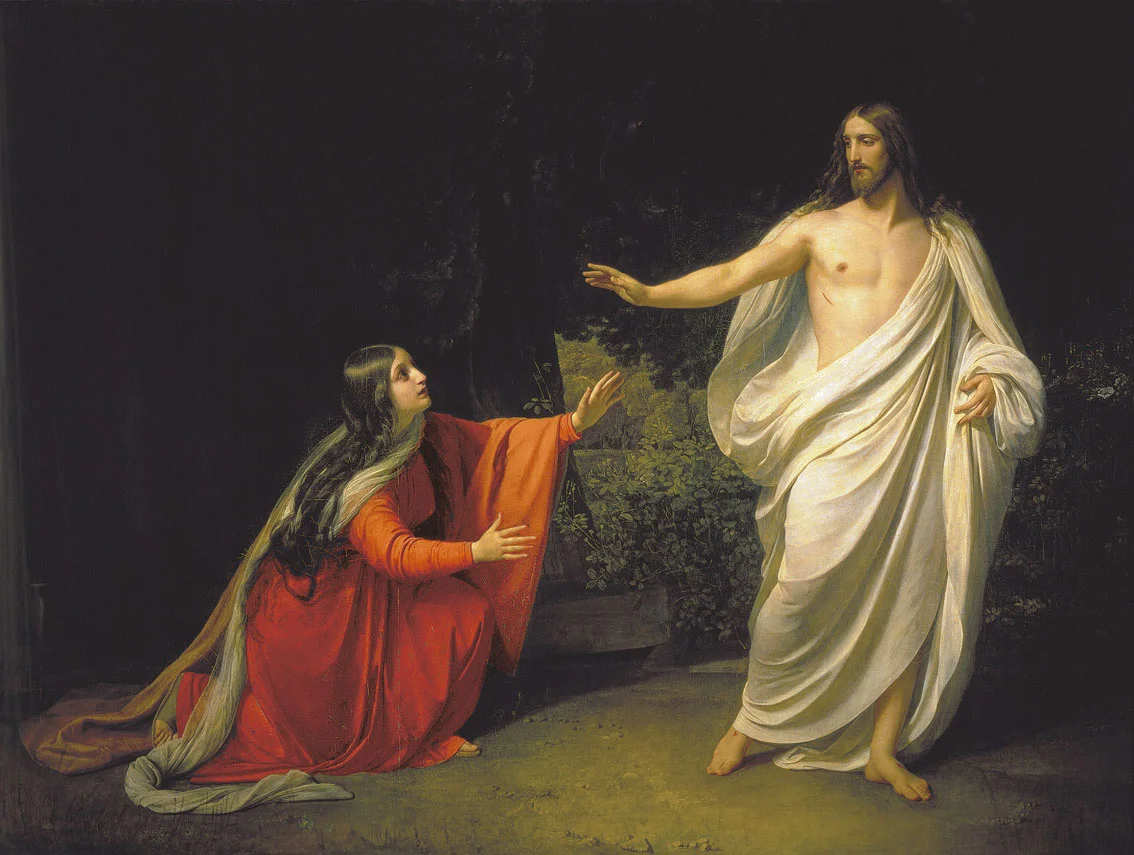
"Christ's Appearance to Mary Magdalene after the Resurrection" By Alexander Ivanov.

"Christ's Appearance to Mary Magdalene after the Resurrection" By Alexander Ivanov.


With the constant press of present troubles, it is easy to forget the simple truth that our contemporary cultural concerns are not all there is. As we look for somewhere to anchor our ethics, it is easier to pursue fashionable schemes than to look for simple explanations in ancient books. It is easier, but often less helpful.

Oliver O’Donovan’s ethics, founded on the biblical storyline, are some of the most helpful for moving readers outside of their cultural context. Though his reasoning is nuanced, the basic principles of his ethics are simple. Ethics is founded on the objective reality in the created order. This order was distorted when Adam chose to sin. The resurrection of Christ began the process of renewal that will eventually restore all of creation to its objective, undistorted goodness.

We live in the time between the beginning of the restoration and the complete renewal of all things. As Christians, we stand with one foot in the fallen world and the other foot poised to step over the threshold into complete renewal. We have certain hope in the coming restoration, but equal certainty of the sinfulness of the world.

Ethics must continually seek to identify the order and coherence with which the world was created. This reveals the reality of the Creator and uncovers the way we should live within creation. Since the created order has been distorted by sin, special revelation––i.e., Scripture––is necessary to point us toward an undistorted moral order.

One of the most dangerous and popular fallacies, or logical errors, is the “naturalistic fallacy.” By definition, the naturalistic fallacy is improper reasoning from the way things are to the way things ought to be. For example, if most teenagers smoke, then it is morally acceptable for teenagers to smoke.

Using the example of smoking, which has been demonized by our culture, this fallacy seems unrealistic. However, if the example is shifted to pre-marital sex, its explanatory power is better revealed. According to the naturalistic fallacy, if many people engage in pre-marital sex, then it must be morally acceptable to engage in pre-marital sex. A logical corollary to this is that those who oppose engaging in pre-marital sex are either sexually repressive or even morally evil for opposing something that has been determined to be morally acceptable.

These conclusions stand in contrast to the traditional Christian perspective, as revealed through Scripture, that sex is designed to occur within marriage. However, this sort of faulty reasoning is common in contemporary ethical debates on issues well beyond sexuality. It is also trapped in a vision of ethics that assumes that morality is determined by social acceptance, rather than an objective standard. In other words, societal norms can be based on a statistical evaluation of present practice, without considering the true nature of the common good.

O’Donovan’s pursuit of an objective moral order that reflects the unchanging character of God frees us from the tyranny of contemporary trends and provides a way of arguing against the naturalistic fallacy. Although it does not rely on proof texts, it is profoundly biblical as it explains why Scripture is an absolute necessity for ethics and shows how Scripture should be applied to ethics.

For example, if an unchanging God created all things in a particular manner that was morally good, then it stands to reason there is a specific way of living that is consistent with that original ordering. That way of living would be an objective, moral good.

However, the status of the created order as morally good leads to a question as to why things are out of line with that moral good. The answer lies in the pages of Scripture, as Genesis 3 informs us that Adam chose to defy God’s command by eating the fruit of the tree of the knowledge of good and evil. This set in motion the disordering of the created order. Humans became sinners and creation itself was put out of line with its original moral goodness.

Thankfully, God didn’t simply leave creation in its distorted state, but he set in motion his plan to restore it all. The resurrection of Christ punctuates that plan, as an exclamation point that points toward the complete restoration of the moral goodness of the created order. The resurrection event reveals the future renewal, but it also exposes the reality of the present disordering. No mere human action could restore the creation to its original moral goodness, it required the death of God himself in Jesus Christ.

In other words, Christ’s death, burial and resurrection are key events in ethics because they explode the myth that things are the way they ought to be. Instead, the radical distortion of creation set in motion by Adam’s sin needed a second Adam, who lived without sin, to set it right. However, to know this, we must have it revealed to us in Scripture.

All of this is freeing as we engage in moral reasoning. Instead of determining what laws should be passed based on current trends in popular opinion, we are freed to look for patterns that promote the common good and are as consistent as possible with the original, objective ordering of creation. While others may reject our proposals and indict us for not applying their reasoning, we can humbly pursue actions that best reflect the restoration of the created order that will come at Christ’s return.

The biblical pattern, built upon the objectivity of the created order and the resurrection of Christ, enables a Christian to seek a timeless ethics, rather than one driven by the winds of contemporary culture concerns.


Podcast: David Baggett on Mothers, God's Love, and Moral Transformation

On this week's episode of the podcast, we sit down with Dr. David Baggett for his thoughts on the importance of mothers to morality. Dr. Baggett shares how his mother shaped his own character, how God can heal those who've lost their mothers, and how mothers reveal the love of God.  

Image: "Mother Son Beach" by E, Merille. CC License. 

Mythopoeia: Evidence of the Image of God in Literature

Photo by Jeff Finley on Unsplash

Photo by Jeff Finley on Unsplash

As a young boy, I loved to read. I would spend hours at the library roaming the shelves, selecting a stack of books to read for the coming week. I became intimately familiar with Asimov, Tolkien, Lewis, Heinlein, Bruce Coville, Lloyd Alexander, and dozens of others who fit somewhere within the sci-fi/fantasy genre. I eventually migrated upstairs from the children’s section to the adult fiction wing of the library, and discovered dozens of new authors who shaped my reading tastes. Though my mother was excited I loved to read, she despaired at getting me to read serious material. “Twaddle” was her word for the kinds of reading I enjoyed. She had little love for Oz, Fantastica, Asgard, or Professor Xavier’s Home; fictional reading was good as long as it was something worthwhile. None of the stories I loved fit the bill.

Over the years, I have come to appreciate the love my mother instilled in me for reading, thinking, and debating. When she challenged my reading choices, it always made me pause and seek to justify why this was “a good book!” In hindsight, many of the books I read were terrible: the prose was inane, the plots simple, the characters flat. And yet, they peopled my childhood with excitement, stories, and worlds beyond measure. My mother and I still disagree on the value of many fantasy authors; catching her reading the latest Dresden Files book might be a sign of the Apocalypse. Some years ago, I ran across a poem in which J. R. R. articulates a great defense for all forms of literature both high and low.

Mythopoeia encapsulates Tolkien’s doctrine of sub-creation which he works out in longer form in his essay, “On Fairy Stories.” Tolkien wrote this poem after an all-night argument with C. S. Lewis in which Lewis claimed myths were worthless, because they were lies “even if breathed through silver.” Challenged by his friend, Tolkien wrote his defense in rhyme and meter.

The poem centers around two worldviews—one materialistic and scientific, the other transcendent and Platonic. Borrowing heavily from Plato’s theory of forms, Tolkien argues that

He sees no stars who does not see them first of living silver made that sudden burst to flame like flowers beneath an ancient song, whose very echo after-music long has since pursued. There is no firmament, only a void, unless a jewelled tent myth-woven and elf-patterned; and no earth, unless the mother's womb whence all have birth.

Without the form existing in the transcendent realm, Tolkien argues, no man could form an idea. He continues in his defense of myth, arguing that their creation is directly connected to the bearing of the imago dei.

Though now long estranged, Man is not wholly lost nor wholly changed. Dis-graced he may be, yet is not dethroned, and keeps the rags of lordship once he owned, his world-dominion by creative act: not his to worship the great Artefact, Man, Sub-creator, the refracted light through whom is splintered from a single White to many hues, and endlessly combined in living shapes that move from mind to mind.

Tolkien argues in these lines that man, though fallen, stills bears signs of being made in the image of God. His lordship is demonstrated in the “creative act.” The implications of Tolkien’s idea are huge—far from literary work being unimportant, worthless in comparison to some other work, it demonstrates the hand of God within mankind.

Tolkien unpacks the details of his theology in “On Fairy Stories.” In essence, he contends that since God is a creator, whenever man creates something he images his Creator. Tolkien then ranks works on how well they either correspond with reality, or how convincingly they connect the reader to the “inner consistency of reality” in the secondary world.

Authors are a special kind of artist in Tolkien’s theory. They use the same medium as God (words) to create a lesser version of primary reality. Whether they realize it or not, authors we love tap into some aspect of the “single White” which is the “refracted light. . . splintered. . . to many hues. . . endlessly combined in living shapes that move from mind to mind.” When I enjoy the worlds of Brandon Sanderson, Orson Scott Card, Robert Jordan, or George R. R. Martin, I do so because they are imaging the creative work of God through their writing.

Year later, I still disagree with my mother over books. What we can come to agree on, however, is that all men are made in God’s image. When we work “as unto the Lord,” we demonstrate his handiwork within us. In world-building, authors (both Christian and non), exercise the creative faculties which cause us to remember that our world too is a secondary creation, one which will one day be joined with Primary Reality when the Lord returns and establishes the New Heavens and New Earth.


Epicurus’ Quadrilemma and the Logical Problem of Evil

Deerfire_high_res_edit.jpg


The logical problem of evil (LPE), in contemporary analytic philosophy, has been taken as the attempt to show that an all-knowing, all-powerful, and all-good being cannot possibly exist with instances of evil in the world. The understood reasoning is that an all-good God would desire to eliminate all evil as far as he can; an all-powerful God could eliminate evil altogether; and an all-knowing God would know how to do so. Thus, if there is such a being as God, then there would be no evil. However, there is evil. Therefore, there is no such God. Epicurus is often taken to be the initiator of LPE (although this is possibly misattributed). He said, “Is God willing to prevent evil, but not able? Then he is not omnipotent. Is he able, but not willing? Then he is malevolent. Is he both able and willing? Then whence cometh evil? Is he neither able nor willing? Then why call him God?”[1] This paper will refer to this as Epicurus’ Quadrilemma. First, the Quadrilemma will be explained, followed by a brief discussion of the possibilities for defeating such a Quadrilemma. Next, two solutions will be proposed. It is the contention of this paper that Epicurus’ Quadrilemma fails to defeat the idea of the Christian God.

As was seemingly typical for the time, Epicurus analyzed all four logical options for God’s willingness and ability to remove evil (God’s knowledge of how to do so is not entertained, but included in discussions since, for the orthodox Christian, God is all-knowing). In order to understand the Quadrilemma, we must first admit that Epicurus was responding to perceived evil in the world. If there was no evil, then there would be no problem to discuss. Thus, four options present themselves: Either God is willing but unable to prevent evil, able but not willing, both able and willing, or neither able nor willing.

One should consider each of these options in turn, as does Epicurus. If God is willing and unable, then he is not omnipotent. J. L. Mackie concurs with this assessment when he writes, “There are no limits to what an omnipotent thing can do.”[2] This, many suppose, is the straightforward definition of what it means to be omnipotent; anything less is quasi-omnipotence, at best. Mackie admits that this option will not be an issue for those who conceive of God in non-standard ways (such as those who are willing to divest God of omnipotence), but for the majority of theists (and all orthodox Christians), such a move is not an option.

The second option Epicurus considers is that God is able to do so, but unwilling. This, says he, means that God is malevolent. Mackie agrees, claiming that, “a good thing always eliminates evil as far as it can.”[3] The third option, though concluded with a question, is just the claim that if God were to be both willing and able to eliminate evil, then there simply would not be evil. However, the initial postulate is that there is real evil in the world, and thus this entails that the conjunction of God’s being both willing and able to eliminate evil is false. Finally, if God is neither able nor willing, then he is not worthy to be called God.

There are three major ways that someone can defeat a proposed dilemma (regardless of the number of options presented). First, one may show other options than those presented. So, if the Quadrilemma gives the Christian four paths to take, this would involve showing there is a fifth option. This does not seem to be available, since Epicurus exhausts the logical possibilities. Second, one can show that the consequences do not follow. So, for example, this would mean showing that if God were both willing and able to prevent evil, that evil could still be around. Finally, one can “bite the bullet” and accept that the proposed paths do show the consequences they claim, but that such consequences are not absurd or otherwise undesirable after all. This last option does not seem to be available to Christians either, since none of these conceptions of God (or of evil’s non-existence) are adequate for Christianity. Thus, if the Christian is to overcome the Quadrilemma, it is to the second way he must look.

There are actually two ways to go about this kind of a solution; first, from the standpoint that God is willing but unable to prevent evil given certain other facts, and second, from the standpoint that God is both able and willing to prevent evil, but that certain other facts interfere. If either of these solutions is even possible, then the LPE fails.

While Epicurus devoted equal writing time in his brief formulation of the LPE to each side, he nonetheless focuses on the idea of omnipotence. This is because the power to control was the key to providence. If this was not compatible with evil, then it showed, for Epicurus, that whether or not such a being as a God existed, he would not be provident in the affairs of men.[4]

The first possible solution is to attack the premise that, “If God is willing and unable, then he is not omnipotent.” This is because God is willing that there be no evil, but given libertarian freedom, this places only a logical limit on God’s power, and thus omnipotence is preserved. Most philosophers, atheist, theist, and otherwise, accept that God’s omnipotence does not entail the ability to do the logically impossible, inasmuch as these are not activities to be done. Therefore, if it were to turn out that, given some other fact, God would not be able to eliminate evil by logic, it would not count against his omnipotence.

Alvin Plantinga suggests that there are some good states of affairs that God cannot bring about without thereby allowing for evil. He takes man’s having libertarian freedom of the will to be one of these states of affairs. He claims, “If a person is free with respect to a given action, then he is free to perform that action and free to refrain from performing it.”[5] If this is the case, then God is both willing that evil should not be (given that he is all-good) and also willing that man should have such libertarian freedom. However, this freedom, by definition, means God cannot guarantee that free creatures will always go right; given their freedom to refrain from performing good actions (and thus also to perform evil ones). Therefore, there is a very real sense in which God is willing that evil should not exist, and unable to prevent it, given the fact of libertarian freedom.

However, it may be objected, per Mackie, that God could simply have created beings who always freely choose the right.[6] That is to say, if God is able to create such beings and willing to do so, there should not be any evil. This leads to the second possible solution to the Quadrilemma: God is both able and willing to prevent evil (since he could force man to act a certain way), but there is evil because he is also willing to allow man libertarian freedom, and this accounts for God and evil. This may sound like the same solution as before, but there are two major differences. First, this is being applied to another horn of the Quadrilemma: the one that assumes God is both willing and able to prevent evil. Second, it will introduce another facet of Plantinga’s thought.

His idea of transworld depravity (TWD) is crucial to understanding the solution. TWD depends on counterfactuals of creaturely freedom (CCFs). The idea is that there are truths about what any free creature would do in any set of circumstances. Plantinga’s example is that if Curley were offered a bribe for $20,000, he either would or would not take it.[7] Suppose that Curley would not have taken such a bribe, but that in the exact same set of circumstances, he would have accepted the bribe at $35,000. This means that such a world containing the exact same set of circumstances as the $35,000 bribe where Curley freely accepts the $20,000 bribe is not feasible for God, by simple logic. God could force Curley to do it, but he could not force Curley to do it freely.

Plantinga’s argument is that it is at least possible, for all we know, that the relevant CCFs are such that for every libertarianly free creature (who is non-divine and enjoys morally significant freedom), they would ultimately go wrong with respect to at least one action in every feasible world in which they are instantiated. If this malady (TWD) affects Curley, then Plantinga concludes, “Every world that God can actualize is such that if Curley is significantly free in it, he takes at least one wrong action.”[8]

This is where Plantinga tightens the rope. After establishing this basic case, he refers to the possibility that, for all we know, every “creaturely essence” is afflicted with TWD.[9] That is, left to themselves, human free creatures will always ultimately go wrong at least once. If this is the case, then, while God is willing that evil be prevented, and is able to do so (say, by causing or forcing man not to go wrong), given libertarian freedom and complete TWD, Mackie’s claim that it is feasible for God to instantiate free creatures who only and always do the good is possibly false. This conclusion may seem weak, but it is important to remember the LPE is purporting that the existence of God is logically impossible to square with evil, and Epicurus’ Quadrilemma is purporting to discuss all of the relevant logical facts and consequences. If these two solutions are even possible, then the Quadrilemma’s consequences are avoided.

In order to understand where Epicurus went wrong, one must understand his underlying moral philosophy. A complete undertaking of that is out of the scope of this paper. However, it should suffice to note that, for Epicurus, the most important thing in life was pleasure. He had a nuanced approach that was more than basic hedonism. By focusing on the life of the mind, the end goal of Epicurus was to lead people to “a transformative experience that altered one’s daily life and led to genuine satisfaction and happiness.”[10] But this was Epicurus’ mistake: his entire Quadrilemma and preceding philosophy presupposes that the point of man’s existence is his own happiness.

William Lane Craig disputes this philosophy entirely. In commenting on the modern objections to evil and suffering in the world, he writes,

One reason that the problem of evil seems so puzzling is that we tend to think that if God exists, then His goal for human life is happiness in this world. God’s role is to provide [a] comfortable environment for His human pets. But on the Christian view this is false. We are not God’s pets, and man’s end is not happiness in this world, but the knowledge of God, which will ultimately bring true and everlasting human fulfillment. Many evils occur in life which maybe [sic] utterly pointless with respect to the goal of producing human happiness in this world, but they may not be unjustified with respect to producing the knowledge of God.[11]

Thus, there is a great good to be had in creating free creatures capable of entering into love relationships with God. While there may be other versions of the problem of evil, LPE as applied by Epicurus’ Quadrilemma fails. This is because God may be willing to eliminate evil, but given his instantiation of free creatures, such a thing is not feasible, nor does it count against his omnipotence due to logical concerns. It may also be that God is able and willing (given he could force creatures never to do evil), but that given the point of free creatures existing and the possibility of TWD affecting all non-divine beings, evil nonetheless exists, as solely the fault of mankind.


Image: John McColgan – Edited by Fir0002 - taken by John McColgan, employed as a fire behavior analyst at the Forest Service, an agency of the U.S. Department of Agriculture. Public Domain. 

Notes:

[1] John Hospers, An Introduction to Philosophical Analysis, 3rd ed. (New York: Routledge, 1990), 310.

[2] J. L. Mackie, “Evil and Omnipotence,” in The Problem of Evil: Selected Readings, Michael L. Peterson, ed. (Notre Dame: University of Notre Dame Press, 1992), 90.

[3] Ibid.

[4] Tim O’Keefe, “Epicurus,” in The Internet Encyclopedia of Philosophy (http://www.iep.utm.edu/epicur/), accessed February 22, 2015.

[5] Alvin Plantinga, God, Freedom, and Evil (Grand Rapids: William B. Eerdmans, 1974), 29.

[6] Mackie, 98.

[7] Plantinga, 46.

[8] Ibid., 47-48.

[9] Ibid., 53.

[10] Aleksandar Fatic and Dimitrios Dentsoras, “Pleasure in Epicurean and Christian Orthodox Conceptions of Happiness,” in South African Journal of Philosophy, Vol. 33, No. 4 (2014:), 524.

[11] William Lane Craig, “The Problem of Evil,” (http://www.reasonablefaith.org/the-problem-of-evil), accessed February 22, 2015.

A Couple of Reasons to Think Theism Best Explains Moral Obligations

Here is a moral fact: It is wrong to torture babies for fun. (Let T stand for “torture babies for fun.”)

But in what sense is it wrong to T? One answer, and a quite popular one, is that T’ing is wrong because it is irrational to do so. Why it is irrational can be explained a several different ways. One option is the egoist option. It is wrong to T because it is not in my self-interest to do so. It may not be in my self-interest because if I T, others might torture me back or otherwise degrade me in retaliation for my T’ing. The idea here is that it is in my self-interest to live in a world where people don’t torture each other for fun, so, in order to bring about that world, I ought to act in a way consistent with the world I want to bring about. Or perhaps we could say it is irrational to T because it is inherently degrading to myself. I destroy my own soul if I go around T’ing and that is not good for me so it is irrational for me to do so.

We might also say that it is wrong to T because it lowers the aggregate human happiness. Since living in a society where, on the whole, there is more happiness than less, I should not T because it is better to live in a more happy society than a less happy one. Or possibly it is wrong to T because there is an implicit social contract being broken when I T. By virtue of living in a society, I implicitly agree to follow certain norms and T’ing counts as a violation of those norms.

Notice that the theories I listed above all cash out the wrongness of T’ing in terms of bringing about an undesirable result. It is wrong because it will result in states of affairs that are not desirable.  Surely, this cannot be the full explanation of why it is wrong to T because, presumably, it would be wrong to T regardless of the consequences. Natural law provides one way to say it is wrong to T, whether the consequences are desirable or not (and it is worth pointing out that on many of the initially suggested options, counterexamples can be constructed in which T’ing would produce desirable results and therefore our belief that it is wrong to T would be undermined).

One way to say more is to appeal to a natural law account of human rights. The idea here would be that human beings, by virtue of being human beings, have certain rights that are owed to them. T’ing would be wrong because it would be a violation of the baby’s rights that obtain by virtue of the baby being human. This is a better explanation than the ones given above because it makes the wrongness of T’ing more than instrumentally wrong.

Now, consider what naturalism might say about how it is that humans have the rights presupposed to exist on a natural law view. Remember that that naturalist is committed to the idea that everything is composed of only matter and is determined by natural laws.  How could norms of action be generated from mere matter and physics? Rights and the associated norms seem like an odd fit on naturalism. Perhaps the naturalist would appeal to Kant here. Kant thought that moral duties obtain because of the dignity of human beings as rational agents. If humans are rational agents, then we ought to never treat them merely as a means and always as ends. However, Kant himself was no naturalist. And the appeal to Kant here by the naturalist is question begging because the naturalist still has not provided an account of how such properties as “dignity” obtain in a naturalistic universe.

But suppose that we grant that if humans really are rational agents, then we ought to treat them as ends and never merely as means. But consider what must be true of humans in order for them to be rational agents. Obviously, they must at least be rational and an agent. Being rational would seem to require that humans act for good reasons. Here the naturalist faces a problem because human action can be fully explained in third person, physical terms. We don’t think machines act for reasons; we think they act because of physical causes. Some naturalists, like Daniel Dennett, think that acting for reasons and being determined are not incompatible. Possibly he is right. But there is another problem. If humans are agents, this would seem to require libertarian free will. If humans are genuine agents, they must at least be understood as being the cause of their own actions (in contrast to the cause of their actions being fully explained in third-person, mechanistic ways). Again, naturalism will have trouble with explaining how humans could be agents in a naturalistic world. So Kant is no help to the naturalists here.

On the other hand, consider how such rights might obtain in a theistic universe where humans are souls resembling God. Here it seems natural to think that divine image bearers would possess essential, natural rights. If we think about Kant’s view of duty and his categorical imperative, we say that plausibly, being a rational agent just is being a divine image-bearer. And so theists can appeal to Kantian ethics as a possible way to ground the wrongness of T.

However, I suspect there is yet more to say about the wrongness of T. There is a kind of authority to the wrongness of T that cannot be fully explicated just in facts about human persons and their nature. Rather, it seems that if I were to T, I would be in violation of moral obligations that obtain not just as a result of degrading human beings. And we can see how this might be so by paying careful attention to what humans actually are, oddly enough.

Suppose of the sake of the argument that humans really are created in God’s image. This provides a ready explanation for how it is humans have rational agency  and why degrading them would be wrong, for sure. However, if humans are the creation of God, then a violation of their rights is not merely a violation of their dignity as humans, but also a violation of God’s intentions for them as humans. When God created humans, he intended for them not be tortured for fun. That is built into human nature, but not reducible to it.  That is to say that two kinds of violations occur: a violation against the human victim and a violation against God himself by virtue of his intentions towards humans. In this way, we actually defy God himself (by defying his intentions) in T’ing.

Now consider the gravity of these two offences taken together. When T’ing, a person not only violates another human person, but a Divine Person. A person who is ultimately valuable, completely good, holy, and maximally authoritative. That is, the breaking of moral obligations constitutes a defiance of God himself. This means that moral obligations, while serious enough understood just in natural law terms, takes on an exponentially greater seriousness when we consider that we have also violated God himself.

I think this view provides a good explanation of the phenomenology and reality of guilt. When we violate a moral obligation, the guilt we feel seems to extend beyond “feeling guilty for violating a human person.” And to be sure, that considered in itself should create a tremendous amount of guilt. But feelings of guilt often extend beyond that. We have not just harmed a person, but we have gone against the grain of Reality itself. When we do what we are morally obligated not to do, we do not just feel out of sorts with the person, but we are in contention with reality itself. Now, how could we make sense of this phenomenon? It does not seem to make sense that we have failed the universe understood naturalistically; rather the better explanation of this feeling of guilt is that we have failed a Person. That is to say, in addition to feeling guilty about violating  the victim, we also feel guilty about violating the intentions of God himself and this better explains the experience of guilt.

Therefore, theism better explains how it is that humans could have natural rights and the full gravity of the wrongness of T’ing than does naturalism. And if theism more successfully explains these things, human rights and the guilt of failing a Person, it also better explains the reality of moral obligations, since both human rights and moral guilt for failing a person entail moral obligations.

Podcast: David Baggett on the Problem of Evil

On this week's episode, we hear from David Baggett. Dr. Baggett is a professor of apologetics at the Liberty University School of Divinity and the co-author of Good God, Christianity Today's 2012 Book of the Year in Apologetics. Dr. Baggett gives us a preview of the chapter on the problem of evil in the upcoming sequel to Good God, God and Cosmos. He explains why the problem of evil really is a problem, for both atheists and Christians, and why Christianity has a better response to the problem. Image: "Jewish Cemetery" by Mycroyance. CC License. 

Summary of Chapter One of God and Morality: Four Views, edited by R. Keith Loftin.

Photo by Allen Cai on Unsplash

Photo by Allen Cai on Unsplash

In this book, two atheists and two Christian theists explain and defend their answers to the following metaethical questions:

  • Where does morality come from?

  • What, if any, is God’s role with respect to morality?

  • Is God necessary for morality?

  • Are morals objective?

  • How do we come to know moral truths?

Each contributor presents and defends his own view, and the other three then provide their comments and critiques of that view. In my summaries of each chapter, I’ll focus on the presentation of the views, and leave the comments and critiques to the reader to pursue in the book itself. The four views included in the text are naturalist moral realism (Evan Fales), naturalist moral nonrealism (Michael Ruse), moral essentialism (Keith Yandell), and moral particularism (Mark Linville). In this post, I will summarize the naturalist moral realism position taken up by Fales, and close with one criticism.

Fales first explains some key terms concerning his view, Naturalist Moral Realism (NMR). For him naturalism is the view that there are no disembodied minds, and that ethical theory should be grounded in a scientific understanding of human beings. Moral realism is the view that moral norms are independent of our beliefs. These norms are determined by facts about us, and other creatures. Fales clarifies that there is still room for differences due to convention on his view. For example, how one expresses kindness through polite behavior might vary across different cultures. What matters for Fales is that the underlying moral principle concerning kindness is the same.

But how does Fales ontologically ground such moral truths? He contends that morality is based on what is good or bad for a being, and morality is primarily about how we ought to treat other human beings. The basis of morality, according to Fales, is our common human nature. Our common nature makes morality objective, because it is objective. That is, we have a particular objective nature as human beings, and it is this nature that grounds objective morality.

Human morality is based on what is good or bad for us, given that we are teleologically organized systems (TOS’s). We are organized such that we have one or more ends, goals, or purposes as human beings. There are several things that are intrinsic goods for human beings with such ends, including health, reproduction, and knowledge. Instrumental goods serve these intrinsic goods. Food, for example, serves the intrinsic good of health. Humans have the particular intrinsic goods or ends that we have as a result of natural evolutionary processes. There is no reason to bring God into the picture, on such a view, because our existence as the type of beings we are is fully explainable by natural means. And since human morality is based on human nature, it is also a result of naturalistic evolutionary processes.

So on this view, how should we live? Fales asserts that morality is primarily about how we ought to treat other human beings. Our most central obligations are those that promote social flourishing, because we are a fundamentally social species. In order to know what our obligations are, we can depend upon empirical data derived from an examination of our teleological organization. Other moral facts are necessary truths, which we can know a priori. For example, Fales states “There is a necessary connection—one we easily recognize—between the nature of a small human child and the prima facie duty not to kill it, a connection mediated by the understanding that in killing it we foreclose in the most fundamental and comprehensive sort of way on the realization of that child’s natural teloi” (p. 25).

A problem arises, however, with respect to justifying moral principles that conflict with demonstrable aspects of human nature, such as our tendencies toward violence, greed, dishonesty, and so on. Theism and naturalism offer distinct explanations of our corruption, and according to Fales they each offer a remedy as well.

On Christian theism, human beings are fallen creatures. Adam and Eve chose disobedience, as do the rest of us. We are morally corrupt, and in need of redemption and transformation. Fales argues that Christians have little evidence to offer that shows their remedy—the saving grace offered via the cross—is effective. For instance, over the centuries the individual and corporate behavior of Christians has been in direct contradiction to the ethical dictates of the Sermon on the Mount, in “sordid and massive ways” (p. 27). I will return to this below.

Naturalists can provide a different account of human corruption. Biological evolution is slow, but cultural evolution is quick. Biological evolution cannot keep pace with cultural evolution. As Fales puts it, “so far as our genetic makeup and the social instincts it controls go, we are basically hunter-gatherers who find ourselves born into social unit orders of magnitude larger and more complex than our biological adaptations are designed to handle” (p. 28). We are not suited for the kind of social life we find ourselves thrown into, but since we can reflect rationally on our moral commitments, there is hope for progress, if we focus on human eudaimonia and what it entails for personal and social morality. With this in mind, if theists and naturalists can agree on what human nature consists of, then there is common ground for agreement about normative ethics.

I think a focus on human eudaimonia and what it entails for personal and social morality is a good place to start. There is common ground based on what theists and naturalists hold in common about human nature. With this in mind theists and naturalists could construct a normative ethic that has much to recommend to them both. But there will be important differences, too, and this could lead to problems in constructing a common normative ethic.

More critically, I think Fales is too quick with respect to the evidence Christians have for the efficacy of their solution to human corruption. He is certainly right that much Christian behavior falls well short of the teachings of Jesus in the Sermon on the Mount (and elsewhere), and that there are lame justifications provided for this. However, it is important to emphasize that just because someone is, or claims to be, a Christian, it does not follow that they are participating in the kingdom of God to the extent that they should or could. There are many reasons for this. One is that on Christianity, human corruption persists in many ways, in both Christians and non-Christians. However, the relevant individuals to consider are those who profess faith in Christ and have diligently pursued transformation in partnership with the Spirit of Christ (see 2 Peter 1:3-11). It is those who have pursued the Way that are the crucial test cases here, not those who have merely professed it. I’m reminded of the well-known G.K. Chesterton line: “The Christian ideal has not been tried and found wanting. It has been found difficult; and left untried.”

Image: "Pacific Silhouette" by T. Lucas. CC License.

St. Anselm and the Perfection of God

A late 16th-century engraving of Anselm, archbishop of Canterbury

A late 16th-century engraving of Anselm, archbishop of Canterbury

April 21st is the birthday of a great philosopher, Jerry Walls. Also, and perhaps slightly more acclaimed, it is the anniversary of St. Anselm’s death celebrated in the Roman Catholic Church, much of the Anglican Communion, and in parts of Lutheranism. St. Anselm of Canterbury was a Benedictine monk, philosopher, and prelate of the Church, holding the office of Archbishop of Canterbury from 1093 to 1109. He was born circa 1033 and died in 1109, 906 years ago.

After entering the priesthood at 27, he was elected prior of the Abbey of Bec, which, under his jurisdiction, became the foremost seat of learning in Europe. During his time there, Anselm wrote his first works in philosophy, the Monologion (1076) and the Proslogion (1077-8), followed by The Dialogues on Truth, Free Will, and Fall of the Devil.

Greatly influenced by Neoplatonism, Augustine, and Pseudo-Dionysius the Areopagite, he exerted a strong influence on Bonaventure, Aquinas, Scotus, and William of Ockham. His motto was “faith seeking understanding,” which for him meant “an active love of God seeking a deeper knowledge of God.” His academic work was notable for many reasons. Two of his most important contributions to theology were his satisfaction theory of atonement and his ontological argument(s) for God’s existence.

An Anselmian conception of God has largely come to be seen as the standard for classical theism—a God who is omniscient, omnipotent, omnibenevolent, and the like. Regarding God’s moral perfection, God is impeccable, essentially sinless, maximally loving; in God there is no shadow of turning. Irrespective of one’s take on the ontological argument, the idea that God is the ground of being, that on which all else depends for its existence, is central to theism classically construed.

On MoralApologetics.com we have argued at length that God, thus conceived, is uniquely able to provide the best explanation of objective moral values and duties, human rights, meaningful moral agency, the convergence of happiness and holiness, and the full rational authority of morality.

On occasion some suggest that God understood as the possessor of the omni-qualities is inconsistent with the God of the Bible. Yoram Hazony, author of, most recently, The Philosophy of Hebrew Scriptures, wrote an interesting and provocative opinion article for the New York Times a few years ago (“An Imperfect God,” November 25, 2012) in which he summarized in no uncertain terms his skepticism about the idea of a perfect God.[1]

Hazony suggests that there are various compelling reasons the God of classical theism and, thus, the perfect being theology of Anselm should be rejected. Hazony wishes to emphasize the need for tentativeness and provisionality in theology because our knowledge of God remains fragmentary and partial. He even pushes an ambitious and dubious interpretation of the great “I am” declaration of God to be, in virtue of being in the imperfect tense, an indication of God’s incompleteness and changeability, rather than, as seems the more straightforward meaning, God’s uncreatedness and ontological independence. In Hazony’s view, “The belief that any human mind can grasp enough of God to begin recognizing perfections in him would have struck the biblical authors as a pagan conceit.”[2]

But as Old Testament scholar Gary Yates puts it, “It seems a little odd that this would be the idea stressed if Yahweh is attempting to assure Moses when Moses is already fearful of the circumstances and the people's response to him. The imperfect conjugation does not actually have tense, so it can also be used to simply state something that is a present or even characteristic reality. Beyond that, there is debate as to what the term means, and if for example, this were a hiphil imperfect, it would stress that the Lord is the one who ‘causes to be.’”

Yates admits that Old Testament scholars tend to move away from some of the more abstract and philosophical understandings of the name and to see it in more concrete, covenantal terms as emphasizing Yahweh as the one who is present with his people in the midst of this circumstance and thus aware of their situation and able to act to help them, hear their cries, and deliver them. That would still most certainly comport with the ideas of God being uncreated and eternal but without necessarily focusing primarily on those more abstract and ontological ideas.

According to the Hebrew Bible, Hazony insists, God represents the embodiment of life’s experiences and vicissitudes, from hardship to joy; and although God is ultimately faithful and just, these aren’t perfections or qualities that obtain necessarily. “On the contrary, it is the hope that God is faithful and just that is the subject of ancient Israel’s faith: We hope that despite the frequently harsh reality of our daily experience, there is nonetheless a faithfulness and justice that rules in our world in the end.”[3]

He concludes his piece like this: “The ancient Israelites, in other words, discovered a more realistic God than that descended from the tradition of Greek thought. But philosophers have tended to steer clear of such a view, no doubt out of fear that an imperfect God would not attract mankind’s allegiance. Instead, they have preferred to speak to us of a God consisting of a series of sweeping idealizations—idealizations whose relation to the world in which we actually live is scarcely imaginable. Today, with theism rapidly losing ground across Europe and among Americans as well, we could stand to reconsider this point. Surely a more plausible conception of God couldn’t hurt.”[4]

Is it indeed theism that is “losing ground,” in the specified parts of the world, or rather a certain cluster of religious institutions? The recent phenomenon of “the New Atheists” as the current spokesmen for disbelief is of interest, but is meeting them halfway a sensible, or even possible tack for the religious to take? It’s certainly undesirable, since in any close reading of their rhetorically engaging works, it becomes clear to any serious student of theism that their conception of God is vastly less sophisticated and philosophically resilient than the concept of a perfect being that was so well captured by Saint Anselm, a man steeped in biblical thought.

What indeed does it even mean to speak of the Hebraic depiction of God as more realistic than the idea of God as altogether perfect? It is certainly more anthropomorphic, or to put it more precisely, anthropopathic—portraying God as if having human passions. But that is the natural outflow of the literary forms in the original biblical documents. The fact that they don’t explicitly present us with the precisely articulated conception of God that philosophers have seen suggested by the cumulative impact of its most exalted passages does not at all compromise the philosophical work of clarifying such a conception, nor does it render the effort artificial, or invalid.

The Greeks had no corner on the market of reason. Why is it merely a Greek notion that God possesses all the perfections? Plenty of Greeks—Euthyphro for example—believed in all sorts of rather morally deficient gods; we could return the favor and suggest that Hazony’s conception of God is more influenced by Greek ideas in this regard than by scripture.

The claim that a perfect God is a Greek convention incorporated into theology is an allegation that potentially overlooks the important role of what theologians refer to as general revelation. The Greeks had no corner on the market of reason. Why is it merely a Greek notion that God possesses all the perfections? Plenty of Greeks—Euthyphro for example—believed in all sorts of rather morally deficient gods; we could return the favor and suggest that Hazony’s conception of God is more influenced by Greek ideas in this regard than by scripture. 

The fact remains, though, that the writers of the New Testament were deeply steeped in Old Testament teachings and theology and saw Jesus as the fulfillment of the Law and the Prophets, and in the New Testament itself we find ample indications of a morally perfect and perfectly loving God. This happy convergence of the a priori deliverances of reason and the a posteriori deliverances of scripture should come as no surprise since one would expect harmonious resonance between the outcomes of special and general revelation. Nothing less than Anselm’s view of God can answer our deepest hopes.

Since it’s Jerry Walls’s birthday, it’s fitting we end with a quote from his latest book Heaven, Hell, and Purgatory, an excerpt that deeply resonates with Anselmianism both in the sense of the deliverances of classical theism and the specific and startling claims of Christianity: “. . . [H]ere we can see what may be the most profound difference of all between those who believe that ultimate reality is love and those who do not; between those who believe love is stronger than death and those who do not; between those who believe in heaven and those who do not. It is the difference between believing that even the best things of life are destined to come to a tragic end and believing that even the worst things can come to a comic end.” [5]


Notes:

[1] http://opinionator.blogs.nytimes.com/2012/11/25/an-imperfect-god/?_r=0 (accessed April 11, 2015). Also see Yoram Hazony, The Philosophy of Hebrew Scriptures (Cambridge: Cambridge University Press, 2012).

[2] Hazony, “An Imperfect God.”

[3] Hazony, “An Imperfect God.”

[4] Hazony, “An Imperfect God.”

[5] Jerry L. Walls, Heaven, Hell, and Purgatory: A Protestant View of the Cosmic Drama (Grand Rapids, MI: Brazos Press, 2015), p. 161.

Hosea and Polyamory: The Sufficiency of Scripture

For two thousand years, Christians have made an extraordinary claim: that a set of books contains the words of God, written through human authors, and that this Bible is sufficient for “life and doctrine.” With conservative estimates dating the Revelation of St. John to approximately 90 AD, Christians believe that writings from 1900 years ago are both relevant for today and contain truth to cover all circumstances. When stated so baldly, this claim seems ridiculous. But what if it is true? What if the Bible is enough to communicate God’s truth to a chaotic world, no matter how it changes?

The world has changed significantly over the past century: from the horrors of the Holocaust to the shifts of feminism in the West, from the rise of legalized marijuana, to the ever evolving sexual landscape. Such changes, systemic as they may seem, are nothing new. St. Augustine wrote his timeless classic The City of God in response to the apparent end of the world in the 5th century sack of Rome. In 1000 AD, Western Europe was convinced the millennial kingdom was imminent. In 1215, Beijing altered irrevocably with the arrival of Genghis Kahn and the Mongol hordes. In a world where tradition appears immovable yet is gone like a leaf in the wind, does the Bible actually provide the counsel of God?

I believe the answer is yes, and want to illustrate timeless biblical wisdom by examining the microcosm of a single but deeply telling issue: polyamory. Polyamory combines two Latin words—poly, meaning “many,” and amor, meaning “love.” This term describes open relationships which may or may not define themselves as a sort of group marriage, or as a single couple who remain together but pursue other sexual partners. Polyamorous relationships fascinate journalists, and have entered into mainstream public discourse in recent years.

I am not arguing that polyamory is something new; there have always been strange sexual practices. From the mystery cults in Greece and Rome to temple prostitution in ancient Sumeria, aberrant practices have always existed outside the norm of marriage. What is unique about polyamory, however, is that it seeks to become a new normal. Where previous generations have had bizarre sexual cults and practices, the present generation stands out for attempting to make these practices appear normative (by which I mean the attempt for the new practice to replace the traditional). One way in which polyamorous couples do this is by implying that traditional marriage is limited, and consumed by jealousy. They are on the moral high road, allowing all consenting adults to fulfill their desires.

The Bible does not describe any polyamorous relationships. It deals with polygamy, monogamy, adultery, fornication, beastiality, and homosexuality, but does not specifically address this manifestation of human sexuality. Does polyamory defeat the idea of the Bible being sufficient for life and doctrine? No—instead we need to examine how the Bible portrays marriage as a training ground for understanding the concepts of faithfulness and unfaithfulness, allowing us to discern that polyamory threatens a truly human concept of fidelity. The prophet Hosea can help us on this journey.

Hosea is written by the eponymous prophet, one of a group of 10th-8th century BC men who preached messages from God to the kingdoms of Israel and Judah before the Assyrian destruction of northern Israel and the Babylonian exile of southern Judah. He wrote before Israel’s destruction, and communicates a message of judgment and eventual restoration. Where Hosea becomes unique, however, is the way in which God commanded him to show his message. The book opens with “When the LORD first spoke through Hosea, the LORD said to Hosea, “Go, take to yourself a wife of whoredom and have children of whoredom, for the land commits great whoredom by forsaking the LORD” (Hosea 1:2). Hosea proceeds to marry Gomer, who remains faithful to Hosea until the after the birth of their first child. The fatherhood of her second two children, however, was suspect. Gomer eventually became a prostitute, and was redeemed by her husband. They had a total of three children, each of whom was named to communicate an aspect of Israel’s infidelity.

On one hand, this is the most appalling scene in the prophets. Can you imagine a preacher getting a vision from God saying, “Go! Marry a prostitute! And when she betrays you and goes back to selling herself on the street, go and buy her back from her pimp, and treat her as if she never left.” Hosea does so, and honors God in his obedience. Rather than stopping at shock in methodology, perhaps the better question is, “Why would God use this living metaphor, and this language?”

It is impossible to read this prophecy and miss the pain and horror of what God commands Hosea to do. These actions are not done purposelessly. Instead, God has a clear point. He reaches for universal human experience to communicate how unjustly Israel has forsaken him. The metaphor of the adulterous wife transcends the context of 8th century BC Israel. It is a picture that the whole human race across all of time can recognize as betrayal, as wrong. This transcendence is part of the beauty of Hosea—reading this prophecy does not require background knowledge. Anyone can pick it up and recognize that Gomer betrayed her husband, and caused him great pain, for no discernable reason. The idea of a woman selling her body is also a universal phenomenon, recognizable through literature where it is not visible on the streets. The vocabulary and metaphor allows the book to transcend the geographic and temporal context and appeal to perennial human experience.

As such, the book communicates on at least two levels. On the divine level, Hosea teaches the reader about God’s response to the betrayal of his covenant with Israel. There will be consequences to that betrayal. It also shows God as the jealous husband, who wants sexual exclusivity with his wife (which in this case represents exclusive worship by his covenant people Israel). On a human level, the reader sees Hosea’s unfailing love for a woman who clearly does not deserve it. Gomer should have been tried in court, divorced, and (under the fullest application of the law) even stoned. Instead, here is the faithful husband who buys her back, and restores her to honor. Hosea’s faithfulness functions as an example for how husbands should love their wives.

Hosea is a beautiful book of prophecy and poetry. Its use of extended metaphor allows it to appeal to all times and places communicating a high ethic of love while also showing the consequences of covenant betrayal. It foreshadows the gospel, where all mankind is Gomer (as we worship other gods and ignore our rightful LORD) and Jesus is Hosea (painfully purchasing the human race from Satan’s reign at the cost of his own blood).

What then does Hosea have to say about the topic of polyamory? Hosea illustrates the biblical teaching that sexuality should occur within fences, within the confines of marriage. When sexuality occurs outside these fences, there are consequences. Polyamory functions as a denial of this foundational principle. It begins with the premise that there should be no fences, no limits to human desire. For the polyamorist, marriage is not predicated upon sexual exclusivity but upon emotional closeness which can exist between multiple partners. Instead, the polyamorist argues that desires are the highest value and that when one person desires sexual intimacy with another, no marriage agreement should stand in the way. Polyamory goes as far as to argue that those who insist on traditional mores limit themselves, and fail to experience the best pleasures.

Where Hosea provides a living metaphor of faithfulness and infidelity, polyamory destroys the structure within which faithful marriage can exist. It denies a fundamental part of our human nature—marital jealousy is right and proper, according to God’s example in dealing with Israel. Polyamory holds up jealousy as evil, where Scripture holds up faithfulness of one spouse as a good. Hosea shows us that these two visions of the good life stand in opposition: they cannot both be true. Either polyamory is correct, and traditional marriage is enslavement to one partner, or biblical morality is correct that as people we are made for exclusive love in marriage just as we are made for exclusive worship of the Triune God.

For two thousand years, Christians have looked to the Bible as their source of how to live life, and what to believe. The world is always a different place; each generation wrestles with how to answer fundamental questions about what it means to be human, how to live the good life, and where to find wisdom. The Bible serves as the Christian bedrock. For all that this world may shift, evolve, and metamorphose, the teachings of Scripture remain true. Regardless of what new phenomena develop, whether it is the national legalization of marijuana, the widespread acceptance of homosexual marriage, or the normalization of polyamory, the Bible still holds the words of the Living God. Scripture is sufficient for all circumstances, and remains our source of life and doctrine.


Image: "Hosea" by Peter. CC License. 

Podcast: Chad Thornhill on the Impeccability and Humanity of Jesus

On this week's podcast, we hear from Dr. Chad Thornhill on the impeccability and humanity of Jesus. Dr. Thornhill explains whether Jesus could sin, what impeccability has to do with Jesus being truly human, and why all this matters for morality.


Image: Ivan Kramskoy - Христос в пустыне - Google Art Project

Chad Thornhill

Chad Thornhill

Dr. A. Chadwick Thornhill is the Chair of Theological Studies and an Assistant Professor of Apologetics and Biblical Studies for Liberty University Baptist Theological Seminary. Chad completed his PhD in Theology and Apologetics through LBTS with an emphasis in biblical studies. His areas of academic interest include ancient Christianity, apologetics, biblical languages, Second Temple Judaism, New Testament studies, Old Testament studies, and theology. He is the author of a forthcoming title (IVP Academic) on the Jewish background of the apostle Paul’s election texts. Dr. Thornhill lives in Lynchburg, VA with his wife Caroline and their two children.

In the Twinkling of an Eye

Photo by LUM3N on Unsplash

Photo by LUM3N on Unsplash

In a course I taught this term on evil, suffering, and hell, one of the books we read was Jerry Walls’ Heaven, Hell, and Purgatory, a distillation of his scholarly and groundbreaking work on eschatology over the last few decades. Mention of purgatory immediately tends to make evangelicals go a bit apoplectic, raising the specter as it does of Catholic indulgences, religious abuses, and satisfaction models of purgation that undermine the sufficiency of the cross. But Walls makes it clear that the model he endorses instead is a sanctification model.

The intuition behind his approach is this. To be fit for heaven, we have to be perfect. The biblical admonition to be holy as God is holy is actually to be taken with dreadful seriousness. None of us at death, however, has achieved such a state. So some amount of posthumous transformation is necessary—for some more than others, but some for all of us. Most evangelicals would agree, but embrace a model of instantaneous transformation—and refuse to call such a process “purgatory.” (If, though, purgatory is thought of as this transformation itself, then purgatory it is, but not much rides on this semantic point, beyond the observation that some of the visceral opposition to Walls’ argument might be opposition more to a perceived pejorative than the idea.) Walls demurs, since such a “zap” model isn’t typically how moral transformation takes place. And such complete immediate radical transformation may well raise intractable identity questions without a coherent enough narrative of how it takes place and a sufficiently gradual process of transformation that salvages an ongoing sense of self.

Walls asks us to re-envision the plot of A Christmas Carol, this time featuring Scrooge going to bed a selfish miser and waking up a new man, with an entirely new moral orientation, but without all the intervening plot twists that explain the transformation. Looking in the mirror the next morning, the “new” Scrooge might understandably ask who he really is.

So Walls pushes the need for a process of transformation that, intuitively, takes time, as events are wont to do. But many would resist his suggestion and opt instead for an instantaneous model of transformation because they’re inclined to think the Bible teaches such a thing. So no matter how clever, how philosophically adroit and logically coherent Walls’ approach may be, it is runs afoul of the Bible. Of course the resistance is based on a relatively few number of verses; on their surface, at least, other biblical verses seem to resonate a great deal with Walls’ suggestions, such as this one: “And I am certain that God, who began the good work within you, will continue his work until it is finally finished on the day when Christ Jesus returns” (Philippians 1:6).

At any rate, a verse adduced to undermine Walls’ argument is likely to be this one: “Dear friends, now we are children of God, and what we will be has not yet been made known. But we know that when Christ appears, we shall be like him, for we shall see him as he is” (I John 3:2). Walls notes that John Polkinghorne, reflecting on this verse, writes that “there is a hint of a salvific process, for we can scarcely suppose that Christ will be taken in at a glance” (emphasis added). But some might find this unpersuasive, and remain adamantly committed to belief in instantaneous transformation after death.

Such people may be right, but, even so, they wouldn’t be right for a reason often cited, namely, that merely shedding the body makes glorification inevitable. That idea seems to be predicated on a pretty big mistake, the clearly unbiblical idea that the body is somehow inherently corrupt. Though an impeccable Gnostic view, it’s not a biblical one, and if instantaneous posthumous transformation is possible or actual, it’s surely not for that reason, which overlooks that our worst sins tend to be entrenched sins of the heart, like pride.

For all we know the whole universe could be contained at the head of a pin; it wouldn’t make flying to London from New York go any quicker. And what might the twinkling of an eye contain?

At any rate, another biblical reference some might wish to adduce to reject a process view is I Corinthians 15:52: “[We will all be changed] in a flash, in the twinkling of an eye, at the last trumpet. For the trumpet will sound, the dead will be raised imperishable, and we will be changed.” For many this seals the deal, precluding any suggestion that a process is needed, despite Walls being surely right that, when considering the logic of moral transformation, most all of our experience seems to demand such a process, one in which we come to terms with the truth, undergo genuine penitence and a change of heart, growth in sympathy and empathy and compassion. We can be forgiven in a moment, but wholesale changes to character don’t generally occur instantaneously. Significant crisis moments can happen, but going from being radically imperfect to totally perfect is nothing any of us has even remotely experienced. And I say this despite my Wesleyan inclinations that make me open to belief that, in an instant, God can fundamentally orient a believer’s heart toward Himself.

So what do we do with this impasse? Complete transformation requires a process incomplete at death, sometimes quite incomplete indeed, but that also arguably has to happen, potentially anyway, in the twinkling of an eye. Is this dilemma intractable?

What I would like to do is tentatively offer an effort at rapprochement. Suppose we grant both that (1) a process is needed, and that (2) it happens in the twinkling of an eye. Are these inconsistent? Only if we assume that the process needs more than the twinkling of an eye. As Corey Latta, author of When the Eternal Can Be Met: The Bergsonian Theology of Time in the Works of C. S. Lewis, T. S. Eliot, and W. H. Auden, puts it, “I imagine the twinkling of an eye to be both anthropomorphic, of course, and an ancient glimpse into a cosmological truth.”

What cosmological truth? Well, it’s natural to think of any process as requiring time, and an elaborate process quite on occasion, but there may be a reason to question this is always the case. Purgatory’s opponent seems to be presupposing a proposition like this: (3) Significant processes require a significant amount of time. If there is reason to doubt this in some important sense, then there may not be much tension at all between glorification taking place in the twinkling of an eye and its requiring a process, perhaps even a protracted one.

Much of the issue pertains to time. So consider a quick insight from science. As Bruce Gordon puts it, “If you were traveling at the speed of light time would not stop in your reference frame, but your clock would appear to have stopped to anyone who could see it from another reference frame (the ‘rest frame’) relative to which you were traveling at the speed of light. Of course, by relativistic length contraction in the direction of motion, the length of your spaceship would also have shrunk to zero as observed from the rest-frame (while nothing would have changed from your perspective). And also of course, unless you managed to transform your spaceship and yourself into massless particles, you wouldn't be traveling at the speed of light anyway, because resistance to acceleration (mass) increases without bound as the speed of light is approached, so the speed of light can never be reached by massive objects because their mass would become infinite.”

So here’s the point for present purposes. Time would not stop in my reference frame even at the speed of light (bearing in mind that this is a counterfactual). And the closer to the speed of light I go, the more my clock appears to slow down from the perspective of someone in the "rest frame." Thus, even a short interval, given this “plasticity” of time, might contain plenty of chance for transformation requiring an interval of time, perhaps a significant interval. To stick with the science example, someone traveling close to the speed of light might to me look like he's experiencing just seconds (if I could see his clock onboard), while to him the experience could be days or weeks or months. So what might seem a mere moment to an observer might contain, for the person experiencing it, ample opportunity for a transformative process of some sort and longer duration.

I don’t presume to have a scientist’s grasp of relativistic implications of time, but this doesn’t undermine the claim that there’s a potential rapprochement between a posthumous process of radical transformation and a near instantaneous event. If time is so difficult to understand, especially after death, why assume that the “twinkling of an eye” precludes a process of transformation? Such an assumption strikes me as presumptuous, the assumption that we have a good bead on how time works after we’ve shuffled our mortal coil. What we do know of time seems to call such sanguine confidence into serious question. So perhaps the resistance to Walls is based less on what the Bible says, after all, and more, perhaps unwittingly, on what someone is supposing to be true about time, and ambitiously assuming at that.

Though an impeccable Gnostic view, it’s not a biblical one, and if instantaneous posthumous transformation is possible or actual, it’s surely not for that reason, which overlooks that our worst sins tend to be entrenched sins of the heart, like pride.

What does the Bible mean when it says that a thousand years in our sight are like a day that has just gone by, or like a watch in the night? Is there not perhaps at least an intimation that time is more fluid or plastic than we might have imagined? C. S. Lewis played with this idea when, after the kids came back from Narnia, just a few minutes had passed, while their experience in Narnia had canvassed years. And an analogous spatial example can also be found in Lewis: Consider in The Great Divorce, when it’s revealed that hell inhabited but a speck of space. In that speck was the entirety of hell. For all we know the whole universe could be contained at the head of a pin; it wouldn’t make flying to London from New York go any quicker. And what might the twinkling of an eye contain?

Arguably the Bible hints that God’s relation to time is fundamentally different from our own, and science seems to hint too that time is not what it at first seems. And apart from those considerations about time itself, there is also the fascinating issue of our subjective experience of time, rife with mysteries of its own. People who seem to “see” their lives flashing before their minds when they think they’re on the brink of death, or the subjective experience of time seeming to slow down in certain emergency situations; it’s not the case, presumably, in these cases, that time itself is showing its plasticity, but it goes to show the relativity or plasticity of our subjective responses to time. For present purposes, again, this is relevant, because it points to the possibility of a great many events transpiring in rapid succession, all within a short interval of time.

If a story is at least possible in which a process can occur in but a moment, then much of the evangelical angst over Walls’ proposal, predicated on the presumption we understand time better than we do—assumptions about how time works that are controversial indeed—may turn out to be misguided. Perhaps we can indeed experience an extensive, elaborate transformative process in a timeless moment, or at least in the twinkling of an eye.

Image: "Time goes by so fast" by J. Ramsden. CC License. 

Grounding Ethics in God: Why God's nature determines morality

Photo by Faye Cornish on Unsplash

The classic apologetic argument from morality is that if God doesn't exist then objective moral truth doesn't exist. It's often assumed in this argument that somehow God's existence explains morality in a way that atheism cannot. However, this argument mostly focuses on why atheism cannot explain morality, rather than how it is that Christian theology offers a more compelling explanation.

What's more the classic Christian response to the Euthyphro argument is to say that the "good"  is that which is like God's nature and character (and because God is unchanging what is good will not change). But how is it that God's character provides the moral foundation for what is good?

I want to suggest that it is the theology of man made in the image of God that not only grounds morality, but also underpins our response to the Euthyphro dilemma. Because we are made in the image of God not only do we have reason to be moral, but what is moral is also that which is like God. But what does it mean to be made in the image of God?

In Genesis God decides "let us make mankind in our image, in our likeness"[1]. The traditional understanding of the image of God has been the one filtered through a Greek mindset. A concept which focuses on the abstract and tries to locate what it means to be made in God's image in terms of some property of existence. However, in the last century there has been much study into the concept of the image of God in its original Hebraic context. The Hebraic understanding of man made in the image of God gives a much more functional, and in many ways fuller, understanding of what it means to be human.

Genesis 1 tells the story of God building a temple (the creation of the Earth).[2] It is in the context of this story, and the wider context of the Ancient Near East, that we have to understand what the Bible means in saying we are created in the image of God. Ancient temples would contain "images" of the god for whom the temple was built. Images of gods in temples, or kings in foreign lands, were "viewed as representatives of the deity or king".[3] Kings in Egypt and Assyria were also considered "images" of their gods; meaning that they were ones who "acted on behalf of, and by, the consent of the divine."[4] Middleton points out that typically it was only the king who bore the image of a god, and the concept of all of humanity being made in the image of a god was incredibly counter cultural at the time.[5]

As people created in God's image we are most fulfilled when we reflect God's character, when we act as God would act: according to his character.

The image of God in Western Theology has often been thought of in terms of a mirror reflecting God's likeness back to himself, however a more apt description might be that of an angled mirror reflecting God's likeness to the world itself. The hebraic concept of the image of God tells us that God puts mankind on the Earth as his representatives, that the purpose of man is to show the likeness of God to the world and to live in relationship with him. Obviously we are not successful at this and most of the time we do not accurately reflect God's likeness, which is why  most theologians talk of the image of God in us being "marred". The consequence of this, though, is that the closer we come to representing God the closer we come to fulfilling our purpose on this Earth.

As people created in God's image we are most fulfilled when we reflect God's character, when we act as God would act: according to his character. Most meta-ethical theories hold that what is moral is in some way or another what is best for us either individually or communally (either because of the actions themselves or the effects of those actions). So we can see that because we best fulfill our purpose when we reflect God then what it is to be moral is to be act most like God's character. God's character is revealed to us supremely in the person of Jesus: as Wilkinson puts it "Jesus is the decisive norm for both divinity and humanity."[6] If we want to know how best to live as humans we need to look at God, and particularly his actions in Jesus.

This argument serves to do two things. Firstly, we have a simple reply to the so called "dilemma" posed by Euthyphro. Is something good because God commands it or does he command it because it is good. The answer is neither, the good is that which agrees with God's character. And because God's character is unchanging, what is good will also not change, and neither could God ever command anything that is evil.

Secondly, and perhaps more importantly, the fact that we as people are made in the image of God gives us a grounding for morality that atheism cannot. The traditional moral apologetic argument shows us that atheism cannot account for normative morality. However, we can do better than that. Not only can we say that atheism cannot account for morality, but we can show that Christianity can give us a solid foundation for morality. Furthermore, because we are made in the image of God we are living most authentically as humans when we reflect God's character. And here we have a concrete link between what is moral and the character of God. If Christianity is true then not only is there a foundation for morality but we have a clear indication of what it is to be moral in the person of Jesus. What's more Jesus not only shows us what it is to be moral, but by his Spirit he promises to help us in making us more like God. Although God's image in us has been marred Jesus's actions on the cross make a way for that image to be restored in us.

Notes:

[1] Genesis 1:26 NIV

[2] Walton, John, "The Lost World of Genesis One", IVP USA, 2009 Morschauser, Scott, "Created in the Image of God: The Ancient Near Eastern Background of the Imago Dei", Theology Matters, Vol. 3 No. 6, Nov/Dec 1997 - p.2-3

[3] Wilkinson, David, "The Message of Creation", Inter Varsity Press, 2002 - p.36

[4] Morschauser, Scott, "Created in the Image of God: The Ancient Near Eastern Background of the Imago Dei", Theology Matters, Vol. 3 No. 6, Nov/Dec 1997 - p.2

[5] Middleton, Richard, "The Liberating Image: The Imago Dei in Genesis 1", Brazos Press, 2005 - p.100

[6] Wilkinson, David, "The Message of Creation", Inter Varsity Press, 2002 - p.37

God’s Goodness and Difficult Old Testament Passages

Old Testament passages dealing with slavery, the status of women, and the destruction of peoples such as the Canaanites and Amalekites have seemed morally problematic to both Christians and non-Christians. These passages, among others, are difficult because they portray God as seemingly condoning and even commanding actions that are, at least on the face of it, immoral. They are thought to be inconsistent or at least in tension with the claim that God is omnibenevolent and morally perfect. A variety of responses have been given with respect to such morally problematic passages. One response, the Concessionary Morality Response (CMR), includes the claim that portions of biblical morality are concessionary insofar as they (i) fall short of God’s ideal morality for human beings; and (ii) are instances of God making allowances for the hardness of human hearts and its consequences in human cultures. My purpose in this essay is to consider the plausibility of the Concessionary Morality Response as a biblical and philosophical component of a defense of God’s perfect moral character.[1]

First, however, consider something which C.S. Lewis once said about the doctrine of hell. In his book The Problem of Pain, Lewis says that "There is no doctrine which I would more willingly remove from Christianity than this, if it lay in my power.” I find myself in a similar position with respect to some of the passages at issue in this essay. I would prefer that they not be in the Bible, because as Alvin Plantinga observes, these passages “can constitute a perplexity”[2] for followers of Christ. Moreover, if I came across such passages within the sacred writings of another religion, this would at least initially be a reason for me to reject the claims of that religion. Nevertheless, these passages are present in the Scriptures, and as morally and intellectually responsible followers of Christ we need to deal with them as best we can.

I will set aside several other explanations that have been given for how we are to deal with these perplexing passages. Perhaps some of the following possibilities described by Plantinga are correct:

….how bad is the moral and spiritual corruption, blasphemy, infant sacrifice, temple prostitution and the like attributed to the Canaanites? Maybe it is worse, even much worse, than we think. (Earlier Christians may have been closer to the truth than we are presently inclined to think.) If so, perhaps God’s sentence upon these people is perfectly just. What about the infants and children? Perhaps, as William Craig says, they are spared a life of degradation and sin. Furthermore, Christians, of course, believe that our earthly career is a mere infinitesimal initial segment of our whole life; perhaps the suffering of these children is recompensed a thousand fold.[3]

Some of the other explanations of these passages include the view that they fail to accurately report God’s commands, that the passages include metaphoric and hyperbolic language, or that they are to be read in some allegorical manner. Though I am open to some of these options, I want to set them aside and focus on one particular response, the Concessionary Morality Response.


What is CMR?

As I stated above, CMR includes the claim that portions of biblical morality are concessionary insofar as they (i) fall short of God’s ideal morality for human beings; and (ii) are instances of God making allowances for the hardness of human hearts and its consequences in human cultures. But what is a moral concession, in this context? In what follows, I will define a divine moral concession as “God allowing, commanding, or performing actions which he would prefer not to allow, command, or perform, all things being equal.” My focus is on actions God performs and commands, rather than what he allows. I want to bracket discussion of the more general problems associated with the existence of evil and focus on the actions and commands of God, rather than human beings.

CMR is one aspect of a defense of the view that Yahweh is morally perfect, in spite of the tension this produces when considered alongside the passages at issue. CMR is sometimes discussed as including the assumption that humanity has made moral progress over the millennia, and that the reason certain perplexities appear in the Old Testament is that the Ancient Near East was especially inhumane and corrupt. I have no objection to offer here, but I am somewhat skeptical about sweeping claims concerning human moral progress. It is more accurate to say that we have progressed in some ways, and regressed in others. With this qualification in mind, I now turn to the biblical basis of CMR.


Biblical Basis for CMR

There is a strong biblical case to be made that God makes moral concessions. Consider the following passage from Matthew 19:

3Some Pharisees came to him to test him. They asked, “Is it lawful for a man to divorce his wife for any and every reason?” 4”Haven't you read,” he replied, “that at the beginning the Creator ‘made them male and female,’ and said, ‘For this reason a man will leave his father and mother and be united to his wife, and the two will become one flesh’? So they are no longer two, but one. Therefore what God has joined together, let man not separate.”

7”Why then,” they asked, “did Moses command that a man give his wife a certificate of divorce and send her away?” 8Jesus replied, “Moses permitted you to divorce your wives because your hearts were hard. But it was not this way from the beginning.”

This is a clear example of God allowing an action because of the hardness of human hearts, even though the action (divorce, in this case) falls short of his perfect moral standard. It is important to note that God is not merely allowing us to misuse our freedom of the will, but he is also making a moral concession in the divine law because of the hardness of human hearts in his instructions to Israel through Moses. God morally concedes but does so for our good, given our character and choices at any particular moment in history and within a particular culture. In the case of divorce, the concession was for the sake of the woman’s welfare, so that she could avoid poverty and shame which would have been the likely result of divorce in the Ancient Near East.[4]

Another element of the Biblical case for God engaging in moral concessions comes from the Sermon on the Mount. Jesus teaches about the fulfillment of the Law, and how the ethic of the Kingdom is more demanding than the Law (Matthew 5):

21"You have heard that it was said to the people long ago, 'Do not murder, and anyone who murders will be subject to judgment.' 22But I tell you that anyone who is angry with his brother will be subject to judgment.”

38"You have heard that it was said, 'Eye for eye, and tooth for tooth.' 39But I tell you, Do not resist an evil person.”

43"You have heard that it was said, 'Love your neighbor and hate your enemy.' 44But I tell you: Love your enemies and pray for those who persecute you, 45that you may be sons of your Father in heaven.”

In each of these instances—and others in the Sermon—we see a pattern in which Jesus states “You have heard it said that…but I tell you….” The law says x, but Jesus says go beyond x in ways that require a deep inner moral and spiritual transformation. It is generally not too difficult to avoid murdering others, but it is relatively much more difficult to refrain from being angry with one’s brother. The salient point is that there is a progression in the standards of God for human beings as his character and moral standards are more fully revealed over time. And if there is a progression of moral standards from time t1 to time t2, then it follows that at t1 God is making a moral concession to human beings. There is much more to say with respect to the Bible and these issues, but I will assume in what follows that there is a sound Biblical basis for the claim that our omnibenevolent God can and does make moral concessions as He relates to human beings.

CMR and God’s Moral Perfection

It has seemed to some that the following two propositions are inconsistent with each other:

(1) God is morally perfect.

(2) God commanded the Israelites to destroy the Amalekite and Canaanite men, women, children, and livestock.[5]

What CMR does, in part, is harmonize these two propositions by adding a third:

(3) God makes moral concessions due to the hardness of human hearts and corrupt nature of human culture.

Moreover, in order to fully grasp the import of this response, a further substantive claim must be made:

(4) Moral perfection does not entail immediate benevolence.

(1)-(4) are logically consistent propositions. Before continuing, it is also important to clarify what it is for God to be morally perfect. It means that God has no moral defects. However, given that God is very different from us, and stands in different relations to the created order than we do, what would be a moral defect in or an immoral act performed by a human is not necessarily a moral defect in or immoral act if performed by God. The similarities and differences between God and human beings must be taken into account when morally evaluating particular traits or actions.[6]

There are some analogous examples which lend support to the claim that (1) and (3) are consistent (i.e. God’s moral perfection is not compromised by divine moral concessions). Such concessions need not compromise moral character, and in fact can be taken as evidence for the goodness of the moral conceder.

Consider the clearly relevant case of a good parent. The rational and moral capacities of one’s child are very different at the ages of 5, 15, and 25. For example, imagine a parent who catches her 5 year old in a lie. It seems that there is a range of appropriate responses. I can imagine circumstances in which the parent might simply ignore this, or only make a minor comment about it in passing. Perhaps the child is having a very rough day emotionally—maybe it was her first day of kindergarten—or she is sick, or she was just disciplined for doing something else that was wrong and further correction would, at the moment, exasperate her (Eph. 6:4). A parent who does this, and who intentionally correlates her parenting with the capacities of her child is no less good, and is in fact better, for so doing. It is both wiser and morally better to concede and work patiently with the child at her developmental stage, than to fully implement all of the relevant moral and religious values in the life of her child without sensitivity to character, context, and other relevant considerations. By parity of reasoning, then, God is no less good by doing the same thing in connection with Israel and other nations.

Another example related to parenthood has to do with bullying in high school. I heard a speaker share about his son who was being bullied during school by another student. The administration and faculty were not addressing the issue, leaving the child vulnerable to harm. The father met with the son, the principal, and teacher, and said this to his son in their presence, “The next time he pushes you, I want you to hit him.” All else being equal, this is not the type of thing a good parent will tell his child. But when certain circumstances obtain, he may have to do so for the sake of some greater good—such as the physical safety of that child. In order to realize this good, the parent believed that he had to tell his child to do something in self-defense that in most circumstances he would not permit him to do. The upshot is that God may have to command his children to do certain things that he would prefer not to have to command them to do, and in ordinary circumstances would not permit them to do, but does so because certain mitigating circumstances obtain.

Next consider an example which I presume will be relevant to all of us. C.S. Lewis, in The Screwtape Letters, has the demon say the following:

To anticipate the Enemy's strategy, we must consider His aims. The Enemy wants to bring the man to a state of mind in which he could design the best cathedral in the world, and know it to be the best, and rejoice in the fact, without being any more (or less) or otherwise glad at having done it than he would be if it had been done by another. The Enemy wants him, in the end, to be so free from any bias in his own favour that he can rejoice in his own talents as frankly and gratefully as in his neighbour's talents—or in a sunrise, an elephant, or a waterfall.[7]

This is one of the recognizable aspects of true humility. God could command us to have such a character at this very moment, and hold us accountable for our failure to do so. But he does not do this, because he knows that to become this type of person requires that we go through certain steps of moral and spiritual growth. To get to this point of moral and spiritual development one would first need to root out the anger and other emotions and beliefs that are barriers to this. God is willing to work with us in the process of spiritual formation. This requires divine patience and divine moral concessions. There is a higher standard which God desires that we achieve but in his moral perfection he is willing to allow for the incremental process that such change in human beings requires. Moreover, there is surely much more to morality and God’s moral nature which God does not burden us with at present, given who and what we are as well as the point we are at in history. God is still conceding, it seems to me, and for this we should be grateful.

In fact, the general point that God engages in moral concessions for our good also reveals the moral goodness of his character. Consider the divine virtues on display as God does this: patience, love, forgiveness, graciousness, longsuffering, and enduring commitment. God will not abandon his children, even if this means that he must make moral concessions, because the ultimate result is their inclusion in a loving community of human persons and the members of the Trinity in the new heavens and the new earth. That this greater good is perhaps the overriding consideration in play is the focus of the next section.


CMR, Pluralistic Deontology, and the Beatific Vision

One feature these examples share is the notion that the existence of some greater good justifies the divine moral concession. I would like to suggest that the greater good which justifies, at least in part, the passages at issue in this essay is the redemption of all things, including what Aquinas referred to as the beatific vision.

There is some biblical precedent for this argument. The purpose of Yahweh in another morally problematic OT episode—the sending of the plagues upon Egypt—was a redemptive purpose: “so you may know that I am the Lord...” (see Exodus 7:5, 17; 8:10; 9:14; 10:2; 14:4). Yet Pharaoh, as was and is true of many people, was not permanently effected by God’s mercy. Often the works of God that are intended to soften the heart of humanity have the opposite effect, depending on the condition of the heart and the free response of human beings.[8] This same redemptive purpose is at work in other morally difficult passages of the Bible. William Bruce has something like this in mind when he considers the morality of God’s wiping out of the Canaanite nation through Israel. Bruce argues that God was presented with a dilemma, in which the choice was between two evils. God could have spared the Canaanites, in which case they would have influenced Israel towards moral and religious corruption to the point at which Israel would no longer be fit as an instrument of God’s revelation to humankind. The other option, the one which God chose, was to end the existence of these Canaanites. Note, I am not saying what follows is true, only that it is one possible response worth considering as we think through these issues.

While Bruce states that “it is to be said with all reverence that there was here but a choice of two evils”,[9] I must take issue with his point. I would prefer not to characterize this as a choice between two evils, as it is a mistake to ascribe evil to God. I think Bruce is merely a bit careless in his terminology, as he states later that “evil can never be attributed to (God).”[10] Still there is something important to consider here. God certainly did not find it pleasing to wipe out the Canaanites, anymore than a morally admirable human judge or jury finds it pleasing to sentence a convicted criminal to death. However, there is still a sense that justice is accomplished, and a sense that we have protected society from future criminal acts by sentencing the criminal to death. Similarly, God is protecting the world and ensuring that his plan of redemption is fulfilled by sentencing the Canaanites to death. It is not a pleasant thing, but neither is it evil. God is doing what He must in response to the free response of human beings to Him. While some claim that God’s order to exterminate Canaan shows him to be a nationalistic God who shows favoritism, Bruce argues that God, as the moral governor of the earth, must take care of all the peoples of the earth. In this case that made it morally acceptable for him to order the Israelites to destroy the Canaanites. Yahweh had the interests of Israel and the rest of the nations of the earth in mind, and acted to prevent the further spread of this influential and morally corrupt culture. Perhaps God was faced with a choice between two different moral concessions, and chose the one which was the least concessionary. This illustrates (4), insofar as a particular action performed by morally perfect being could be justified by long-term considerations. That is, long-term benevolence may necessitate actions which in isolation appear to be non-benevolent or even malevolent.

One way of understanding these issues from the perspective of normative ethical theory is through the lens of pluralistic deontology.[11] On this moral theory, there is an objective fact of the matter with respect to our moral duties. These duties are prima facie duties. A prima facie duty is objectively true and exceptionless, but it may be overridden by a weightier duty in a particular circumstance, such as lying to save the life of an innocent person.[12]

Given that God relates to human beings in a fallen world, there will be times at which two or more prima facie duties come into conflict. When this occurs, the morally proper action is the one that is in accord with the weightier moral principle (or principles). Perhaps this is the best way to understand God’s actions at issue in (2). If we combine this understanding of moral duty with graded absolutism, we gain a way of understanding how God can be morally perfect and yet order the destruction of the Amalekites and Canaanites. Perhaps God’s actions are necessitated by beneficence (improving the lives of some people with respect to virtue, intelligence, or pleasure) and fidelity (keeping promises) at the expense of non-maleficence (not harming others). Non-maleficence remains relevant as an exempted moral principle which makes its presence felt in the situation, but it is overridden by the other two moral duties.[13] In such a situation, it seems that God’s moral perfection is preserved.

Recall that a divine moral concession is “God allowing, performing, or commanding actions which he would prefer not to allow, perform, or command, all things being equal.” But in our world, things are often not equal. For example, a good parent would never allow someone to kill his son, when it was in his power to stop it. This seems true, on the surface. However, when we fill in the details, we can see that there are counterexamples to this claim. What if allowing his son to be killed saves millions from death? If there is merit to some of the above points with respect to God’s redemptive motivations in his dealings with the Canaanites and others, then the redemption of humanity and the rest of creation could at least be part of the reason for these events. Given that, it is at least plausible to hold that God’s moral perfection is consistent with the passages at issue.

To be in relationship with us seems to entail that God must make certain moral concessions. These concessions show respect for persons, grace, forgiveness, and other morally praiseworthy traits. The divine moral concessions present in the perplexing passages at issue in this essay are perhaps a necessary means for the ultimate redemption of human beings who live in communion with one another and God. In this state, human beings attain what Aquinas refers to as the beatific vision: an intellectual vision of God which also engages the upright will and constitutes our ultimate happiness.[14] This, I suggest, is what may ultimately justify the divine moral concessions found in the Bible.[15]


Conclusion

I would like to close with a passage from Brennan Manning’s book, The Ragamuffin Gospel, because it captures something important about the character of God that is relevant to the issues considered in this paper:

Grace is the active expression of his love. The Christian lives by grace as Abba’s child…At the same time, the child of the Father rejects the pastel-colored patsy God who promises never to rain on our parade. A pastor I know recalls a Sunday morning Bible study at his church when the text under consideration was Genesis 22. God commands Abraham to take his son Isaac and offer him in sacrifice on Mount Moriah. After the group read the passage, the pastor offered some historical background on this period in salvation-history, including the prevalence of child sacrifice among the Canaanites. The group listened in awkward silence. Then the pastor asked, “But what does this story mean to us?” A middle-aged man spoke up, “I’ll tell you the meaning this story has for me. I’ve decided that me and my family are looking for another church.” The pastor was astonished, “What? Why?” “Because,” the man said, “when I look at that God, the God of Abraham, I feel like I’m near a real God, not the sort of dignified, businesslike, Rotary Club God we chatter about here on Sunday mornings. Abraham’s God could blow a man to bits, give and then take a child, ask for everything from a person, and then want more. I want to know that God.”[16]

Image: "Adam, Noah, Moses" by W. Andersen. CC License. 

Notes:


[1] This essay was inspired in part by the conference “My Ways are not Your Ways: The Character of the God of the Hebrew Bible,” available via streaming video at http://www.nd.edu/~cprelig/conferences/video/my_ways/.

[2] Alvin Plantinga, “Response to Fales,” unpublished paper from the conference “My Ways are not Your Ways: The Character of the God of the Hebrew Bible.”

[3] Ibid.


[4] Paul Copan, “Is Yahweh a Moral Monster?” Philosophia Christi, 2 (2008): 7-37.

[5] See 1 Samuel 15 and Deuteronomy 20.

[6] Peter van Inwagen, The Problem of Evil (New York: Oxford University Press, 2006), p. 27.

[7] C.S. Lewis, The Screwtape Letters, rev. ed. (New York: Macmillan, 1982), p. 64. The Enemy in this passage is God, as the speaker is the demon Screwtape.

[8] Walter Kaiser, Toward Old Testament Ethics (Grand Rapids, MI: Zondervan, 1983), p. 256.

[9] William S. Bruce, The Ethics of the Old Testament (Edinburgh: T. & T. Clark, 1895), p. 263.

[10] Ibid., p. 266.

[11] W.D. Ross, The Right and the Good (Oxford: Oxford University Press, 1930; Hackett Reprint).

[12] J.P. Moreland and William Lane Craig, Philosophical Foundations for a Christian Worldview (Downers Grove: InterVarsity Press, 2003), p. 453.

[13] This would not be the case if the claim was these passages constitute moral exceptions.

[14] Rebecca Konyndyk DeYoung, et. al. Aquinas’s Ethics (Notre Dame: University of Notre Dame Press, 2009), pp. 75-76.

[15] This is in fact consistent with the justification given in Dt.

For example, in Deuteronomy 7 Moses tells the Israelites

When the Lord your God has delivered them over to you and you have defeated them, then you must destroy them totally. Make no treaty with them and show them no mercy. Do not intermarry with them. Do not give your daughters to their sons or take their daughters for your sons, for they will turn your sons away from following me to serve other gods. . . This is what you are to do to them: Break down their altars, smash their sacred stones, cut down their Asherah poles and burn their idols in the fire.

Later in the same speech Moses says:

. . . in the cities of the nations the Lord your God is giving you as an inheritance, do not leave alive anything that breathes. Completely destroy them . . . Otherwise, they will teach you to follow all the detestable things they do in worshiping their gods, and you will sin against the Lord your God. (20:16, 18)


[16] Manning, pp. 96-97.