A Fundamental Issue with Sam Harris’s The Moral Landscape

In the Introduction to his book The Moral Landscape, Sam Harris states, “The goal of this book is to begin a conversation about how moral truth can be understood in the context of science.” While others “imagine that no objective answers to moral questions exist,” Harris asserts that a science of morality is possible. While I appreciate Harris’s efforts to come up with an empirically measurable moral system, and agree with some of his foundational points, I believe his system is fundamentally flawed because “other branches of science are self-justifying in a way that a science of morality could never be.”

A root of this issue comes down to some vagueness with the term “science” in Harris’s argument. Harris’s hope is that moving morality into the realm of science will give it a status and authority similar to that of physics or medical science; however, I will show that the type of moral science Harris proposes is significantly different than either of these and, therefore, would not carry the same epistemic clout.

In addressing morality as a science, Harris is concerned that some people define “’science’ in exceedingly narrow terms.” However, in the book, Harris’s working definition—“Science simply represents our best effort to understand what is going on in the universe,”—provides so broad a definition that practically any rational endeavor fits, including astrology. While I know Harris, in practice, draws sharper boundaries than this, in his argument he ignores the fact that there are different types of science and that some types have more epistemic weight than others. For example, the “hard” sciences are seen by many as having more authority than the “soft” sciences; this leads to an interesting question: Is Harris’s science of morality a hard science or soft one? For many people, the answer to this question will lead to a qualitative difference in how the findings of this science should be viewed.

Physics, generally, is a hard science based upon the discovery of ontologically objective facts. That is, independent of any conscious minds, the physical world exists and the laws of physics hold. Once discovered, they are the same for all people—invariably. Harris’s science of morality, on the other hand, is fundamentally different because it is based upon ontologically subjective facts: There is no person-independent reality to draw from. Harris ignores this important difference when he states, “We must have a goal to define what counts as ‘right’ or ‘wrong’ when speaking about physics or morality, but this criterion visits us equally in both domains.” While he is correct that the standard must be set for each, the goal of physics is to accurately describe the objective world in which we live; however, there is no such ontologically objective starting point for Harris’s moral science. This ontologically objective base gives physics comparatively more authority, just as astronomy should carry more weight than astrology.

If Harris’s moral system is not like physics, what type of science should it be compared to? In his introduction, Harris discusses possible similarities between human moral flourishing and human health, so perhaps medical science or nutrition is a better match. Upon initial inspection, this analogy seems apt because there is definitely a person-subjective aspect here, based upon an individual’s biochemical response to events in the world. For some people, peanuts are a good source of protein and part of a healthy diet. For others, peanuts are poison.

But here, the type of subjectivity is still fundamentally different. In medicine and nutrition, people respond to different medicines or foods based upon their underlying biochemistry. These events, in principle, are directly observable from a third-person perspective and are not dependent upon a person’s first-person point-of-view. Harris alludes to this difference when describing how the “sciences of mind are predicated on our being able to correlate first-person reports of subjective experience with third-person states of the brain.”  Unlike medicine or nutrition, however, Harris’s moral science needs to measure first-person experience—how people perceive events determines the “moral” quality of those events. While medicine has a subjective component, the subjectivity is not dependent upon first-person experience.

Although this problem does not remove morality from science broadly defined, it again shows a substantial qualitative difference between Harris’s moral science and medical science/nutrition and brings into question the authority with which such a science can speak.

At its core, Harris’s moral science is fundamentally different because it attempts to measure first-person experience. To make this a science (instead of an opinion poll or marketing survey), Harris rightly wants to correlate this to the brain states which underlie the experiences, and then draw broad conclusions from this. Unfortunately, this first-person to third-person gap produces significant uncertainty. For some, living a comfortable life—filled with fine dining and travel—produces in them brain states that they interpret as well-being. For others, living a difficult life—bringing some comfort to the poor and needy in Calcutta—produces in them a different biochemical response, which they interpret as well-being. More directly, a masochist’s perception of certain C fiber stimulation is going to be perceived very differently than the same event in other people.

While Harris is correct that a science could be formed like this, I believe it is obvious that it would not have significant imperative force behind it. I think that Harris will want to argue in his science of morality that some actions—like murder—are always wrong. This type of forceful statement works well with sciences based upon objective facts, but not so well with ones based upon subjective “facts.” Unfortunately, murder brings a biochemical response that some criminals interpret as a sense of well-being, and, at the biochemical level, it may be indistinguishable from the feeling others get from helping the poor. So while Harris has put together a system of morality that can be measured empirically, foundational issues leave it with very questionable epistemic authority or imperative force, unlike other branches of science.

Image: "Brain" by D. Schaefer. CC License. 

Video: Genocide and War in the Old Testament

1759 map of the tribal allotments of Israel

1759 map of the tribal allotments of Israel

Liberty University recently hosted a lecture by Dr. Gary Yates & Dr. Don Fowler on "Genocide and War in the Old Testament." If you're interested in this topic, Yates and Fowler provide a compelling explanation of these Old Testament narratives that is well worth your time. If you'd  like more on this topic, you can listen to Yates' podcast on the subject here.  

Uploaded by Liberty University on 2015-08-05.


Image: "Joshua Passing the River Jordan with Ark of the Covenant" by Benjamin West. 

Gary Yates

Gary Yates is Professor of Old Testament Studies at Liberty Baptist Theological Seminary in Lynchburg, Virginia where he has taught since 2003.  Prior to that he taught at Cedarville University in Ohio and pastored churches in Kansas and Virginia.  He has a Th.M. and Ph.D. in Old Testament Studies from Dallas Theological Seminary.  His teaching interests are the Old Testament Prophets, the Psalms, Biblical Hebrew, and Biblical Theology.  He is the co-author of The Essentials of the Old Testament (B&H, 2012) and The Message of the Twelve (B&H, forthcoming) and has written journal articles and chapters for other works.  Gary continues to be involved in teaching and preaching in the local church.  He and his wife Marilyn have three children.

Easter and Moral Apologetics

Joyous Kwanzaa.jpg

Easter is the most important holy day for Christians; it’s the day we celebrate the resurrection of Jesus. Christianity is unapologetically historical. If the resurrection didn’t happen, and happen literally, then Christianity is false; and anyone and everyone is perfectly within their prerogative to heap scorn on Christianity to their heart’s content. If Jesus wasn’t raised from the dead, then Christians are of all men most miserable, for their hopes are in vain and their faith vacuous. But if Jesus was raised from the dead, scarcely anything could be more important, more revelatory of ultimate reality, more hopeful for the world and human beings.

When I think of the resurrection, my mind goes to Antony Flew, who had three debates with my friend and colleague Gary Habermas on the resurrection. Flew, perhaps the most famous philosophical atheist of the twentieth century, underwent a huge change of mind near the end of his life.

Having argued forcefully but respectfully his whole career that the evidence led in the direction of atheism, he came to believe that the preponderance of evidence pointed instead to the existence of God—though more the deity of Aristotle than the God of Abraham. On the strength of scientific arguments for theism, especially biological and fine-tuning ones, Flew left atheism behind, but only to become a deist, not a classical theist.

Interestingly enough, he remained unmoved by the moral argument, C. S. Lewis’s variant as the salient example in his mind. Since a deist does not believe in an interventionist God, arguments for the historicity of the resurrection of Jesus never quite brought Flew around, despite his having said that, if he became a theist, he would probably become a Christian because of the power of the case for the resurrection.

Flew’s resistance, it would seem, was primarily rooted in his inability to affirm God’s moral attributes, and his difficulty overcoming this challenge explains his resistance to the moral argument for God’s existence. Moral arguments have the distinctive advantage of accentuating God’s moral nature: his omnibenevolence, his impeccability, his goodness. If such arguments work, they make sense of a God who does more than merely contemplate himself; indeed, they dovetail and resonate perfectly with a God who pursues, who would deign to intervene, become involved, stoop to save, die to bring life. Flew could not bring himself to believe this, as far as we know.

Flew was a firm moral realist and, later on, a believer in libertarian free will. Belief in moral regrets, moral responsibilities, moral rights, and moral freedoms, one would have hoped, might have enabled him to see the power of theism to explain such realities. He came to see the inadequacy of a naturalistic perspective when it came to the laws of nature, the existence of something rather than nothing, human consciousness, the efficacy of reason, and the emergence of life. He took all of these to be sound evidential considerations in favor of a divine Mind. Why not moral experience and the existence of a moral law as well?

As far as I can tell, the reasons for his resistance to the moral argument(s) were four-fold. One issue was that he was convinced biblical exegesis led to the view that God inexplicably predestines some to an eternal hell for lives they could not have avoided. A second issue was that if morality were to depend on God, God would be its justification, which would lead, at most, to prudential reasons to be moral, based on the prospects of punishment for failure to comply. A third issue was his concern over the equation of goodness and being, originally deriving from the teachings of Plato. One like Gottfried Leibniz, Flew argued, used this equation to derive a system of ethics on theistic foundations that is irremediably arbitrary. Things not at all recognizably good are to be called good anyway. This concern basically sounds like the classical arbitrariness and vacuity problem rooted in Ockhamistic voluntarism.

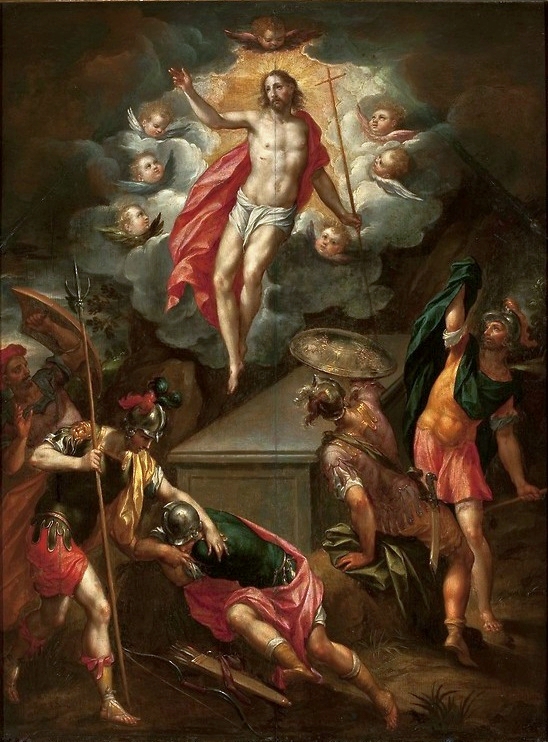
Resurrection of Christ by Hans Rottenhammer

Resurrection of Christ by Hans Rottenhammer

And a fourth issue was perhaps the biggest of all, and in a sense the culmination of all of the above: the problem of evil. Flew’s resistance to the moral argument makes good sense thus construed, and it was inevitable that until he thought of God as personal and moral, rather than merely intellectual and impersonal, his resistance to special revelation would remain intact and he would continue to be convinced by the teleological and cosmological arguments but not the moral one. Of course his resistance to the case for the resurrection would persist as well.

Flew’s story underscores the need for moral apologetics, because all of Flew’s worries can be effectively answered. The historical, biblical, and philosophical evidence weighs heavily against the problematic predestinationist soteriology that worried him, and most recent theistic ethicists, especially since Locke, have focused on the ontological grounding of moral facts in God, not the motivational and prudential incentive for morality provided by divine threats. A theistic ethic that avoids Ockhamistic voluntarism can be defended, and moral apologetics and the problem of evil are locked in a zero-sum battle; only one can survive, and I think the evidence for the success of moral apologetics is strong. This is not to say the problem of evil lends itself to any simple solution; certainly it doesn’t. In fact, the way the problem of evil remains a problem for Christianity, though not an intractable one ultimately, is one of the distinctive strengths of this worldview; it’s the worldview that lacks the resources to offer a robust account of evil in the first place that suffers from explanatory inadequacy.

What all of this shows is that the case for the resurrection of Jesus—likely the strongest argument for Christianity (even more so than the moral argument!)—goes hand in hand with moral apologetics. They are not in competition; they are rather two star players on a very talented team.

Moreover, the resurrection shows the inauguration of God’s kingdom life; resurrection living, free from the fear of death and sin, is the sort of life for which we were designed. Resurrection represents God’s work of re-creation; the power that raised Jesus from the dead can be at work within us, renewing us, transforming us, making us into the people God intended us to be. The resurrection shows that our hope is not in vain, that the moral gap can be closed by God’s transforming grace, and ultimately that there is no tension or conflict between the dictates of morality and rationality. The resurrection shows that the grain of the universe is good; that God intends to redeem the entirety of the created order, making it teem with life according to his original plan; that the worst of evils can be redeemed and defeated; that life is a comedy, not a tragedy; that the day will come when all our tears will be wiped away.


Touching Thomas (John 20:1-29)

"The Incredulity of St. Thomas" by Caravaggio. Public Domain. 

"The Incredulity of St. Thomas" by Caravaggio. Public Domain. 


Why should I have touched His wounds,

Who asked a measure more than those

Who only saw, and made His peace their joy?

Still others, seeing not, will have His touch.

And I, who walked with Him and shared

A thousand days of common ground,

But ran away when He was taken off

To bear the wounds I now have touched--

These wretched hands have felt the anguish of

The wounds He took for me.

Little did I know that what I asked

Was sharing in His pain.

Yet in his love for me, He let

My probing hands renew the desecrating

Thrust of nails and spear;

And now I know that all along

His sufferance of our selfish, grasping fingers,

Seeking only fleshly touch,

Was of a piece with baring all His wounds.

How far He had to reach

To let me touch His side!


                                                      --Elton Higgs

                                                       5/3/87


Elton Higgs

Dr. Elton Higgs was a faculty member in the English department of the University of Michigan-Dearborn from 1965-2001. Having retired from UM-D as Prof. of English in 2001, he now lives with his wife and adult daughter in Jackson, MI.. He has published scholarly articles on Chaucer, Langland, the Pearl Poet, Shakespeare, and Milton. His self-published Collected Poems is online at Lulu.com. He also published a couple dozen short articles in religious journals. (Ed.: Dr. Higgs was the most important mentor during undergrad for the creator of this website, and his influence was inestimable; it's thrilling to welcome this dear friend onboard.)

A Matter of Conscience (Matt. 27:1-10)

"Judas returning the thirty silver pieces" by Rembrandt

"Judas returning the thirty silver pieces" by Rembrandt


They were exceedingly careful

In handling blood-money;

They picked it up gingerly,

And debated what,

In conscience,

Could be done

With the price of another man's life.

They provided

For the burial of the poor

With the rejected silver,

Then busily turned

To the murder

Of the man it had bought.


                                      --Elton D. Higgs

                                                  (12/17/80)


Elton Higgs

Dr. Elton Higgs was a faculty member in the English department of the University of Michigan-Dearborn from 1965-2001. Having retired from UM-D as Prof. of English in 2001, he now lives with his wife and adult daughter in Jackson, MI.. He has published scholarly articles on Chaucer, Langland, the Pearl Poet, Shakespeare, and Milton. His self-published Collected Poems is online at Lulu.com. He also published a couple dozen short articles in religious journals. (Ed.: Dr. Higgs was the most important mentor during undergrad for the creator of this website, and his influence was inestimable; it's thrilling to welcome this dear friend onboard.)

Cock-Crowing (Luke 22:61)

The Denial of St. Peter. circa 1620-1625. Gerard Seghers.

The Denial of St. Peter. circa 1620-1625. Gerard Seghers.

("And the Lord turned and looked at Peter. And Peter
remembered the Lord's words . . . .") Luke 22.61

Grey dawn
Gone,
But day
Still waits.
Cock-crowing
Flowing
Flashing
Tearing
Through anguished heart.
Part
Of me
Is dead--
The thread
Of boasting, knowing,
Throwing words about
Is snapped,
And dangling ends ensnare the dawn.
Dark my heart since dawn
And dark the curtain drawn
Across my soul
By fear which stole
My light away.
But day must come.
The One who prophesied the broken thread
And gazed on new-made shreds
Can knit my soul and turn
Cock's call to Light indeed.
It needs my Master's face
To make cock-crowing
Both breaking
And making
Of dawn's first rays.

--Elton D. Higgs
(Spring 1973)

Elton Higgs

Dr. Elton Higgs was a faculty member in the English department of the University of Michigan-Dearborn from 1965-2001. Having retired from UM-D as Prof. of English in 2001, he now lives with his wife and adult daughter in Jackson, MI.. He has published scholarly articles on Chaucer, Langland, the Pearl Poet, Shakespeare, and Milton. His self-published Collected Poems is online at Lulu.com. He also published a couple dozen short articles in religious journals. (Ed.: Dr. Higgs was the most important mentor during undergrad for the creator of this website, and his influence was inestimable; it's thrilling to welcome this dear friend onboard.)

Nicodemus, Post Mortem (John 3:1-21; 7:45-52; 19:38-42)

"The Entombment of Christ" by Luca Giordano.

"The Entombment of Christ" by Luca Giordano.


His words are done, and now He rests,

A fragrant corpse in a rich man's tomb.

Lifted up, indeed—but are we healed?

The night He chided me for darkened mind

Is not behind me yet,

For this death no more

Than second birth I grasp.

How can earth receive

A body so unlike itself?

Not spice nor worthy grave

Can honor Him, nor rescue us,

But only words of life I heard

When cowardly I went by night.


No words now—but pregnant death!

That brings us to the womb again

And stirs our souls to breathe anew

The air His Spirit stirred!

Both birth and death are buried now

In the Word that does not die.

--Elton D. Higgs

(Nov, 11, 1980; rev. 3/18/04)


Elton Higgs

Dr. Elton Higgs was a faculty member in the English department of the University of Michigan-Dearborn from 1965-2001. Having retired from UM-D as Prof. of English in 2001, he now lives with his wife and adult daughter in Jackson, MI.. He has published scholarly articles on Chaucer, Langland, the Pearl Poet, Shakespeare, and Milton. His self-published Collected Poems is online at Lulu.com. He also published a couple dozen short articles in religious journals. (Ed.: Dr. Higgs was the most important mentor during undergrad for the creator of this website, and his influence was inestimable; it's thrilling to welcome this dear friend onboard.)

The Final Steps (Mark 14: 32-42)

"Christ in the Garden" by Caravaggio. 

"Christ in the Garden" by Caravaggio. 


I have slept in Gethsemane,

Lacking the sense

Of immanent pain

My Master bears.

His sorrow

Has been my pillow,

And I have slumbered

In the shadow

Of a dying God.

Because I cannot look upon

The final step that Love must walk,

He kneels alone,

And trembling

Takes the proferred cup

For Him and me.


"Wake up!" He says;

"Though you could not watch with me—

Though you could not

Embrace my task—

I have met my fear alone,

To seal the bonds of brotherhood,

That we might live at one."


--Elton D. Higgs

10/15/78


Elton Higgs

Dr. Elton Higgs was a faculty member in the English department of the University of Michigan-Dearborn from 1965-2001. Having retired from UM-D as Prof. of English in 2001, he now lives with his wife and adult daughter in Jackson, MI.. He has published scholarly articles on Chaucer, Langland, the Pearl Poet, Shakespeare, and Milton. His self-published Collected Poems is online at Lulu.com. He also published a couple dozen short articles in religious journals. (Ed.: Dr. Higgs was the most important mentor during undergrad for the creator of this website, and his influence was inestimable; it's thrilling to welcome this dear friend onboard.)

Sacrifice, Not Martyr (Matt. 26, Mark 14, Luke 22, John 13, 18, 20, 21)

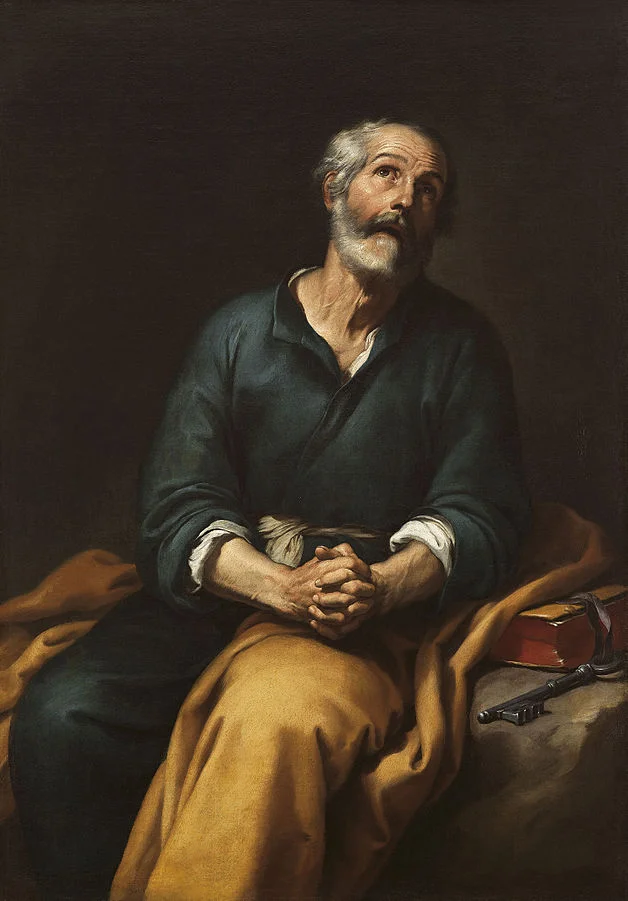
Saint Peter by Bartolomé Esteban Murillo (1617–1682)

Saint Peter by Bartolomé Esteban Murillo (1617–1682)

How glorious it seemed to me,

To die for Jesus.

And so I shall,

But not for my glory.

His story, not mine, defines my death.


He knew

My peril as prey of Satan,

And prayed for me;

But His warning found no place

To pierce my pride.

I turned aside His words,

And plunged headlong into the trap

The Enemy had set for me.

In the Garden I was ready,

Sword in hand, bold for battle!

But the Master stayed my hand

And healed the man I struck.

Disarmed and cowed,

I fled.


Following from afar,

Defenseless now for the real assault

(For I could not shift to the plane of His example),

I stood by the fire to observe,

Hoping yet to save Him from Himself.

And then those questions—

Pointing to me as one of His.

But none of His I proved.

Oblivious to my sin,

I betrayed Him from within.

And then His gentle gaze

Drove home cock’s crow,

Soul-piercing sound

That brought the bitter tears.


That purging, though,

Was not the end,

For Him nor me.

As Thomas touched His wounds

And healing found therein,

So I was also called anew

Beside Genessaret,

When one last time He supped with us.

Not my boast this time

Was focus for His words,

But gentle probing of my love for Him.

Profounder death he called for then

Than sword could bring:

Living sacrifice to serve His sheep,

And glory at the end,

When God would send

His cross for me.

                                                                                                Elton D. Higgs

                                                                                                July 1, 2014


Elton Higgs

Dr. Elton Higgs was a faculty member in the English department of the University of Michigan-Dearborn from 1965-2001. Having retired from UM-D as Prof. of English in 2001, he now lives with his wife and adult daughter in Jackson, MI.. He has published scholarly articles on Chaucer, Langland, the Pearl Poet, Shakespeare, and Milton. His self-published Collected Poems is online at Lulu.com. He also published a couple dozen short articles in religious journals. (Ed.: Dr. Higgs was the most important mentor during undergrad for the creator of this website, and his influence was inestimable; it's thrilling to welcome this dear friend onboard.)

The Silent Christ (Mark 15:1-5)

Nikolai Ge, Christ and Pilate ("What is truth?"), 1890

Nikolai GeChrist and Pilate ("What is truth?"), 1890

Why, Jesus, no reply?
If ever defense was needed,
It was then,
When Pilate and the rabble
Confronted you.
You were not what you seemed--
Beaten, friendless, bound--
For you had trod the path of God,
And angels awaited your call.
These petty men had no idea
Of the Power they dared.

And yet you said nothing.

Yours was the last defense
Against the folly of men:
The silence of Love.
Oh, words may be prelude,
And daily in the Temple
They heard yours.
But when Satan has triumphed,
Blending the lies of men
With our own despairing doubts
To turn our virtue into pitch,
The time of words is past,
And we search the depths within
To find a place
Beyond defense,
Beyond our righteousness,
Beyond integrity,
To stand with the Silent Christ.

--Elton D. Higgs
June 20, 1977

Elton Higgs

Dr. Elton Higgs was a faculty member in the English department of the University of Michigan-Dearborn from 1965-2001. Having retired from UM-D as Prof. of English in 2001, he now lives with his wife and adult daughter in Jackson, MI.. He has published scholarly articles on Chaucer, Langland, the Pearl Poet, Shakespeare, and Milton. His self-published Collected Poems is online at Lulu.com. He also published a couple dozen short articles in religious journals. (Ed.: Dr. Higgs was the most important mentor during undergrad for the creator of this website, and his influence was inestimable; it's thrilling to welcome this dear friend onboard.)

Pilate's Quandary (John 19:4-16; Matt. 27:24)

Cristo davanti a Pilato, oil on canvas painting by Giuseppe Vermiglio

Cristo davanti a Pilato, oil on canvas painting by Giuseppe Vermiglio


The gods lurk everywhere,

Even, perhaps,

In this wretched Nazarine!

How can I judge the judgment

Of this world

On one whose very presence

Scorns the power of death?

The breath of other-worldly royalty

Stirs upon his lips

And blows my threats away.


The people shout for blood

And wait upon my word.

Their guilt is greater--

So he said--

But mine is great enough,

And leaves no room

For subtle sophistry.

If "truth" has brought him here,

Then "truth" will have to save him--


But not through me.

Long ago I banked the fire of truth

That I might not be consumed.

The open flame is in his eyes,

And brooks no compromise.


I turn my face

And call for a basin

Of lukewarm water.

                                 --Elton D. Higgs

                                   Aug. 25, 1978


Elton Higgs

Dr. Elton Higgs was a faculty member in the English department of the University of Michigan-Dearborn from 1965-2001. Having retired from UM-D as Prof. of English in 2001, he now lives with his wife and adult daughter in Jackson, MI.. He has published scholarly articles on Chaucer, Langland, the Pearl Poet, Shakespeare, and Milton. His self-published Collected Poems is online at Lulu.com. He also published a couple dozen short articles in religious journals. (Ed.: Dr. Higgs was the most important mentor during undergrad for the creator of this website, and his influence was inestimable; it's thrilling to welcome this dear friend onboard.)

The Broken Jar (Mark 14:3-9)

 Jacob Andries Beschey - Maria Magdalene washing the feet of Christ


Jacob Andries Beschey - Maria Magdalene washing the feet of Christ

The ointment with abandon

Runs down His cheek,

Sweetly joining tears of love

Set flowing by her extravagance.

Beauty and prescience

Are mingled there,

While spare and cautious faces

Grimace at the waste.

They advocate the shorter way—

Slipping pennies to the poor,

And making sure the books are kept.

But Jesus wept

That one should share His sacrifice,

And break the jar to pour out all.


                              --Elton D. Higgs

                                (Jan 9, 1977)


Elton Higgs

Dr. Elton Higgs was a faculty member in the English department of the University of Michigan-Dearborn from 1965-2001. Having retired from UM-D as Prof. of English in 2001, he now lives with his wife and adult daughter in Jackson, MI.. He has published scholarly articles on Chaucer, Langland, the Pearl Poet, Shakespeare, and Milton. His self-published Collected Poems is online at Lulu.com. He also published a couple dozen short articles in religious journals. (Ed.: Dr. Higgs was the most important mentor during undergrad for the creator of this website, and his influence was inestimable; it's thrilling to welcome this dear friend onboard.)

The Brimming Basin (John 13:1-17)

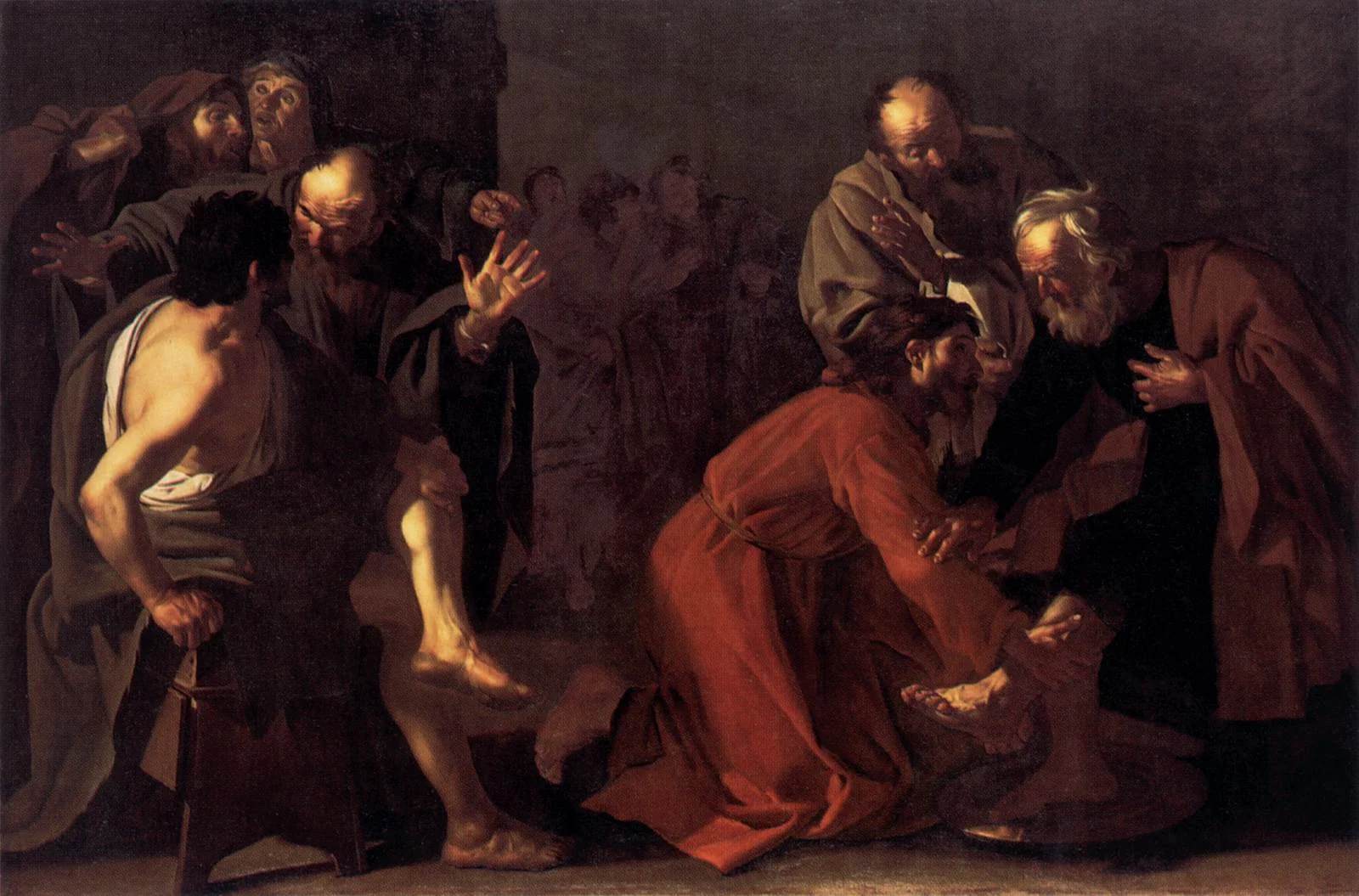
 Dirck van Baburen - Christ Washing the Apostles Fee


Dirck van Baburen - Christ Washing the Apostles Fee

The basin was fuller

Than any of them knew.

There was the water, true,

But also humble love

That laved their dusty feet.

The Master chose to meet

Their need both higher and lower

Than clouded minds could see.

In later days,

When Paraclete was guide,

They too filled up

The bowl of servanthood,

Before they drank

The final bitter cup

He promised them.


Elton D. Higgs

(Feb. 14, 2010)


Elton Higgs

Dr. Elton Higgs was a faculty member in the English department of the University of Michigan-Dearborn from 1965-2001. Having retired from UM-D as Prof. of English in 2001, he now lives with his wife and adult daughter in Jackson, MI.. He has published scholarly articles on Chaucer, Langland, the Pearl Poet, Shakespeare, and Milton. His self-published Collected Poems is online at Lulu.com. He also published a couple dozen short articles in religious journals. (Ed.: Dr. Higgs was the most important mentor during undergrad for the creator of this website, and his influence was inestimable; it's thrilling to welcome this dear friend onboard.)

Keeping the Moral Demand and the Christian Hope for the Good Life

Photo by Kristine Weilert on Unsplash

If we think that moral realism is true, and we live in a morally rich world then some unsettling issues arise. If, for example, humans really are intrinsically valuable, then something like Kant’s categorical imperative must be required of us. That is, if humans really are rational agents, then they ought to be treated never merely as means and always as ends. This is our moral obligation. The unsettling part of this is that this creates a moral demand upon us that we could never possibly meet. All we need to do is think of the history of humanity, a history riddled with war, injustice, and selfishness of a mind-boggling variety. If that is not enough, at least in my case, I need only think over the past week to tally up a rather depressing number of cases where I have failed to do what I ought. But it only gets worse.

In order to keep the moral demand placed on us, we must follow something like the categorical imperative perfectly. But how is that possible? The only way I can see is by a total transformation of character. That is, not only must we keep the moral law perfectly, but in order to do so we must actually become persons of moral character. Kant saw this himself when he suggested that not only must we do the right thing, we must do the right thing with the right motivation and for the right reasons. Simply doing the right thing is not enough, we must become a certain kind of person. Indeed, we must become morally perfect people if we are going to live up to the moral demand.

And there is yet another difficulty we must overcome. If we understand the human telos in Aristotelian terms, moral perfection requires not only the maximizing of our own character, but a society of others with similarly formed character. That is, in order to really live the moral life for which we are intended, we must not only transform ourselves, but the very society we live within must also be transformed. This is a very high demand indeed and one that history gives us reason to doubt will ever occur. No human individual seems able to meet the moral demand, and if we ever hope to actually live as we are intended, all humans must meet the demand together.

The way I see it, there are two kinds of problems here. One: we have a moral demand we cannot meet on our own. Two: if we want to live successfully as human beings, if we want to really experience the good life for which we are intended, we face apparently insurmountable difficulties in our way. So there is a challenge to human rightness and human goodness.

How should we respond in light of this incredible demand placed on us by morality? One might be tempted to give up the moral life together. What is the point of pursuing the good life or trying to do the right thing if we can never succeed? This does not seem like an acceptable option. We must find a way to meet the impossible demand or face the unacceptable reality that the moral and good life is just not possible.

John Hare has suggested that naturalists will opt for one of three strategies when faced with this demand: they will either suggest some naturalistic way for humans to be aided in meeting the demand, they will reduce the demand, or exaggerate man’s capacities to meet the demand. Here I do not want to lay out the naturalistic possibilities for responding to the moral demand. But I will just suggest that broadly speaking there are some major difficulties for the naturalist. One we must keep in mind is that whatever we say about man’s capacities or the possible aids, these must be explicated with some serious limitations. Namely, the limitations of the causal closure of the universe and at least the determination of human actions on a macro-level.  We will be as moral we are determined to be, with or without some material aid or greater capacity. And unless we are willing to deny either that humans are intrinsically valuable in a robust sense or lower the expectation of what counts as the good life (which is itself determined by our view of human dignity and worth) then we cannot lower the demand.

But what does Christian theism say about this problem we face in light of the moral demand? One important thing is that the Christian view affirms that the moral demand I have sketched is actually correct. Jesus told us to love one another as we love ourselves. God also commands us to be holy as he is holy. That is a very high standard, indeed. In addition, the Bible also gives an incredible vision for the good life for humans. The biblical view is that humans are meant for a life of satisfaction and happiness lived out in relationship to God, each other, and creation itself. We see this vision glimpsed in the Garden and in the vision of the messianic kingdom which is to come. So the Bible teaches that humans ought to always do the right thing and that they are meant to live in a world characterized fully by shalom. This is certainly no reduction of the moral demand.

How then does Christianity meet the moral demand? By providing divine aid to meet it. Since Christians are not (or at least should not be) committed to causal closure, real, transcendent help for humans is available. And God has made a dramatic step toward humans in sending his Son as part of the process of transforming the human heart, and creation itself. God also sends his Spirit to enable Christians to act according to the moral law. The Spirit also is at work in the transformation of the character of the believer so that through the process of sanctification, a person is able to be made like Christ.

In addition to that, the Kingdom of God provides the right context for human flourishing to occur. When God’s Kingdom is fully realized, all those who live within it will also be transformed by the power of God. This makes Aristotle’s vision of the good society something for which we can hope and do so not in vain. So not only does Christianity provide the resources for individuals to live up to the moral demand with God’s help, it also makes it possible for humans to attain the good life.

This is such a dramatic and beautiful answer to the problem that the moral demand raises that even if naturalists could say how, on their view, they could both live as they ought and obtain the good life, it is unlikely they could ever match the aesthetic quality of the Christian vision.


Naturalism, Christianity, and the Best Explanation of Moral Goodness

Photo by Jordan Steranka on Unsplash

In this essay I suggest that Christian theism better explains the existence of moral goodness than does naturalism. But what is goodness? One way to answer this question is by ostension.  We can point to things that are good as examples. If we asked a child, “What is water?” she would not likely respond, “It is a molecule composed of two hydrogen atoms and one oxygen atom.” Instead, she might answer by pointing to the stuff that comes from the sink.  In the same way, we might not know what the essential nature of goodness is, but we can readily identify a wide array of things that are good. For example, most would agree that being healthy is good, the beauty of the Grand Canyon is good, having a trusted friend is good, and that William Wilberforce’s abolitionism is good. But if we ask the further question, “What is the nature of goodness?” then we are faced with a deeper challenge. Socrates was notorious for pushing his interlocutors for essential meanings rather than definitions by ostension, and it didn’t win him many popularity contests.

One way to respond is by giving an account of instrumental goods. A thing is good if it has instrumental value. These are features of a thing that allow for some goal to be achieved. If, for example, I am learning chess, it would be good to study the play of Garry Kasparov. In this case, we might understand “good” to mean “whatever conduces to a given goal.” One way naturalists might be tempted to cash out the essential nature of goodness is in instrumental terms. We could, for example, read Philippa Foot’s teleological, nonconsequential view this way. Human virtues are just those things that conduce toward her preferred end of human thriving as a species. Or, on egoism, it is good to do whatever is in my self-interest. But, of course, instrumental goods exist in obviously bad places, too. The rounding up of the Jews was instrumentally good in Hitler’s plan for their extermination. What this suggests is that while instrumental goodness may get us some way toward understanding the essential nature of goodness, it cannot possibly be the whole story. And mere instrumentality does not explain how to make sense of a wide range of other things that are obviously good.

Clearly, what we are after here is something much more robust than mere instrumentality. We want to understand goodness as intrinsic and not merely extrinsic value.  Let us try again to get at the essential nature of goodness by ostension. What can we point to as an uncontroversial and obvious case of goodness? A good candidate here is humanity itself. The intrinsic value and worth of human beings is often assumed as the starting place of many ethical theories. So, if being human is good, how can we make sense of this claim? This view will have to accord with what we think humans actually are.

Consider, for example, the naturalist view of human persons. Naturalism usually utilizes what might be called “atomistic” metaphysics. That is to say, everything that exists is explainable in terms of the periodic table plus physical laws. All that exists is the material world. Further, matter does not possess any powers that cannot be captured in scientific, physicalistic terms. It follows, then, that humans too are composed of atoms and are governed by the physical laws. If this is true, then we cannot talk about human nature as some additional metaphysical category that obtains simply because there are collections of atoms arranged in a human-shape and that behave in human ways. Generating this kind of nature is not explainable in terms of the powers of physical things. Therefore, on naturalism, humans are piles of atoms arranged human-wise. And when I say “piles,” I do not mean it to be a caricature or a derogatory way of capturing the naturalist view. Rather, I think that is just the honest way to put it. If it seems degrading or silly, the problem lies with the naturalist and his metaphysics that commit him to such a view.

Given this picture of human beings, in what sense can we say that it is good to be human or that humans posses intrinsic value and worth? This will be hard for the naturalist to answer for a couple of reasons. In the first place, he must explain such strange categories as “value,” “worth,” and “dignity” in materialistic, scientific terms. But what combination of atoms conjoined with what set of physical laws will allow us to explicate such notions? In what sense can piles have intrinsic value? This seems like an exceptionally hard question to answer. On the other hand, it will be difficult to even meaningfully distinguish between humans and other physical objects. What can the naturalist point to as the relevant difference between, say, a human pile and a rock pile? This is, of course, a dramatic example. And it is a strong accusation to make to say naturalists cannot provide some relevant difference. But consider what the famous and brilliant popularizers of naturalism, Carl Sagan and Neil DeGrasse Tyson, say when trying to capture the wonder of humanity. They point out the rather startling fact that humans are composed of star dust. Humans are made of the same stuff that makes the stars. On the surface, that has an aesthetic appeal, certainly. However, the rock pile is composed of the same stuff. Should this lead us the same wonder and awe of rock piles? Presumably not.

One way the naturalist would likely object here and say that humans are better than rock piles because humans have minds and rock piles do not. But if the naturalist that raises this objection is a thorough going materialist, then this objection will not get him any traction. This is because, presumably, by pointing to the fact that humans have minds, the naturalist wants to indicate some obvious and relevant difference between humans and rock piles. And there is an obvious difference indeed. The trouble is, however that this obvious and qualitative difference cannot be captured using the periodic table plus the physical laws. This is why philosophers of mind committed to materialism often try to reduce, identify, or functionalize mental phenomena to the physical. For example, naturalist and philosopher of mind, Paul Churchland says, “the human species and all its features are the wholly physical outcome of a purely physical process. Like all but the simplest organisms, we have a nervous system… We are notable only in that our nervous system is more complex and powerful than those of our fellow creatures. Our inner nature differs from that of simpler creatures in degree, but not in kind.”[1] In this case, if naturalist like Churchland were to say, “Well humans are better than rocks because they have minds” he would be committing a mistake given the truth of his own view. There just is no such thing as the mental understood as a unique kind of property or substance distinct from the physical. Rather, there is only a physical nervous system; the periodic table plus the laws of physics. Human piles may in some ways be more complex than rock piles, but mere complexity does not somehow generate intrinsic value.

Now perhaps the naturalist will want to say that despite the fact that humans are piles, they are still somehow special. I am open to hearing that case, but I suspect that the naturalist will have trouble giving an adequate explanation for how it is that humans, if they are complex material piles, are intrinsically valuable and worthy of dignity and respect. It seems to me that if the naturalist wants to explain human dignity and remain an atheist, he will at least need to abandon reductive materialism and opt for something like Nagel’s panpsychism or Wielenberg’s moral Platonism (and here he will face a new set of difficulties).

To put the problem more precisely: on naturalism, there can nothing in principle different between human piles and rock piles. They are both composed of matter and they both operate only and always according to physical laws. When one group of humans considers themselves intrinsically better than another just because of their biological make-up, we call those people racists. On naturalism, thinking human piles are better than other piles smacks of a kind of “matter-ism” and those who hold such views are “matter-ists.” So, if we want to avoid being matter-ists and we want a meaningful way to explain human value and dignity we must look elsewhere.

Consider in contrast to the naturalist position, the theistic one. Instead of positing matter and physical laws as fundamental, theists propose that God is fundamental. Classical theists hold that not only is God the ground of all things, He is also maximally great. That is, He possesses all great-making properties to the maximally compossible degree. God, then, is understood to be maximally and intrinsically valuable. Further, theists reject the physicalist metaphysics of naturalism. Instead, they say that spirit is fundamental because God is spirit. Matter exists contingently as the product of God’s free choice to create a material world. In light of this, we need not explain all things in term of matter and physics. We have other resources to appeal to, namely theists can say that possibly some things are composed of spirit.

Now let us turn our attention to the theistic view of human persons. In pondering this question, we might talk Alvin Plantinga’s advice. Plantinga suggests that Christian philosophers who want to understand what kind of things human persons fundamentally are should turn their thoughts to God because

God is the premier person, the first and chief exemplar of personhood. God, furthermore, has created man in his own image; we men and women are image bearers of God, and the properties most important for an understanding of our personhood are properties we share with him. How we think about God, then, will have an immediate and direct bearing on how we think about humankind.

In light of Plantinga’s insight, let us consider how humans might have intrinsic value. For one, humans, being in God’s image, bear a resemblance to Him. If God is intrinsically valuable, then humans too, insofar as they resemble God, also have intrinsic value. This may seem like too easy an answer to give and that could raise suspicion. But notice why the answer is easy. Contrary to the naturalists, theists hold that essential to the fundamental nature of reality is maximal intrinsic value. Value is right at the center of the world so it is not hard to say how value in general comes about. Value exists as a necessary and essential part of Reality. Further, the Christian view, based on the opening chapter of Genesis, is that humans are imagers of God – they bear a resemblance to God. The easy move to explain human value on Christian theism is due to the richness of the theistic world. This is not a fault, but a strength.

But there is more to say. Earlier, I said that naturalists face a “matter-ist” problem. That is, they cannot provide a meaningful difference between human piles and rock piles. This is not the case on theism. Humans are not piles on theism. Instead, humans are souls. Being a soul means being, fundamentally, an immaterial person imbued with the powers of volition, creativity, and the like. It also means bearing essentially a resemblance to God, who is the premier Person. God is spirit and so are humans, although humans have physical bodies in addition to being souls. It is our souls that ground the resemblance to God, not our physical parts. In this way, humans possess a relevant difference from rock piles. Rock piles have no soul and therefore do not resemble God. It really is better to be human than rocks on theism.

Christian theism, then, provides a better explanation of the reality of the intrinsic value of human beings in particular and moral goodness in general than does naturalism.


[1] Paul Churchland, Matter and Consciousness, MIT Press 1990, 21.

Podcast: David Baggett on Moral Knowledge

On this week's episode, we hear from Dr. David Baggett. Dr. Baggett and co-author Dr. Jerry Walls have just sent in their manuscript of God and Cosmos to the publisher. And in these next few podcasts, we get a little bit of preview of the book! God and Cosmos is a sequel to Christianity Today's 2012 Apologetics Book of the Year, Good God. In Good God, Walls and Baggett offer an abductive moral argument for the existence of God. In God and Cosmos, they focus their attention on various secular ethical theories and show why these theories do not provide as robust an explanation of morality as theism. One of the chapters in the book is "Moral Knowledge" and its that chapter we will be discussing today. This is a substantive topic, so we will be dividing the conversation up into two parts. The first part lays out some of the basic issues related to moral knowledge, including what exactly moral knowledge is, the kinds of moral knowledge available, and the general problems associated with saying we have moral knowledge. The second part aims to answer the question, "How do we have moral knowledge?" Dr. Baggett will discuss and critique some atheist explanations of how we have moral knowledge before offering his own theistic account.

"Good Persons, Good Aims, and the Problem of Evil," A Lecture by Linda Zagzebski

Photo by Joe Gardner on Unsplash

Photo by Joe Gardner on Unsplash

Philosopher of  religion, Dr. Linda Zagzebski, gave a lecture at the Contemporary Moral Theory and the Problem of Evil Conference held at the University of Notre Dame. In this lecture, Dr. Zagzebski analyzes the nature of the problem of evil and how it is usually framed. She discusses what makes some state of affairs intrinsically evil and suggests that perhaps we should use a virtue theory to explicate goodness and badness instead of considering states of affairs in isolation from the agents that bring them about. It's a very creative and insightful lecture; well worth your time if you're interested in the problem of evil or the application of virtue ethics.  


Contemporary Moral Theory and the Problem of Evil Conference held at the University of Notre Dame on November 15-16, 2013.

The Moral Poverty of Evolutionary Naturalism

"Emptiness in Decay" by H. Adam. CC License. 

"Emptiness in Decay" by H. Adam. CC License. 

Darwin’s account of the origins of human morality is at once elegant, ingenious, and, I shall argue, woefully inadequate.  In particular, that account, on its standard interpretation, does not explain morality, but, rather, explains it away.  We learn from Darwin not how there could be objective moral facts, but how we could have come to believe—perhaps erroneously—that there are.

Further, the naturalist, who does not believe that there is such a personal being as God, is in principle committed to Darwinism, including a Darwinian account of the basic contours of human moral psychology.   I’ll use the term evolutionary naturalism to refer to this combination of naturalism and Darwinism.  And so the naturalist is saddled with a view that explains morality away.  Whatever reason we have for believing in moral facts is also a reason for thinking naturalism is false.  I conclude the essay with a brief account of a theistic conception of morality, and argue that the theist is in a better position to affirm the objectivity of morality.

A Darwinian Genealogy of Morals

According to the Darwinian account, given the contingencies of the evolutionary landscape—i.e., the circumstances of survival—certain behaviors are adaptive.  And so, any propensity for such behaviors will also be adaptive.  Such explains the flight instinct in the pronghorn, the spawning instinct in the cutthroat salmon and my instinctual aversion to insulting Harley riders in biker bars.  Insofar as such propensities are genetic (at least the first two examples would seem to qualify here), they are heritable and thus likely to be passed down to offspring.

Imagine, for example, a time in the early history of hominids when the circumstances of survival prompted an early patriot (and kite-flying inventor, perhaps) to advise, “We must all hang together, or assuredly we shall all be torn apart by ravenous wolves.”  Insofar as such cooperation depends upon heritable dispositions of group members, those dispositions will confer fitness.

Darwin speaks of “social instincts” that are at the root of our moral behavior.

These include a desire for the approbation of our fellow humans and a fear of censure. They also include a general sympathy for others.  He explains,

In however complex a manner this feeling may have originated, as it is one of high importance to all those animals which aid and defend one another, it will have been increased through natural selection; for those communities  which included the greatest number of the most sympathetic members, would flourish best, and rear the greatest number of offspring.[1]

A favored “complex manner” of the origin of such feelings involves an appeal to two varieties of altruism: kin altruism is directed at family members—chiefly one’s offspring—and reciprocal altruism is directed at non-family members and even to strangers.  The former is an other-regarding attitude and behavior—particularly concerning one’s own children, but extending in descending degrees to other family members—that does not seek any returns.  The advantage, of course, is in the reproductive success.  The sense of parental duty that is possessed by, say, a female sea turtle ensures only that she lay her eggs somewhere above the high tide mark.  From there, her relatively self-sufficient offspring are quite on their own against daunting odds —something like a one in ten thousand chance of reaching maturity.  Those odds are offset by the sheer numbers of hatchlings so that a fraction manage to survive the elements and elude myriads of predators.

Such a numbers strategy would hardly work for the human species, given the utter helplessness of the human infant.  Babies tend to suffer an inelegant fate if left untended.  The probability that a human infant will die if left to its own resources at, say, just above the high tide mark, is a perfect 1.  And those same odds would prevail for each of ten thousand similarly abandoned babies.  (Word would spread quickly in the wild: “Hey, free babies!”)  Human parents possessed of no more parental instinct than sea turtles would find that their line came to an abrupt end.  Thus, a strong sense of love and concern is adaptive and heritable, and has the same function—a means to reproductive success—among humans that hatchling self-sufficiency and sheer numbers have among turtles.

Reciprocal altruism, on the other hand, is rooted in a tit-for-tat arrangement that ultimately confers greater reproductive fitness on all parties involved.  Consider, for instance, the symbiotic relationship that exists between grouper and cleaner shrimp.  Though the shrimp would certainly make a nice snack for a hungry grouper and is busily flossing the fish’s teeth from the inside, the benefit of long-term hygiene (Whiter teeth! Fresher breath!) outweighs that of short-term nourishment, and so the fish is programmed to pass on the prawn. The shrimp, of course, benefits from a delectable meal of the gunk otherwise responsible for halitosis in grouper.

Similarly, there is benefit to be gained from cooperative and altruistic behavior among humans.  For example, Darwin observes,

A tribe including many members who, from possessing in a high degree the spirit of patriotism, fidelity, obedience, courage, and sympathy, were always ready to aid one another, and to sacrifice themselves for the common good, would be victorious over most other tribes; and this would be natural selection.[2]

And membership in such a victorious tribe has its advantages.  To attempt a metaphor, when a baseball team functions like a well-oiled machine, say, with a Tinker, Evers and Chance infield, the likelihood that all of the members will sport World Series rings is increased.

Thus, the human moral sense—conscience—is rooted in a set of social instincts that were adaptive given the contingencies of the evolutionary landscape.  Of course, there is more to the moral sense than the instincts that Darwin had in mind.  All social animals are possessed of such instincts, but not all are plausibly thought of as moral agents.[3]  According to Darwin, conscience emerges out of a sort of “recipe.”  It is the result of the social instincts being overlain with a certain degree of rationality.  He writes,

The following proposition seems to me in a high degree probable—namely, that any animal whatever, endowed with well-marked social instincts, the parental and filial affections being here included, would inevitably acquire a moral sense or conscience, as soon as its intellectual powers had become as well, or nearly as well developed, as in man.[4]

Wolves in a pack know their place in the social hierarchy.  A lower ranked wolf feels compelled to give way to the alpha male.  Were he endowed with the intellectual powers that Darwin had in mind, then, presumably his “moral sense” would tell him that obeisance is his moral duty.  He would regard it as a moral fact that, like it or not, alpha interests trump beta or omega interests.  And our grouper, if graced with rational and moral autonomy, might reason, “It would be wicked of me to bite down on my little buddy here after all he has done for me!”

Of course, such a “recipe” is precisely what we find in the human species, according to Darwin.  We experience a strong pre-reflective pull in the direction of certain behaviors, such as the care for our children or the returning of kindness for kindness, and, on reflection, we conclude that these are our moral duties.

Evolutionary Naturalism and Moral Knowledge

It is not clear that the resulting account of the origin and nature of human morality does full justice to its subject.  For one thing, it is hard to see why anyone who accepts it is warranted in accepting moral realism—the view that there are objective, mind-independent moral facts that we sometimes get right in our moral beliefs.  For it would appear that the human moral sense and the moral beliefs that arise from it  are ultimately the result of natural selection, and their value is thus found in the adaptive behavior that they encourage.  But then it seems that the processes responsible for our having the moral beliefs that we do are ultimately fitness-aimed rather than truth-aimed.   This is to say that, in such a case, the best explanation for our having the moral beliefs that we do makes no essential reference to their being true.

If we have the moral beliefs we do because of the fitness conferred by the resulting behavior, then it appears that we would have had those beliefs whether or not they were true.  Some writers have taken this to imply that ethics is “an illusion fobbed off on us by our genes in order to get us to cooperate.”[5]  This is to suggest that there are no objective moral facts, though we have been programmed to believe in them.  A more modest conclusion might be that we are not in a position to know whether there are such facts because our moral beliefs are undercut by the Darwinian story of their genesis.  This is because that story makes no essential reference to any such alleged facts.   Thus, our moral beliefs are without warrant.  But if our moral beliefs are unwarranted, then there can be no such thing as moral knowledge.  And this amounts to moral skepticism.

If the argument developed here succeeds, its significance is in its implications for the naturalist, who maintains that reality is exhausted by the kinds of things that may, in principle, be the study of the empirical sciences.  For the naturalist’s wagon is hitched to the Darwinian star.  Richard Dawkins was recently seen sporting a T-shirt that read, “Evolution: The Greatest Show on Earth, The Only Game in Town.”  Perhaps Dawkins’ shirt reflects his more careful comment elsewhere that, “Although atheism might have been logically tenable before Darwin, Darwin made it possible to be an intellectually fulfilled atheist.”[6]  Before Darwin, the inference to Paley’s Watchmaker seemed natural, if not inevitable, given a world filled with things “that give the appearance of having been designed for a purpose.”[7] Naturalism without Darwinism is a worldview at a loss for explanation.  Further, to appeal to natural selection to explain libidos and incisors, but to withhold such an explanation for human moral psychology is an untenable position.  Moral behavior is not the sort of thing likely to be overlooked by natural selection because of the important role that it plays in survival and reproductive success.[8]   But if naturalism is committed to Darwinism, and Darwinism implies moral skepticism, then naturalism is committed to moral skepticism.

Darwinism and Normativity

In The Descent of Man, Darwin asks, “Why should a man feel that he ought to obey one instinctive desire rather than another?”[9]  His subsequent answer is that the stronger of two conflicting impulses wins out.  Thus, the otherwise timid mother will, without hesitation, run the greatest risks to save her child from danger because the maternal instinct trumps the instinct for self-preservation.  And the timid man, who stands on the shore wringing his hands while allowing even his own child to drown out of fear for his own life, heeds the instinct for self-preservation.[10]

What Darwin never asks—and thus never answers—is why a man ought, in fact, to obey the one rather than the other.  The best that he offers here is the observation that if instinct A is stronger than B, then one will obey A.  What he does not and, I suggest, cannot say is that one ought to obey A, or that one ought to feel the force of A over B.  That is, whereas Darwin may be able to answer the factual question that he does ask— why people believe and behave as they do—this does nothing to answer the normative question of how one ought to behave or of what sets of instincts and feelings one ought to cultivate in order to be virtuous.  It is, of course, one thing to explain why people believe and behave as they do; it is quite another to say whether their beliefs are true (or at least warranted) and their behaviors right.  As it stands, it appears that Darwin has precious little of moral import to say to the timid man.

One could, I suppose, reply on Darwinian grounds that the father who lacks a strong paternal instinct is abnormal, lacking traits that are almost universally distributed throughout the species and are, perhaps, even kind-defining.[11]  Darwin refers to the man who is utterly bereft of the social instincts as an “unnatural monster.”  Doesn’t this observation lend itself to a normative evaluation of behaviors?  Who wants to be a monster, after all?  But it is not at all clear that this can give us what is needed.  After all, departure from a statistical average is not necessarily a bad thing.  If the average adult’s IQ is around 100, Stephen Hawking is something of a freak.  And, presumably, the first hominids to use tools (Hawking’s direct ancestors, perhaps?) or to express themselves in propositions were unique in their day.[12]   Indeed, the Gandhis and Mother Theresas of the world are certainly abnormal—enough that one evolutionary naturalist refers to them as “variations”—yet we tend to like having them around.

I suppose that the evolutionary naturalist could go on to observe that, not only do we notice that the timid father is different in that his parental instinct was not sufficient to prompt him to rescue his child, but it is a difference that naturally elicits negative moral emotions.  We disapprove of him and think him blameworthy.  Indeed, perhaps the man later experiences some negative moral emotions himself, such as   “remorse, repentance, regret, or shame.”[13]  According to Darwin, the sense of guilt is the natural experience of anyone who spurns the prompting of any of the more enduring social instincts, and it bears some similarity to the physical or mental suffering that results from the frustration of any instinct of any creature.  Darwin considers the suffering of the caged migratory bird that will bloody itself against the wires of the cage when the migratory instinct is at its height.  Indeed, he considers that conflict between the migratory and maternal instincts in the swallow, which gives in to the former and abandons her young in the nest.  He speculates,

When arrived at the end of her long journey, and the migratory instinct has ceased to act, what an agony of remorse the bird would feel, if, from being endowed with great mental activity, she could not prevent the image constantly passing through her mind, of her young ones perishing in the bleak north from cold and hunger.[14]

Like the moral sense in general, guilt is the yield of a sort of recipe: one part spurned instinct to one part “great mental activity” that permits remembrance and remorse.  And so, when our timid man’s own personal danger and fear is past so that the strength of his selfish instinct has receded, the scorned paternal instinct will have its revenge.  Also, because we are social animals, we are endowed with sympathies that make us yearn for the approbation of our fellows and fear their censure.  The cowardly father is thus likely in for a long bout of insomnia.  Further, Darwin may explain that the experience of remorse may result in a resolve for the future, with the further result that the paternal instinct is bolstered and stands a greater chance of being the dominant of two conflicting instincts.  Thus, “Conscience looks backwards, and serves as a guide for the future.”[15]

But even if we are assured that a “normal” person will be prompted by the social instincts and that those instincts are typically flanked and reinforced by a set of moral emotions, we still do not have a truly normative account of moral obligation.  There is nothing in Darwin’s own account to indicate that the ensuing sense of guilt—a guilty feeling—is indicative of actual moral guilt resulting from the violation of an objective moral law.  The revenge taken by one’s own conscience amounts to a sort of secondorder propensity to feel a certain way given one’s past relation to conflicting first-order propensities (e.g., the father’s impulse to save his child versus his impulse to save himself).  Unless we import normative considerations from some other source, it seems that, whether it is a first or second-order inclination,16one’s being prompted by it is more readily understood as a descriptive feature of one’s own psychology than material for a normative assessment of one’s behavior or character.  And, assuming that there is [16]anything to this observation, an ascent into even higher levels of propensities (“I feel guilty for not having felt guilty for not being remorseful over not obeying my social instincts…”) introduces nothing of normative import.  Suppose you encounter a man who neither feels the pull of social, paternal or familial instincts nor is in the least bit concerned over his apparent lack of conscience.  What, from a strictly Darwinian perspective, can one say to him that is of any serious moral import?  “You are not moved to action by the impulses that move most of us.”  Right. So?

The problem afflicts contemporary construals of an evolutionary account of human morality.  Consider Michael Shermer’s explanation for the evolution of a moral sense—the “science of good and evil.”  He explains,

By a moral sense, I mean a moral feeling or emotion generated by actions.  For example, positive emotions such as righteousness and pride are experienced as the psychological feeling of doing “good.”  These moral emotions likely evolved out of behaviors that were reinforced as being good either for the individual or for the group.[17]

Shermer goes on to compare such moral emotions to other emotions and sensations that are universally experienced, such as hunger and the sexual urge.  He then addresses the question of moral motivation.

In this evolutionary theory of morality, asking “Why should we be moral?” is like asking “Why should we be hungry?” or “Why should we be horny?”  For that matter, we could ask, “Why should we be jealous?” or “Why should we fall in love?”  The answer is that it is as much a part of human nature to be moral as it is to be hungry, horny, jealous, and in love.[18]

Thus, according to Shermer, given an evolutionary account, such a question is simply a non-starter.  Moral motivation is a given as it is wired in as one of our basic drives.  Of course, one might point out that Shermer’s “moral emotions” often do need encouragement in a way that, say, “horniness,” does not.  More importantly, Shermer apparently fails to notice that if asking “Why should I be moral?” is like asking, “Why should I be horny?” then asserting, “You ought to be moral” is like asserting, “You ought to be horny.”  As goes the interrogative, so goes the imperative.  But if the latter seems out of place, then, on Shermer’s view, so is the former.

One might thus observe that if morality is anything at all, it is irreducibly normative in nature.  But the Darwinian account winds up reducing morality to descriptive features of human psychology.  Like the libido, either the moral sense is present and active or it is not.  If it is, then we might expect one to behave accordingly.  If not, why, then, as a famous blues man once put it, “the boogie woogie just ain’t in me.”  And so the resulting “morality” is that in name only.

In light of such considerations, it is tempting to conclude with C. S. Lewis that, if the naturalist remembered his philosophy out of school, he would recognize that any claim to the effect that “I ought” is on a par with “I itch,” in that it is nothing more than a descriptive piece of autobiography with no essential reference to any actual obligations.

A Naturalist Rejoinder

A familiar objection to my line of argument is that it assumes what is almost certainly false: that all significant and widely observed human behavior is genetically determined as the result of natural selection.  Daniel Dennett refers to this assumption as “greedy reductionism.” Dennett observes that all tribesmen everywhere throw their spears pointy-end first, but we should not suppose that there is a “pointy-end first gene.”[19] The explanation rather resides in the “non-stupidity” of the tribesmen.  And when C.S. Lewis’s character, Ransom, was at first surprised to discover that boats on Malacandra (Mars) were very similar to earthly boats, he caught himself with the question, “What else could a boat be like?’” (The astute Lewis reader might also have noticed that Malacandran hunters throw their spears pointy-end first, despite being genetically unrelated to humans, just as Dennett might have predicted.)  Some ideas are just better than others and, assuming a minimal degree of intelligence, perhaps we have been equipped to discover and implement them.

One might thus insist that perhaps all that evolution has done for us is to equip us with the basic capacities for intelligent decision-making and problem-solving, and the enterprise that is human morality is the product of human rationality; not the mere outworking of some genetic program.  If the process that has led to our having the moral beliefs we do has involved conscious rational reflection, then we have reason for optimism regarding our facility for tracking truth.  We have no more cause for moral skepticism than we do, say, mathematical skepticism.

The same greedy reductionism might be thought to plague my argument that

Darwinian accounts of human morality are merely descriptive.  I have said above that, “unless we import normative considerations from some other source,” we are left with a merely descriptive rather than a normative account.  My critic may insist here that we do bring in normative considerations from elsewhere, namely, from moral theory.  If there are true moral principles that yield moral directives and values, then, regardless of how one does feel and behave, it will remain the case that he ought to behave in a certain way.

For example, should it prove true that humans have a natural propensity for xenophobia as a part of their evolutionary heritage, we might nevertheless conclude that, say, a respect-for-persons principle requires that they overcome such fear and potential mistreatment of strangers.  The mere fact that people have a propensity for a behavior does not entail that it is justified.

I plead not guilty to the charge of greedy reductionism.  The argument in no way supposes that well-formed moral beliefs are somehow programmed by our DNA.  Richard Joyce considers the belief, “I ought to reciprocate by picking up Mary at the airport.”[20]  He then asks, “What does natural selection know of Mary or airports?”  Or consider a mother’s belief, “I ought to ensure that my child gets plenty of fruits and vegetables.”  There is, of course, no imperative regarding the dietary needs of toddlers that may be read off of the DNA.  One might as well suppose that there is a genetically programmed human tendency directed specifically at popping bubble wrap.

But Darwin’s account certainly does imply that the basic predisposition for repaying kindness with kindness or for caring for one’s offspring is programmed, and that such programs run as they do because of the reproductive fitness that is—or was for our remote ancestors—achieved by the resulting behaviors.

Philosopher Mary Midgley speaks of instincts as “programs with a gap.”[21]  Consider, for instance, the migratory instinct of the sandhill crane.  The basic drive to follow the sun south every winter is genetically programmed.  But there is a “gap” that allows for variations in the itinerary.  Midgley notes that the more intelligent the species is the wider is the gap so that room is available for deliberation and rational reflection.  Less psychologically complex creatures may be strictly determined in their behavior by their genetic hardwiring.  As P.G. Wodehouse’s newt-loving character, Gussie Fink-Nottle explains to Bertie Wooster, “Do you know how a male newt proposes, Bertie? He just stands in front of the female newt vibrating his tail and bending his body in a semicircle.”[22]  Assuming Gussie’s description is accurate, we may also safely assume that newt courting behavior, unlike that observed in aristocratic British bachelors, is genetically choreographed.   In humans, the “gap” allows for countless ideas and beliefs that clearly are the products of culture rather than biology.

Still, the basic programming itself is, on Darwin’s scheme, determined by our genetic makeup, and, therefore, so is the range of rational options in that “gap” of deliberation.  Given the perennial problem of tribal warfare, early tribesmen reasoned that thrown spears are far more effective than thrown bananas.  But had humans evolved to be non-aggressive herbivores, spears might have been, well, pointless.   Had the course of human evolution been such that human infants, like baby sea turtles, were self-reliant, the human maternal instinct might never have evolved as a means to the end of reproductive fitness.    Indeed, Darwin thought that, had the circumstances for reproductive fitness been different, then the deliverances of conscience might have been radically different.

If . . . men were reared under precisely the same conditions as hive-bees, there can hardly be a doubt that our unmarried females would, like the worker-bees, think it a sacred duty to kill their brothers, and mothers would strive to kill their fertile daughters, and no one would think of interfering.[23]

As it happens, we weren’t “reared” after the manner of hive-bees, and so we have widespread and strong beliefs about the sanctity of human life and its implications for how we should treat our siblings and our offspring.

But this strongly suggests that we would have had whatever beliefs were ultimately fitness-producing given the circumstances of survival.  Given the background belief of naturalism there appears to be no plausible Darwinian reason for thinking that the fitness-producing predispositions that set the very parameters for moral reflection have anything whatsoever to do with the truth of the resulting moral beliefs.  One might be able to make a case for thinking that having true beliefs about, say, the predatory behaviors of tigers would, when combined with the an understandable desire not to be eaten, be fitness-producing.  But the account would be far from straightforward in the case of moral beliefs.[24]   And so the Darwinian explanation undercuts whatever reason the naturalist might have had for thinking that any of our moral beliefs are true.  The result is moral skepticism.

If our pre-theoretical moral convictions are largely the product of natural selection, as Darwin’s theory implies, then the moral theories that we find plausible are an indirect result of that same evolutionary process.  How, after all, do we come to settle upon a proposed moral theory and its principles as being true?  What methodology is available to us?

By way of answer, consider the following “chicken-and-egg” question.  Which do we know more certainly: the belief, It is wrong to stomp on babies just to hear them squeak, or some true moral principle that entails the wrongness of baby-stomping?  In moral reflection, do we begin with the principle, and only then, principle in hand, come to discover the wrongness of recreational baby-stomping as an inference from that principle?  Or do we begin with the belief that baby-stomping is wrong and then arrive at the principle that seems implicated by such a belief?  Pretty clearly, it is the latter.  We just find ourselves with certain beliefs of a moral nature, and actually appeal to them as touchstones when we engage in conscious moral reflection.  Indeed, if we were to conclude that some philosopher’s proposed moral principle would, if true, imply the moral correctness of recreational baby-stomping, then we might say, “So much the worse for that proposed principle.”  As philosopher Mary Midgley has put it, “An ethical theory which, when consistently followed through, has iniquitous consequences is a bad theory and must be changed.”[25] This methodology, which begins with deep-seated, pre-reflective moral beliefs and then moves to moral principles that are implicated by them, is sometimes called reflective equilibrium.[26]

Presumably, reflective equilibrium, employed by bee-like philosophers in those worlds envisioned by Darwin, would settle upon moral principles that implied the rightness of such things as siblicide and infanticide.  Thus, the deliverances of the moral theories endorsed in such worlds are but the byproducts of the evolved psychologies in such worlds.  But, again, this suggests that our pre-theoretical convictions are largely due to whatever selection pressures happened to be in place in our world.   If this is so, then the deliverances of those moral theories that we endorse, to which we might appeal in order to introduce normative considerations, are, in the final analysis, byproducts of our evolved psychology.  The account, as it stands, thus never takes us beyond merely descriptive human psychology.

A Theistic Alternative

The worry, then, is that our efforts at moral reflection are compromised by features of our constitution that are in place for purposes other than the acquisition of truth.  As philosopher Sharon Street puts it,

If the fund of evaluative judgments with which human reflection began was thoroughly contaminated with illegitimate influence . . . then the tools of rational reflection were equally contaminated, for the latter are always just a subset of the former.[27]

In order to inspire confidence in those initial evaluative judgments of which Street speaks, the moral realist owes us some account of their origin that would lead us to suppose that they are reliable indicators of truth.  What we need is some assurance that our original fund is not contaminated.  And so our question is, What reason have we for supposing that the mechanisms responsible for those judgments are truth-aimed?  What we seek is what Norman Daniels calls “a little story that gets told about why we should pay homage ultimately to those [considered] judgments and indirectly to the principles that systematize them.”[28]

It is just here that the theist may oblige us in a way that the naturalist may not.  Robert Adams, for example, has suggested that things bear the moral properties that they do—good or bad—insofar as they resemble or fail to resemble God.  He goes on to offer the makings of a theistic “genealogy of morals.”

If we suppose that God directly or indirectly causes human beings to regard as excellent approximately those things that are Godlike in the relevant way, it follows that there is a causal and explanatory connection between facts of excellence and beliefs that we may regard as justified about excellence, and hence it is in general no accident that such beliefs are correct when they are.[29]

The theist is thus in a position to offer Daniels’ “little story” that would explain the general reliability of those evaluative judgments from which reflective equilibrium takes its cue.  Certain of our moral beliefs—in particular, those that are presupposed in all moral reflection—are truth-aimed because human moral faculties are designed to guide human conduct in light of moral truth.[30]  The moral law is “written upon the heart,” the apostle Paul wrote to the church in Rome.

Conclusion

A century ago, the philosopher Hastings Rashdall observed,

So long as he is content to assume the reality and authority of the moral consciousness, the Moral Philosopher can ignore Metaphysic; but if the reality of Morals or the validity of ethical truth be once brought into question, the attack can only be met by a thorough-going enquiry into the nature of Knowledge and of Reality.[31]

We have seen that both the evolutionary naturalist and the theist may be found saying that certain of our moral beliefs are by-products of the human constitution: we think as we do largely as a result of our programming.  Whether such beliefs are warranted would seem to depend upon who or what is responsible for the program.  And this calls for some account of the metaphysical underpinnings of those beliefs and the mechanisms responsible for them.  Are those mechanisms truth-aimed?  And are they in good working order?  The sort of account available to the evolutionary naturalist ends in moral skepticism.  The theist has a more promising story to tell.[32]

Notes:

[1] Charles Darwin, The Descent of Man and Selection in Relation to Sex (New York: Barnes and Noble Publishing, 2004), 88.

[2] Darwin, Descent, 112.

[3] And, of course, though any two species of social animals have in common the fact that they are prompted by social instincts, the resulting behavior may vary widely.  It is not clear, for instance, which of the grazing Guernseys is the “alpha cow.” Wiener dogs seem not to come equipped with the obsessive herding instincts of border collies, and would likely endure derisive laughter from the sheep if they did.

[4] Darwin, Descent, 81.

[5] Michael Ruse and E.O. Wilson, “The Evolution of Ethics,” in Religion and the Natural Sciences, ed. J.E. Huchingson (Orlando: Harcourt Brace, 1993), 310-11.

[6] Richard Dawkins, The Blind Watchmaker (New York: Norton & Co., 1986), 6.

[7] Ibid., 1.

[8] Tamler Sommers and Alex Rosenberg, “Darwin’s Nihilistic Idea: Evolution and the Meaninglessness of Life,” Biology and Philosophy 18/5 (2003): 653-88.

[9] Darwin, Descent, 91.

[10] I cannot resist including a personal anecdote here.  I once rescued a young man from drowning in the Mississippi River.  After I swam out and pulled him to shore, his mother, who had watched helplessly from the beach,  explained that she would have saved him herself but she could not go into the water because her toe was infected.  She produced the sore toe.  I had to agree that it did look very sore.

[11] The Chinese philosopher Mencius seems to have maintained that the possession of at least the rudimentary “seeds” of the virtues (e.g., the feeling of commiseration is the seed of the virtue of jen —“human-heartedness”) are essential to humanity so that anyone lacking them would not be human.

[12] Consider Gary Larson’s cartoon depicting a group of cave men.  To the left is a small group huddled around a fire, roasting drumsticks by clenching them in their fists directly over the flames.  They are all very obviously in agony.  To the right is another fire with only one cook.  He has the meat roasting on a stick, and is seated at a comfortable distance.  A member of the group to the left has noticed this, and is saying, “Look what Og do!”

[13] Darwin, Descent, 94.

[14] Ibid.

[15] Ibid., 95.

[16] So if the impulse either to save the child or one’s own hide is a first-order inclination, second-order inclinations would include feelings of, say, guilt or pride regarding the first-order propensities and resulting actions.

[17] Michael Shermer, The Science of Good and Evil (New York: Times Books, 2004), 56.

[18] Ibid., 57.

[19] Daniel Dennett, Darwin’s Dangerous Idea: Evolution and the Meanings of Life (New York: Simon and Schuster, 1996), 486.

[20] Richard Joyce, The Evolution of Morality (Cambridge, MA: MIT Press, 2006), 180.

[21] See Mary Midgley, Beast and Man (London: Routledge Press, 1979).

[22] Taken from P.G. Wodehouse, Right Ho, Jeeves (New York: Penguin, 2000), ch. 2.

[23] Darwin, Descent, 82.

[24] Here’s why.  This would imply, for instance, that human mothers are possessed of a powerful maternal instinct for the prior reason that it is true that they have a moral duty to care for their children.  But, given naturalism, the simpler explanation for the maternal instinct is just that it confers reproductive fitness.  Why think that moral facts have any role to play—particularly when we observe similar instinctual behavior in animals that are not plausibly thought of as moral agents?  Further, to what mechanism could the naturalist plausibly appeal to explain how reproductive fitness “tracks” moral truth?  For more on this, see Sharon Street’s excellent paper, “A Darwinian Dilemma for Realist Theories of Value,” Philosophical Studies 127 (2006): 109-166.


[25] Mary Midgley, “Duties Concerning Islands,” in Christine Pierce and Donald VanDeVeer eds., People, Penguins and Plastic Trees (Belmont, CA: Wadsworth Publishing, 1986), 157.

[26] Reflective equilibrium involves more than this one-way move from particular beliefs to general principles.  In actual practice, it begins with those pre-reflective beliefs, moves from there to systemizing principles, and then back to other particular beliefs that are entailed by the principles.  There is always a standing possibility that an entailed beliefs is incompatible with one or another of the beliefs with which one began.  In that case, adjustment and revision is called for.  The goal is to arrive at a set or system of principled beliefs that is internally consistent and plausible.

[27] Sharon Street, “A Darwinian Dilemma for Realist Theories of Value. Philosophical Studies, 127 (2006), 125.

[28] Norman Daniels, “Wide Reflective Equilibrium and Theory Acceptance in Ethics,” Journal of Philosophy 76/5 (1979): 265.

[29] Robert M. Adams, Finite and Infinite Goods (Oxford: Oxford University Press, 1999), 70.

[30] For the purposes of this argument, the appeal to “design” leaves open the question of whether the process responsible for the appearance of moral agents was evolutionary in nature.  Daniels’ “little story” requirement is satisfied whether the tale involves special creation or directed evolution.

[31] Hastings Rashdall, The Theory of Good and Evil (Oxford: The Clarendon Press, 1907), 192.

[32] As always, I wish to thank David Werther for his many helpful comments on and criticisms of earlier versions of this essay.



Podcast: Jon Pruitt on Whether It's Good to be Human

On this week's episode, we will be discussing whether or not it is good to be human. We will mainly consider this question from an atheist and Christian perspective. We will see that in order to answer the question, one must first explain what it would mean for something to be good and second what it would mean to be human. What we suggest is that Christianity provides the best explanation of the goodness of humanity.  

Photo: "Creation of Adam (detail)" By Michelangelo. Public Domain. 

Telling Time: The Apologetic of the Present, Part 2

Photo by Srikanta H. U on Unsplash

Photo by Srikanta H. U on Unsplash

Part 1

Temporality, once reflected upon and resigned to, proclaims to humanity its essential question—the one Tolkien so eloquently asked—“what to do with the time given us.” It’s a common philosophical observation that time isn’t in itself material but is used to measure the distance, relationship, and alteration between material things. We measure our lives by time. We consider a relationship significant if it lasts fifty years. We call service to a job quality if it has the tenure of time. We want to make something of our lives in the time we have. We reflect on the past as a way to understand what kind of people we are. We look to the future in hopes that we won’t repeat the mistakes of today. We hope to leave moral legacies behind us as we near the end of our time.

Biblical authors understood the importance of time in creating moral urgency, and they often wielded timely rhetoric in attempts to empower their audiences to action. Jeremiah laments for the time wasted by his kinsman and delivers an urgent warning, "The harvest is past, the summer has ended, and we are not saved" (Jeremiah 8:20). Chiefly, the scripture writers emphasized the importance of the present. The temporal now is the only time to obey the will of Yahweh. 2 Corinthians 6:2 tells us that God proclaims, “At just the right time, I heard you. On the day of salvation, I helped you. Indeed, the ‘right time’ is now. Today is the day of salvation.” If one is to know Christ, there is no other time in which to know him than the present. And since God meets me only in the always present and since existence, in response to God’s presence, isn’t actualized in past or future,[1] I have only this present moment to respond to God. The eternal Christ can’t be met yesterday or tomorrow, only in today’s exact now.

Perhaps no period of time has seen more attention paid to the present than the twentieth century. Writers like Joseph Conrad, Walter Benjamin, Paul Valery, Wyndham Lewis, and C. S. Lewis fore-fronted the importance of time as the ultimate measure of humanity’s existential significance. Through time, we know ourselves. In time, we become the people we desire or fear to be. By time, we measure the space between the meaningful moments in our lives. From time, we learn an Ecclesiastian mortality. For Christian writers like C. S. Lewis, time pressed upon the human soul with all the force of heaven and hell behind it. In The Great Divorce, Lewis’s most superb example of his theology of the present, a ghost with a little red lizard on his shoulder is approached by a flaming, radiantly angelic solid person on the high plains of heaven. The ghost, a lost soul, has a strained, spiritually unhealthy relationship with the lizard, a metaphor for the ghost’s besetting sin of lust. Lewis catches sight of the ghost and noticed that “he turned his head to the reptile with a snarl of impatience. ‘Shut up, I tell you!’ he said. It wagged its tail and continued to whisper to him.”

Lewis then narrates the solid person’s reply, “Would you like me to make him quiet’ said the flaming Spirit—an angel, as I now understood.” Once the ghost admits that he would like to be rid of the lizard, the flaming Spirit announces, “Then I will kill him.” Shocked and afraid, the lizard-clad ghost defers, “Well, there’s time to discuss this later.” The flaming Spirit announces, “There is no time.” The ghost complains, “It would be most silly to do it now. I’d need to be in good health for the operation. Some other day, perhaps.” To which the solid person replies, “There is no other day. All days are present now.”

As a part of Lewis’s fictive eternal order, the angelic being serves as a metonym for God’s very essence. Though eternal, though standing outside of time—the slippage of time runs throughout the text serving as the novel’s bedrock theme—the angel’s eternality speaks to his moral perfection. In the high plains, once good is ripened, perfect timeless solidity constitutes nature. God’s timelessness, like His holiness, His perfect loving-kindness, and His omnipotence becomes the banner under which our temporality, like our sinfulness, our selfishness, and our weakness surrender. The solid person incarnates an apologetic of the present, which exposes the ontologically incomplete and morally decaying nature of temporal existence and of the ghost’s ephemeral sins. It is the weight of the present bearing down on the ghost that causes his conversion. He dies to what is temporal, knowing it as non-existence against heaven’s ultimate reality, and lives into the eternal. Once the ghost resigns to time’s deterioration, giving his decay over to destruction, a death by eternity, he transforms into pure, immortal substantiality. But transformation must take place in the present. All days are present for the ghost because all days are present for God.

If, alongside Augustine, Boethius, the biblical writers, and writers like Lewis, we are to understand God, then we must do so in full embrace of His atemporal existence. If I am to know God, then it will be at that crossroads of eternality and temporality called the present. Temporality proves an apologetic of ruin that forces from us the undeniable cry of mortality. The eternal God stands in perfect existence beyond time, though He enters time through the always present that we might shed the temporal and put on the incorruptible. Through time time is conquered. We turn to the eternal through the temporal present, which is the eternal present for God, and we gain immortal solidity. As Lewis says in his allegorical Pilgrim’s Regress, “The human soul was made to enjoy some object that is never fully given—nay, cannot even be imagined as given—in our present mode of subjective and spatio-temporal experience.” May we enjoy more than time can afford.

[1] In other words, there is only evidence of my existing yesterday through artifact and memory. And I’m sure I’ll exist tomorrow. But I only exist in freedom of will and full actualization of life now.


Corey Latta

Corey Latta holds a BA in Biblical Studies from Crichton College, an MA in New Testament Studies from Harding School of Theology, an MA in English from the University of Memphis, and a PhD in Twentieth-Century Literature from the University of Southern Mississippi. Corey is currently Vice President of Academics at Visible Music College. Corey is the author of numerous articles, poems, and three books, including “Election and Unity in Paul’s Epistle to the Romans,” and “Functioning Fantasies: Theology, Ideology, and Social Conception in the Works of C. S. Lewis and J. R. R. Tolkien.” His latest book, When the Eternal Can Be Met: A Bergsonian Theology of Time in the Works of C. S. Lewis, T. S. Eliot, and W. H. Auden, was published by Wipf & Stock in April.