Lord’s Supper Meditation – Jesus’ Unique Cup

 A Twilight Musing

When the disciples James and John wanted to be assured of prominent positions in Jesus’ kingdom, He asked them whether they were able to drink of the cup that He was to drink of.   When in their presumption and beyond their understanding they said they could, Jesus predicted that indeed they would share His cup.  But their sharing in that cup of suffering even to the point of martyrdom would have had no meaning had Jesus not drunk it to the dregs first.

The most oppressive burden that Jesus bore was not merely stooping to be human, or being rejected, or even being shamefully killed; it was fully knowing that ahead of Him was that moment of unique loneliness on the cross when He experienced the fullest measure of alienation from God, the death-penalty of sin.  From that acute knowledge in Gesthemene burst the agonized prayer, “Father, if it is your will, remove this cup from me.”   But none of this prescient agony could he communicate to His disciples, for even as He uttered that anguished plea for deliverance, the sleeping disciples behind Him symbolized the deep separation that He experienced even from those who knew Him best.

But the greatest wonder of the Gospel of Jesus is that after being driven to the depths of emptiness by his acceptance of the will of the Father, the Son of God wants to share with sinners what He gained by facing that emptiness alone.  We can now share in the cup of suffering that He drank, but we can endure it in confidence and hope because He tempered its bitterness with the forsaken flow of His life’s blood.   And He invites us to sit and eat with Him—the One who ate the bread of sorrow in desolation.  For now that He has passed through the Shadow for all of us, He calls to us, “Dearest ones, do not cling to your loneliness and isolation, which I have endured for you; cast it off, and sup with me, and we shall be together, as it was meant to be.”


Elton_Higgs+(1).jpg

Dr. Elton Higgs was a faculty member in the English department of the University of Michigan-Dearborn from 1965-2001. Having retired from UM-D as Prof. of English in 2001, he now lives with his wife in Jackson, MI. He has published scholarly articles on Chaucer, Langland, the Pearl Poet, Shakespeare, and Milton. Recently, Dr. Higgs has self-published a collection of his poetry called Probing Eyes: Poems of a Lifetime, 1959-2019, as well as a book inspired by The Screwtape Letters, called The Ichabod Letters, available as an e-book from Moral Apologetics. (Ed.: Dr. Higgs was the most important mentor during undergrad for the creator of this website, and his influence was inestimable.


Elton Higgs

Dr. Elton Higgs was a faculty member in the English department of the University of Michigan-Dearborn from 1965-2001. Having retired from UM-D as Prof. of English in 2001, he now lives with his wife and adult daughter in Jackson, MI.. He has published scholarly articles on Chaucer, Langland, the Pearl Poet, Shakespeare, and Milton. His self-published Collected Poems is online at Lulu.com. He also published a couple dozen short articles in religious journals. (Ed.: Dr. Higgs was the most important mentor during undergrad for the creator of this website, and his influence was inestimable; it's thrilling to welcome this dear friend onboard.)

One Good Reason to Believe in the Bible: Guilt (and man’s attempts to avoid it)  

One Good Reason (1).png

Editor’s note: Good Reasons Apologetics has graciously allowed us to republish their series, “One Good Reason” You can find the original post here.

For the time is coming when people will not endure sound teaching, but having itching ears they will accumulate for themselves teachers to suit their own passions, and will turn away from listening to the truth and wander off into myths-2 Timothy 4:3 

On September 12th, 2021 a 90 year old man named John Shelby Spong passed away in his sleep. Spong was an American Bishop of the Episcopal Church in Newark, New Jersey from 1979 to 2000. In the course of his tenure as Bishop and afterward, Spong wrote a number of books expressing his thoughts on God and Christianity. Spong’s works were not what you might guess would come from a person who had risen to such a position of prominence in a Christian church. Spong called for a “fundamental rethinking of Christian belief away from theism and traditional doctrines.” 1 

Spong came up with what came to be called his 12 theses. Just as Martin Luther nailed his 95 theses to a church door at Wittenburg, Germany to call for a reformation of the Roman Catholic Church, Bishop Spong posted his 12 ideas for a new reformation of the Christian Church today. The 12 ideas Spong put forward included the ideas that the idea of God as we’ve always understood it is totally wrong, the story of a perfect creation and fall from grace is nonsense, there is no set of laws that can govern people for all time (think 10 Commandments), prayers to God are meaningless, the miracles of the Bible are untrue, there was no virgin birth of Jesus, the story of Christ’s death on a cross for the salvation of others is barbaric and primitive, and Jesus could not have been literally resurrected.

Of Bishop Spong’s 12 theses, the one that may be most telling is his belief that, “the hope for life after death must be separated forever from the behavior control mentality of reward and punishment. The Church must abandon, therefore, its reliance on guilt as a motivator of behavior.” 

I would argue that it was the last idea that led to him trying to sell the other 11 as facts, with much pushback from scholars I might add. With the exception of a few sociopaths, being guilty is a problem for us. In the course of interviewing many people suspected or known to have committed crimes, clues of someone lying  all boiled down to the person being physically uncomfortable with lying or facing the idea of their own guilt. I also  found that when a true confession came, there was a tremendous sense of relief by the confessor. The burden of hiding the truth was over, and they were almost always visibly relieved to let the truth be known, despite the consequences. 

Spong followed the patterns of many “critical” scholars who have attempted to dig holes under all of the things that the first 2000 years of Chirstianity claimed to be true of itself, such as the idea that God created everything perfectly, mankind is fallen, we have all sinned, and therefore we all need the sacrifice of Christ crucified to return us to fellowship with our Creator. In his attempts to remove an all knowing, all powerful God, creation, sin, guilt and Christ’s work on the cross, Spong was ultimately trying to provide another way out of guilt that he seemed to be accusing Christianity of using against its members. However, if we are honest with ourselves we all know the truth. We know we are guilty anyway. Like a defendant pleading not guilty, just because you say it doesn’t make it true.  

Like me, I am confident that you have done things you wish you could take back. You have had to be forgiven, or pay the price for things you’ve done. People know the guilt is there without needing to go to church. We make excuses for our behavior, but that doesn’t get rid of guilt. However, the sooner we acknowledge the truth of our own guilt, the sooner we can work to reconcile those we have hurt. Even if it’s the Creator of the universe.   


IMG_3560.jpg


Tony Williams is currently serving in his 20th year as a police officer in a city in Southern Illinois. He has been studying apologetics in his spare time for two decades, since a crisis of faith led him to the discovery of vast and ever-increasing evidence for his faith. Tony received a bachelor's degree in University Studies from Southern Illinois University in 2019. His career in law enforcement has provided valuable insight into the concepts of truth, evidence, confession, testimony, cultural competency, morality, and most of all, the compelling need for Christ in the lives of the lost. Tony plans to pursue postgraduate studies in apologetics in the near future to sharpen his understanding of the various facets of Christian apologetics. Tony has been married for 9 years and has two sons. He and his family currently reside in Southern Illinois.

Can a Divine command theory account for the objectivity of moral requirements? Brink and Appraiser Independence

Editor’s note: This article was originally posted at MandM. It has been posted here with permission of author.


David Brink has objected to a divine command theory of ethics by contending such theories cannot vindicate the objectivity of ethics. Brink begins by defending a particular conception of the objectivity of ethics and then argues that a divine command theory fails to meet that conception.  Brink writes:

Our commitment to the objectivity of ethics is a deep one. Ethics is objective just in case there are facts or truths about what is good or bad and right or wrong that obtain independently of the moral beliefs or attitudes of appraisers. A commitment to objectivity is part of a commitment to the normativity of ethics. Moral judgments express normative claims about what we should do and care about. As such, they presuppose standards of behavior and concern that purport to be correct, that could and should guide conduct and concern, and that we might fail to accept or live up to. Normativity, therefore, presupposes fallibility, and fallibility implies objectivity. Of course, this presupposition could be mistaken. There might be no objective moral standards. Our moral thinking and discourse might be systematically mistaken. But this would be a revisionary conclusion, to be accepted only as the result of extended and compelling argument that the commitments of ethical objectivity are unsustainable. In the meantime, we should treat the objectivity of ethics as a kind of default assumption or working hypothesis [1]

 He continues:

…Ethical subjectivism is one way to deny ethical objectivity. It claims that what is good or bad and right or wrong depends on the moral beliefs or attitudes of appraisers. But voluntarism is just subjectivism at the highest level. If God exists and is both omniscient and perfectly good, then his approval – if only we could ascertain it – would be a perfectly reliable – indeed, infallible – indicator of what was good or right. This is what naturalism claims. But voluntarism implies that God’s attitudes play a metaphysical, not just an epistemic, role in morality; his attitudes make things good or right. This is a form of subjectivism about ethics. But then the supposition that morality requires a religious foundation, as voluntarism insists, threatens, rather than vindicates, the objectivity of morality.[2]

The argument can be summarised as follows:

[1] Our commitment to morality presupposes that moral requirements are objective

[2] Moral requirements are objective just in case there are facts or truths about what is right or wrong that obtain independently of the moral beliefs or attitudes of appraisers.

[3] If divine command metaethics is true, facts about right and wrong depend on the attitude of an appraiser.

The conclusion is that a divine command theory fails to vindicate and instead contradicts a presupposition of our commitment to morality. 

This argument is invalid to see why consider the definition of objectivity Brink proposes in [2]; “Ethics is objective just in case there are facts or truths about what is good or bad and right or wrong that obtain independently of the moral beliefs or attitudes of appraisers[3]. Central to his definition is the idea that objectivity involves appraiser independence. The truth of a moral judgement does not depend on the attitude of the appraiser.

However, there are two ways one can understand the notion of appraiser independence here, which correspond (loosely) to different accounts of objectivity in meta-ethical literature. One way is that truths about what is right and wrong obtain independently of the beliefs and attitudes of actual human appraisers. i.e. appraisers like you and I who are imperfect reasoners with limited information, subject to biases and make errors and mistakes.  

Chris Meyers expounds an understanding of appraiser independence along these lines. Meyers states that moral truth is objective when it’s “truth is independent of any particular appraisers or appraisals, but not independent of appraising generally”[4]

The truth of a moral judgment is determined not by our actual judgments – which might be arbitrary, biased, or otherwise irrational – but on the judgments we would hypothetically make under ideal circumstances. An act is wrong, for example, if it would be prohibited by principles regulating interpersonal conduct that would be freely agreed to by rational agents in ideal conditions.

This understanding of appraiser independence distinguishes the attitudes and beliefs of actual human appraisers and the attitudes and beliefs that an appraiser would hold in ideal conditions: conditions of full information, flawlessly rationality, impartiality, etc. Moral judgements are subjective when facts about what is right and wrong depend on the attitude of actual human appraisers towards those judgements. 

This understanding of objectivity is associated with constructionist accounts of morality. However, it is also implicit in the writings of moral realists who account for moral facts in terms of the attitudes of ideal observers or facts about what communities or individuals would rationally desire or endorse under conditions of full information. [5]

The second understanding of appraiser independence is that moral judgements are objective just in case truths about right and wrong obtain independently of what any appraiser thinks. This would include actual human appraisers, but also idealized agents, hypothetical ideal observers or even God.

These two different understandings of “appraiser independence” help us see Brink’s argument’s subtle flaw. Suppose we adopt the first understanding of appraiser independence. Brink’s argument becomes: 

[1] Our commitment to morality presupposes that moral requirements are objective 

[2] moral requirements are objective if and only if facts or truths about what is right or wrong obtain independently of the moral beliefs or attitudes of any actual human appraisers. 

[3] If divine command metaethics is true, facts about right and wrong, depend on the attitude of an actual human appraiser. 

Taken this way [3] is obviously false. Divine command metaethics does not make facts about right and wrong depend upon an actual human appraiser. It entails that moral facts depend on God’s attitudes. Brink is aware of this fact. He argues that divine command metaethics is “subjectivism at the highest level” because “God’s attitudes play a metaphysical, not just an epistemic, role in morality; his attitudes make things good or right” Moreover, in the very same paragraph, Brink states that: “If God exists and is both omniscient and perfectly good, then his approval – if only we could ascertain it – would be a perfectly reliable – indeed, infallible.” So, God, would be a person who appraises under ideal conditions.  He is not an appraiser like you or I: an imperfect reasoner with limited information, subject to biases, and makes errors and mistakes. 

For this reason, I think it is best to read Brink as adopting the second understanding of appraiser independence in his argument. Hence we should read the argument as:

[1] Our commitment to morality presupposes that moral requirements are objective 

[2] moral requirements are objective if and only if facts or truths about what is right or wrong that obtain independently of the moral beliefs or attitudes of any human or ideal appraisers. 

[3]If divine command metaethics is true, facts about right and wrong, depend on the attitude of an ideal appraiser. 

Given Brink’s own meta-ethical views, this seems to be a much more plausible interpretation of his intent. This reading of the argument also makes [3] true. Divine command theories do entail that facts about right and wrong depend on the attitude of an ideal appraiser. In this respect, it is similar to ideal observer theories, constructivist theories and various forms of response-dependent realism. All of which account for moral facts in terms of the responses of appraisers under ideal conditions. 

The problem, however, is that for this argument to be valid, the word “objective must have the same meaning in premises [1] and [2]. Consequently, we must read premise [1] as claiming that our commitment to morality presupposes that moral requirements are appraiser independent in the sense Brink defines in premise [2].

However, there doesn’t appear to be any reason for thinking that our commitment to the objectivity of morality commits us to this stronger conception of appraisal independence. Note again the argument Brink gives for [1]

Ethics is objective just in case there are facts or truths about what is good or bad and right or wrong that obtain independently of the moral beliefs or attitudes of appraisers. A commitment to objectivity is part of a commitment to the normativity of ethics. Moral judgments express normative claims about what we should do and care about. As such, they presuppose standards of behaviour and concern that purport to be correct, that could and should guide conduct and concern, and that we might fail to accept or live up to. Normativity, therefore, presupposes fallibility, and fallibility implies objectivity.[6] 

Note the inference here; Brink concludes that normative judgements assume that moral facts are appraiser independent. Why? Because normative judgements presuppose that “we” can fail to accept and live up to moral judgements. “We” are “fallible” and can make mistaken moral evaluations. Because “we” are fallible in this way that facts about what is right and wrong must be independent of the moral beliefs and attitudes of appraisers. 

This inference is valid if the appraisers in question are actual human appraisers. i.e. appraisers like you and I: imperfect reasoners, who have  limited information, are subject to biases, and make errors and mistakes. If “we” can have mistaken moral attitudes and beliefs, then correct moral judgements are independent of our attitudes and the attitudes of beings like us who share these limitations. But the argument is a non sequitur if Brink the appraisers in question include agents that appraise in ideal conditions. The fact, “we” can have mistaken moral attitudes and beliefs entails that correct moral judgements are independent of our attitudes. It does not entail that correct moral judgment is independent of appraisers’ attitudes who don’t make those mistakes. Ex hypothesis: agents who appraise under Idealised conditions, are not subject to the kind of biases, errors, and mistakes we are. 

I think this problem will afflict any attempt to argue that divine command metaethics does not account for the objective nature of moral judgements. Reasons for thinking morality is objective are typically based fallibility of the appraisers in question. The fact that individuals and societies can make mistaken appraisals. That history demonstrates reformers have pointed out flaws in our moral thinking and correctly advocated change against the tide of social pressure. That we think certain actions are wrong even if everyone approved of them. That societies have made progress in their judgements over time. That moral disagreement involves contradicting judgements other appraisers make and pointing out flaws in their reasoning or facts missed. That we don’t consider the appraisals made by racists and anti-Semites as correct as those made by people who advocate benevolence and charity. These features of moral discourse point to the fact that human appraisers are fallible: fallibility implies that the moral evaluations I make and what is wrong are distinct things and not always co-extensive. However, these features of our discourse do not presuppose that the truth of moral judgements is independent the attitudes of those who appraise under ideal conditions. They do not support the strong appraiser independence needed to justify the claim that God’s commands are not objective facts.


Matthew Flannagan

Dr. Matthew Flannagan is a theologian with proficiency in contemporary analytic philosophy. He holds a PhD in Theology from the University of Otago, a Master's (with First Class Honours), and a Bachelor's in Philosophy from the University of Waikato; he also holds a post-graduate diploma in secondary teaching from Bethlehem Tertiary Institute. He currently works as an independent researcher and as teaching pastor at Takanini Community Church in Auckland, New Zealand.

Lord’s Supper Meditation – Jesus as Host

Communion Meditation – Bread of Earth & Bread of Heaven (5).png

a Twilight Musing

          The Lord’s Supper is a meal of acceptance, the supreme symbol of divine hospitality.  In gathering around the table, we are the guests of Jesus.  We have not invited Him to join us; rather, we sit at the feast He has prepared.  Whenever we are invited to dinner, we expect the host or hostess to welcome us warmly when we enter, to make us comfortable, to put himself or herself to some trouble to help us overcome the strangeness of being for a while a part of another family.  But how astonished we would be if the host, in addition to giving us the comforts of his home and the nourishment of his food, said to us, “In order to make it possible for you to eat this meal—indeed, in order for you to continue to live at all—I must offer up my life.”  That was Jesus’ message to His disciples at the Last Supper, and He continues to serve as the ultimately self-sacrificing host at each observance of it.  He serves us not with the fruits of a few hours’ cooking, but with Himself. 

          How can Jesus be both the host and that which is eaten?  There is the mystery which draws us together.  The Lord took the form of our human bodies for a time to assure that we, His handiwork, would not come to an end.  The wonder of it is that in leaving His divine invulnerability, in sacrificing His human body and all the human desires that went with it, in giving so excruciatingly much, He was not diminished.  That truth is the eternal substance behind the Eucharistic symbols of His body and blood.  It takes the shocking image of guests solemnly eating the flesh of their host and drinking his blood, while he yet lives, to make us realize the inexhaustible intimacy of God’s gift through Christ.  The Son reaches out His hands to us, as we must to each other, and every occasion at His table opens the door into the heart of God.


Elton_Higgs+(1).jpg

Dr. Elton Higgs was a faculty member in the English department of the University of Michigan-Dearborn from 1965-2001. Having retired from UM-D as Prof. of English in 2001, he now lives with his wife in Jackson, MI. He has published scholarly articles on Chaucer, Langland, the Pearl Poet, Shakespeare, and Milton. Recently, Dr. Higgs has self-published a collection of his poetry called Probing Eyes: Poems of a Lifetime, 1959-2019, as well as a book inspired by The Screwtape Letters, called The Ichabod Letters, available as an e-book from Moral Apologetics. (Ed.: Dr. Higgs was the most important mentor during undergrad for the creator of this website, and his influence was inestimable.


Elton Higgs

Dr. Elton Higgs was a faculty member in the English department of the University of Michigan-Dearborn from 1965-2001. Having retired from UM-D as Prof. of English in 2001, he now lives with his wife and adult daughter in Jackson, MI.. He has published scholarly articles on Chaucer, Langland, the Pearl Poet, Shakespeare, and Milton. His self-published Collected Poems is online at Lulu.com. He also published a couple dozen short articles in religious journals. (Ed.: Dr. Higgs was the most important mentor during undergrad for the creator of this website, and his influence was inestimable; it's thrilling to welcome this dear friend onboard.)

Necessary Joy: The Relationship between Anselm’s Ontological Argument and “Fullness of Joy” (Part 2)

Necessary Joy.png
Part 1

Part Two: What Does Anselm Teach Regarding the “Fullness of Joy?”

Anselm’s teaching regarding the “fullness of joy” in his Proslogion is preceded by a discussion of God as the ultimate good. In transitioning to this discussion of God’s goodness, which, as Finley elucidates, “refers to what He is in Himself: to His own, possessed, internal ‘greatness,’” Anselm confesses to God that “You are nothing save the one and supreme good, You who are completely sufficient unto Yourself, needing nothing, but rather He whom all things need in order that they may have being and well-being.”[1] Anselm’s words at this point are significant insofar as they emphasize that the necessary and self-sufficient God is the source of not just a person’s being (i.e., existence), but his or her well-being; thus, human wholeness (i.e., well-being) necessarily comes from God.

Anselm goes on to discuss how the three Persons of the Trinity are indivisibly one and the same in terms of this ultimate goodness, leading him to challenge his own soul to “rouse and lift up your whole understanding and think as much as you can on what kind and how great this good is.”[2] Anselm asks, “For if life that is created is good, how good is the Life that creates? If the salvation that has been brought about is joyful, how joyful is the Salvation that brings about salvation?”[3]

Why does Anselm ask these questions? He is demonstrating that the S-t-w-n-g-c-b-t is not only the greatest and necessary being, but that the S-t-w-n-g-c-b-t is also the source of all goodness and true/full human life. To enjoy the things that come from God, such as life and salvation, raises the heart and mind to consider how great the source of these things must be. Anselm is, in a sense, inviting his readers to move with him from celebrating the gifts to celebrating the Giver; to recognize that the gifts are given not for their own sake but to draw the recipient to the Giver, who is Himself the ultimate gift. As Anselm explains, “Why, then, do you wander about so much, O insignificant man, seeking the goods of your soul and body? Love the one good in which all good things are, and that is sufficient. Desire the simple good which contains every good, and that is enough.”[4]

Later, following a litany of desires that one might have that are realized only in and through God (e.g., beauty, freedom, health and longevity, satisfaction, melody, pleasure, wisdom), Anselm describes how even friendship is ultimately found in God: “If it is friendship [they seek], they will love God more than themselves and one another as themselves, and God will love them more than they love themselves because it is through Him that they love Him and themselves and one another, and He loves Himself and them through Himself.”[5] Although complex, Anselm’s language here is richly describes the rewards of knowing God as the beginning and end of all of life.

Anselm concludes with this paradoxical thought, thereby introducing the discussion of joy that concludes the Proslogion:

[I]f they love God with their whole heart, their whole mind, their whole soul, while yet their whole heart, their whole mind, their whole soul, is not equal to the grandeur of this love, they will assuredly so rejoice with their whole heart, their whole mind, and their whole soul, that their whole heart, their whole mind, their whole soul will not be equal to the fullness of their joy.[6]

Anselm follows this thought with his consideration of whether or not the joy found in experiencing God as the ultimate source of all that humans desire is the same “fullness of joy” Jesus speaks of in John 16:24, “Ask and you will receive, that your joy may be full,” and in Matthew 25:21, where Jesus rewards His servants with the directive to “enter into the joy of [the] Lord.”)[7] What is Anselm’s conclusion?

Anselm offers what may be described as a “now and not yet” answer: as for the “now” aspect, there is a sense in which great joy comes to those who give themselves wholly to know and love S-t-w-n-g-c-b-t; but there is also a “not yet” as to the depth of joy that is only known when it is experienced perfectly in heaven. Anselm describes the “now and not yet” tension, “For I have discovered a joy that is complete and more than complete. Indeed, when the heart is filled with that joy, the mind is filled with it, the soul is filled with it, the whole man is filled with it, yet joy beyond measure will remain. The whole of that joy, then, will not enter into those who rejoice, but those who rejoice will enter wholly into that joy.”[8] The last sentence of this quote captures the essence of the “now and not yet.” Yes, present joy is truly amazing; however, the fullness of that joy will not enter into the believer now, but the believer will enter into it in the eschaton. Anselm sees the believer’s joy in this life as a foretaste of the greater joy to come.

To summarize: 1) Anselm argues that the triune God is the greatest good, and that only in seeking Him will His creatures find their ultimate fulfillment and well-being; 2) Anselm discusses the depth of God’s goodness, leading to the question of whether or not seeking and experience God as the greatest good is the “fullness of joy” Jesus promises; 3) Anselm answers ‘Yes,’ and ‘No.’ ‘Yes,’ concludes Anselm, God is the “fullness of joy” that the believer experiences as a result of living life in relationship with Him. ‘No,’ the believer will not experience the “fullness of joy” Jesus promises until the culmination of all things in the coming eschaton. The next consideration is how the “fullness of joy” relates to the ontological argument.


[1] Finley, PHH 605 Lecture Notes for Week 11,” and Anselm, Proslogion, 99.

[2] Anselm, Proslogion, 100.

[3] Anselm, Proslogion, 100-101.

[4] Anselm, Proslogion, 101.

[5] Anselm, Proslogion, 101.

[6] Anselm, Proslogion, 102-103. Paradox is used here not in the sense of contradiction, but in the sense of an apparent contradiction that is, upon closer examination, mysterious but not contradictory.

[7] Unless otherwise noted, all Scripture quotations are taken from The Holy Bible: New King James Version (Nashville: Thomas Nelson, 1982).

[8] Anselm, Proslogion, 103.


4805.jpeg

T. J. Gentry is the Executive Editor of MoralApologetics.com, the Senior Minister at First Christian Church of West Frankfort, IL, and the Co-founder of Good Reasons Apologetics. T. J. has been in Christian ministry since 1984, having served as an itinerant evangelist, youth minister, church planter, pastoral counselor, and Army chaplain. He is the author of numerous books and peer-reviewed articles, including Pulpit Apologist: The Vital Link between Preaching and Apologetics (Wipf and Stock, 2020), You Shall Be My Witnesses: Reflections on Sharing the Gospel (Illative House, 2018), and two forthcoming works published by Moral Apologetics Press: Leaving Calvinism, Finding Grace, and A Moral Way: Aquinas and the Good God. T. J. is a Clinical Pastoral Education Supervisor, holding board-certification as a Pastoral Counselor and a Chaplain. He is a graduate of Southern Illinois University (BA in Political Science), Luther Rice College and Seminary (MA in Apologetics), Holy Apostles College and Seminary (MA in Philosophy), Liberty University (MAR in Church Ministries, MDiv in Chaplaincy, ThM in Theology), Carolina University (DMin in Pastoral Counseling, PhD in Leadership, PhD in Biblical Studies), and the United States Army Chaplain School (Basic and Advanced Courses). He is currently completing his PhD in Theology at North-West University, Potchefstroom, South Africa (2021), his PhD in Theology and Apologetics at Liberty University (2022), and his PhD in Philosophy of Religion at Southern Evangelical Seminary (2024). T. J. married Amy in 1995, and they are blessed with three daughters and two sons. T. J.’s writing and other projects may be viewed at TJGentry.com.

“Christians Are Hypocrites” Objection: A Response

“Christians Are Hypocrites”.png

There are numerous people who indicate the very reason they refuse to go to church or consider Christianity is because Christians fail to practice throughout the week what they preach on Sundays. In other words, Christians are hypocrites. Likewise, consider the response when a Christian leader fails morally—news feeds are quickly flooded with various forms of the “Christians are hypocrites” objection. This is undoubtedly one of the most glaring problems among Christians and one of the most common objections raised against Christianity.

There are at least four points to consider regarding this objection.[1] First, one should admit that Christians do oftentimes behave badly; they fail to live up to the notion that they have been reborn or made new in some sense. It is true that careless living on behalf of Christians gives the outer world grounds for doubting the veridical status of the Christian faith. Actually, this is probably a fair judgment raised against Christians, considering that Jesus himself stated in his Sermon on the Mount that Christians will be known “by their fruits” (Mt. 7:16, 20).

Second, one must consider not the behaviors of Christians themselves as the primary reason for rejecting Christianity, but the founder of the Christian faith himself: Jesus Christ. It is a non sequitur to claim that Christianity is false because Christians behave badly at times. Indeed, their bad behavior is a function of their departing from Christian dictates. However, one cannot put Christianity off simply because his or her Christian neighbors, co-workers, or other acquaintances are behaving badly; this is nothing more than evading the issue, predicated on a sad but common fallacy. Again, when considering whether to accept or reject the Christian faith, one should primarily consider the central figure of Christianity, the founder of the entire movement, Jesus Christ (Heb. 12:2). Are there any complaints about Jesus? Is there anything hypocritical in his life? Where did he fall short morally? Did he do what he promised to do? Has he been raised from the dead? These sorts of questions should be dealt with before one dismisses Christianity altogether.

Third, to illustrate why it is a non sequitur to dismiss Christianity on the basis of Christians living hypocritically, think about the following example:

 Imagine there is a man who hops into his truck each morning and drives around each day, noticing as he goes about his daily business that there are frequently bad drivers who cut him off in traffic and fail to keep other basic traffic laws. We will call this man Scott. Finding this to be a common occurrence each day, Scott begins noticing that virtually every “bad driver” that he encounters is driving a Toyota vehicle of some sort: Sequoia, 4Runner, Highlander, Sienna, RAV4, Tundra, Tacoma, Camry, Corolla, and perhaps worst of all, the Prius. Consequently, in his anger, Scott vows to never purchase a Toyota vehicle of any kind in the future. He completely rejects the Toyota brand because the drivers of Toyota vehicles drive badly.

 One does not have to think hard to see the problem with Scott’s total rejection of the Toyota brand. It simply does not follow that because the drivers of Toyota vehicles drive badly that the entire Toyota brand should be rejected. If Scott is going to reject the Toyota brand, he should do so on some other more central basis (e.g., the reliability of Toyota vehicles, their cost, etc.). Similarly, it does not follow that because Christians behave badly (i.e., live hypocritically at times) that Christianity as a whole should be rejected.

 Fourth, there are many examples of genuine Christians throughout history. Some examples include the apostle Paul, Polycarp, Augustine, William Tyndale, Martin Luther, Adoniram Judson, William Wilberforce, Billy Graham, Ann Judson, Harriet Tubman, Lottie Moon, Fanny Crosby, Corrie ten Boom, and Elisabeth Elliot, among others. Of course, none of these men and women are perfect examples—as Jesus is the only perfect example—but they do demonstrate that authentic Christian living is achievable with God’s help.  

 In sum, even though Christians do behave hypocritically at times, the core of Christianity remains untouched and unmoved by the “Christians are hypocrites” objection. Jesus is both the founder of Christianity and the ultimate standard for how one should live his or her life as a Christian. In order to take issue with Christianity, one has to go after the founder himself—not merely Christians who fail to live up to Christ’s standard. Furthermore, there are past, present, and (by God’s grace) there will be future examples of Christians who authentically live out what they claim to believe.


“[Look] to Jesus, the founder and perfecter of our faith, who for the joy that was set before him endured the cross, despising the shame, and is seated at the right hand of the throne of God” (Hebrews 12:2).


Picture1.jpg

Stephen S. Jordan currently serves as the Campus Pastor at Liberty Christian Academy, after previously serving as a high school Bible teacher at the school for nine years. Dr. Jordan is also a teacher and curriculum developer/editor at Liberty University Online Academy, a Senior Research Fellow and curriculum developer at The Center for Moral Apologetics at Houston Baptist University, and an associate editor at MoralApologetics.com. Prior to these positions, he served as a youth pastor in North Carolina for several years and taught courses at a local Seminary Extension for a year. He possesses four graduate degrees (MAR, MRE, MDiv, ThM) and a PhD in Theology and Apologetics. His doctoral dissertation was on the moral argument, where he argued for the existence of a personal God from morality. Stephen and his wife, along with their four children, reside in Goode, Virginia. In his spare time, he enjoys spending time with his family, being outdoors, fitness, sports, and good coffee/tea.


[1] This article intends to address the “Christians are hypocrites” objection. Another article would be needed in order to explain why Christians succumb to hypocrisy, and how they can overcome it in their lives.

Necessary Joy: The Relationship between Anselm’s Ontological Argument and “Fullness of Joy” (Part 1)

Necessary Joy.png

Part One: What is Anselm’s Ontological Argument?

Introduction

Anselm of Canterbury (1033-1109) was a Benedictine monastic and the Archbishop of Canterbury.[1] A prolific writer, Anselm’s works include theological treatises, prayers, meditations, and numerous letters; all written, as Van Engen explains, so “that learning should serve the ends of the religious life.”[2] Anselm’s approach to learning and writing may be summarized in the following statement from the first chapter of the Proslogion, “For I do not seek to understand so that I may believe; but I believe so that I may understand. For I believe this also, that ‘unless I believe, I shall not understand’ (Isa 7:9).”[3] In light of this commitment to the priority of faith in learning, Anselm presents his confession-like argument for the existence of God in a form discussed below that has come to be known as the ontological argument, providing thereby the starting point of his broader thought in the Proslogion, which moves from his consideration of God’s existence to his concluding thoughts on the “fullness of joy,” all presented in a manner that is “at once speculative and prayerful.”[4]

Our purpose in this three-part discussion will be to consider: 1) Anselm’s ontological argument for God’s existence; 2) Anselm’s discussion of the “fullness of joy;” and 3) the relationship between Anselm’s ontological argument and his discussion of the “fullness of joy.” I will argue that Anselm’s ontological argument provides the foundation for his discussion of the “fullness of joy,” and that the ontological argument and the discussion of the “fullness of joy” are two interrelated parts in forming the whole of an effective argument for God’s existence.

What is Anselm’s Ontological Argument?

Two questions are helpful in considering Anselm’s ontological argument. 1) What is the context in which Anselm presents his discussion of God’s existence? 2) What is the basic argument Anselm presents for God’s existence?

Regarding the context of Anselm’s discussion of God’s existence, consider two things. First, the broader concern of the Proslogion is, as Finley explains, “‘pumping up’ the spiritedness of the believer to work his understanding so as to see . . . what he already sees through the eyes of belief.”[5] This is clear from the trajectory of the Proslogion, a movement across twenty-six chapters beginning with an attempt at “rousing of the mind to the contemplation of God” in chapter one, and concluding in chapter twenty-six with a consideration of how such contemplation is related to “the ‘fullness of joy’ which the Lord promises.”[6] This movement is intentionally directed toward helping believers grow in their devotion to God; therefore, it is reasonable to conclude that whatever argumentation Anselm presents in the Proslogion assumes, rather than seeks to prove, the existence and knowledge of God. Anselm’s Proslogion is primarily an intrafamilial discussion among believers.

Second, Anselm’s basic approach in the Proslogion is to argue without the direct aid of special revelation. He is not opposed to the use of Scripture and sacred tradition, but Anselm’s fundamental presupposition is that the believer must cultivate the ability to discern and articulate matters of divine truth through the rational use of an intellect made in the image of God; in this sense Anselm may be considered (to use a descriptor anachronistically) a philosophical theologian.[7] Sweeney aptly portrays Anselm’s philosophical theological bent, describing Anselm’s goal for faith as “that which proposes the problems for reason to solve.”[8] Thus, in the Proslogion in general and the ontological argument particularly, Anselm appears to be about the task of exercising Christian reason in the cause of faith.

Moving from the context of Anselm’s work, what is his basic argument for God’s existence? In what Matthews and Baker describe as an argument of “elegant simplicity,” Anselm presents his argument in the form of a prayer that is both doxological and apologetic.[9] Early in his prayer, Anselm confesses, “Now we believe that You are something than which nothing greater can be thought.”[10] This description of God as “something than which nothing greater can be thought” (hereafter S-t-w-n-g-c-b-t) in then explained by Anselm with the following line of argumentation, as summarized by Finley.

(1) [A]nyone can understand in his mind S-t-w-n-g-c-b-t; that is, such a thing can exist in anyone’s mind. (2) But for this thing to really be S-t-w-n-g-c-b-t, it must exist in reality, for what has real existence is greater than what has merely mental existence. (3) Thus, since we do know that [S-t-w-n-g-c-b-t] exists in our minds, and that to be itself it must exist in reality, we conclude that in reality, [S-t-w-n-g-c-b-t] exists.[11]

Two conclusions may be drawn from this argument. First, as Anselm explains, even the fool who wants to deny the existence of God in his heart (cf. Ps 14:1) cannot really do so, since to conceive of God in one’s heart for the sake of denying Him is still to conceive of Him, and if God (i.e., S-t-w-n-g-c-b-t) can be conceived of He must exist, since “existence . . . is simply part of [God’s] greatness.”[12] Second, the argument Anselm presents for God as S-t-w-n-g-c-b-t is logically valid and, as Groothuis argues, even the “most common objections to Anselm’s . . . argument run aground because the following three propositions are sound: (1) The idea of a Perfect Being is conceivable. (2) Existence can function as a predicate for God. (3) It is better for a Perfect Being to exist than not to exist.”[13]

In summary, in the early chapters of the Proslogion Anselm provides a prayer/discussion that engages faith and reason in the pursuit of knowing God as “something than which nothing greater can be thought.”[14] In part two of our discussion we will focus on Anselm’s concluding chapter in the Proslogion, regarding the “fullness of joy.”


[1] J. Van Engen, “Anselm of Canterbury,” in the Evangelical Dictionary of Theology, 2nd ed., Walter A. Elwell, ed. (Grand Rapids: Baker, 2001), 66-67.

[2] Van Engen, “Anselm of Canterbury,” 66.

[3] Anselm of Canterbury, Proslogion, in The Major Works, ed. by Brian Davies and G. R. Evans (Oxford: Oxford University Press, 1998), 87.

[4] Van Engen, “Anselm of Canterbury,” 67.

[5] John Finley, “PHH 605 Lecture Notes for Week 11: Anselm on God’s Existence and Attributes.”

[6] Anselm, Proslogion, 83-84,

[7] Van Engen, “Anselm of Canterbury,” 66.

[8] Eileen C. Sweeney, “Anselm's Proslogion: The Desire for the Word.” For a discussion of how a modified version of Anselm’s argument is helpful in arguing for God’s existence, see Gareth B. Matthews, and Lynne Rudder Baker, "The Ontological Argument Simplified," Analysis 70, no. 2 (April 2010): 210-212.

[9] Matthews and Baker, "The Ontological Argument Simplified," 210.

[10] Anselm, Proslogion, 87. Malcolm and Hartshorne both argue that Anselm gave two versions of the ontological argument; the first in chapter two of the Proslogion, and the second in chapter three. See Norman Malcolm, Knowledge of Certainty: Essay and Lectures (Englewood Cliffs: Prentice-Hall, 1963), 149-150; and Charles Hartshorne, Anselm’s Discovery: A Re-examination of the Ontological Argument for God’s Existence (Chicago: Open Court, 1965). However, as Groothuis discusses, it is reasonable to conclude that Anselm’s discussion in chapter two focuses on God’s greatness and in chapter three focuses on God’s necessity (a corollary of greatness); thus, the second argument in chapter three amplifies the first argument in chapter two without presenting a new/different argument. See Douglas Groothuis, Christian Apologetics: A Comprehensive Case for Biblical Faith (Downers Grove: InterVarsity, 2011), 194-195.

[11] Finley, “PHH 605 Lecture Notes for Week 11.”

[12] Anselm, Proslogion, 87, and Groothuis, Christian Apologetics, 193.

[13] Groothuis, Christian Apologetics, 194.

[14] Anselm, Proslogion, 87.


4805.jpeg

T. J. Gentry is the Executive Editor of MoralApologetics.com, the Senior Minister at First Christian Church of West Frankfort, IL, and the Co-founder of Good Reasons Apologetics. T. J. has been in Christian ministry since 1984, having served as an itinerant evangelist, youth minister, church planter, pastoral counselor, and Army chaplain. He is the author of numerous books and peer-reviewed articles, including Pulpit Apologist: The Vital Link between Preaching and Apologetics (Wipf and Stock, 2020), You Shall Be My Witnesses: Reflections on Sharing the Gospel (Illative House, 2018), and two forthcoming works published by Moral Apologetics Press: Leaving Calvinism, Finding Grace, and A Moral Way: Aquinas and the Good God. T. J. is a Clinical Pastoral Education Supervisor, holding board-certification as a Pastoral Counselor and a Chaplain. He is a graduate of Southern Illinois University (BA in Political Science), Luther Rice College and Seminary (MA in Apologetics), Holy Apostles College and Seminary (MA in Philosophy), Liberty University (MAR in Church Ministries, MDiv in Chaplaincy, ThM in Theology), Carolina University (DMin in Pastoral Counseling, PhD in Leadership, PhD in Biblical Studies), and the United States Army Chaplain School (Basic and Advanced Courses). He is currently completing his PhD in Theology at North-West University, Potchefstroom, South Africa (2021), his PhD in Theology and Apologetics at Liberty University (2022), and his PhD in Philosophy of Religion at Southern Evangelical Seminary (2024). T. J. married Amy in 1995, and they are blessed with three daughters and two sons. T. J.’s writing and other projects may be viewed at TJGentry.com.

Book Recommendation: Truth About God: What Can We Know and How Can We Know It?

Motivated by a practitioner’s heart and informed by decades of teaching philosophy and apologetics, Richard Knopp’s handy primer is an eminently useful roadmap for navigating the thorny terrain of whether and what we can know about God. Crackling with both biblical and philosophical clarity, these pages can serve to embolden and equip prospective defenders of the faith. With rigor and winsomeness, perspicacity and orthodoxy, Knopp’s work, in impressively short compass, by turns resonates with the likes of Charles Taylor and John Henry Newman, C. S. Lewis and A. E. Taylor, impeccably helping fill the dire need for such substantive and streamlined treatises.
— David Baggett, Director of The Center for Moral Apologetics

No, Wormwood, Empathy is Not a Sin

No, Wormwood, Empathy is Not a Sin.png

Recently, the Desiring God community received public attention by claiming that empathy was not something to be desired (no pun intended), but rather it was in fact a sin. Mark Wingfield’s article “Have You Heard the One about Empathy Being a Sin?,” draws attention to the debate and notes the disdain that Rigney, Piper, and others hold for the practice of empathy.

The source behind Wingfield’s article is a piece written by Joe Rigney in 2019. Joe Rigney—the president of Bethlehem College and Seminary, teacher for DesiringGod.org, and pastor of Cities Church—uses the form of C. S. Lewis’s classic tale The Screwtape Letters to depict empathy as a sinful practice. He argues that compassion suffers with another person, while empathy suffers in them.[1] Rigney’s problems with empathy are further noted in a podcast with Doug Wilson where he notes, “Empathy is the sort of thing that you’ve got when someone is drowning, or they’re in quicksand, and they’re sinking. And what empathy wants you to do is jump into the quicksand with them…Problem is, you’re both now sinking.”[2] Sympathy, in contrast, is dragging the person out while safely standing on solid ground. James White later ignited Twitter with his comments, “When you start with man as image-bearing creature of God, you can understand why sympathy is good, but empathy is sinful. Do not surrender our mind to the sinful emotional response of others.”[3]

The question, however, remains unsettled: If Screwtape were to write to Wormwood, would he truly enlist empathy as a tool of Satan or a tool of God? I would argue that empathy is not only a tool of God, but rather empathy is the cornerstone upon which compassion and sympathy are built. To argue this point, first, we will define empathy as it is properly understood. Then, we will look at biblical references calling Christians to empathize with others. Finally, we will peer into Scriptures that show divine manifestations of empathy towards us.


Empathy Defined: What It Is and What It Isn’t

The first step in evaluating any logical claim is to define the terms. Peter Kreeft rightly says that if a “term is ambiguous, it should be defined, to make it clear. Otherwise, the two parties to the argument may thing they are talking about the same thing when they are not.”[4] This is especially true for our endeavor. The reason that Rigney, Piper, White, and others ascribe empathy as a sin is because they have not properly understood empathy, or at least the importance of the practice. Let us first define what empathy is.

Empathy is understood as sharing in one another’s emotional experience. But it is more than that. It means that you try to put yourself in the person’s shoes. You try to understand the argument that the person is making, or at least try to understand the person’s perspective. It sure seems like the world could use more of it. As one with slight genetic ties to the Cherokee Indian tribe of northwestern North Carolina, I often heard the phrase, “you never know what someone is going through unless you walk a mile in his moccasins.” The phrase actually originates a poem written by Mary T. Lathrap in 1895 entitled Walk a Mile in His Moccasins. The poem begins by saying, “Pray, don’t find fault with the man that limps, or stumbles along the road unless you have worn the moccasins he wears, or stumbled beneath the same load.”[5] Lathrap reveals the importance of empathy when interacting with those who experience trouble in life.

Empathy encourages us to make an emotional connection with the person in need. D. H. Stevenson defines empathy as follows:

Empathy is generally understood to mean sharing in another person’s emotional experience in a particular situation. To be empathic we must have the ability to step outside ourselves and into another’s private world. We can experience empathy at different times, in various places, and in many forms: when we get teary during a sad movie; when we feel elated or disappointed with the fortunes of our favorite team; when we enter fully into the meaning of a work of art; and when we imagine the deep hurt of another’s loss of a loved one. The term empathy has a long philosophical and psychological history. Some social and moral philosophers give this term preeminence as the basis for all human emotion.[6]

Empathy is further defined as “one human being sitting with another, being present in a time of darkness, offering a ministry of mercy while avoiding trite words of advice or comfort.”[7] Empathy attempts to understand the person’s physical, emotional, and spiritual state without making any judgment calls. It is to see the person as he or she exists. Now that we have defined what empathy is, let us now look at what empathy is not.

Empathy does not mean that difficult topics are never discussed. It does not indicate that the counselor never encourages the counselee to adopt a new path or better practices. As McMinn observes, it creates a “safe environment where [one can] feel as comfortable as possible before…[being] willing to consider his need to become psychologically naked in my presence.”[8] Before one opens up to another, trust and confidence must be built. Without empathy, such a task is impossible. Empathetic attitudes, while not condoning sin, identifies with the human condition, all of which is enshrouded in one’s awareness of God’s grace.[9] Using Rigney’s comparison of one finding another in quicksand, empathy realizes the importance and value of the person in the quicksand. It identifies with the person, realizing the dire state of the person in need. That is empathy. Empathy leads one to extend a hand to the person in need, while remaining on solid ground, to pull the person to safety. Empathy actualizes the rescue mission. Without empathy, the person would have been like the priest in Jesus’s Parable of the Good Samaritan, merely continuing one’s journey without taking time to help the quicksand’s victim. Empathy does not require losing one’s moral foundations. Rather, to assist one in need, empathy requires a strong moral mooring. Empathy that leads us not to action is not empathy at all.[10]


The Biblical Call for Empathy

Seeing that the gospel is built on the love of God, it is unsurprising that the Bible calls for Christians to exhibit empathy for their fellow man.[11] While many other biblical passages could be noted at this juncture, three particularly stand out.

In Matthew 22:39, Jesus notes that after the love of God, the greatest commandment that one could hold is to “Love your neighbor as yourself.”[12] He continues by saying, “All the Law and the Prophets depend on these two commandments. Loving neighbor as oneself epitomizes the nature of empathy. To love neighbor as oneself is to put oneself in another’s shoes. It sees outside oneself to elevate the status of his or her fellow man. Jesus’s expression of neighbor does not only apply to those like oneself. Rather, as shown in the Parable of the Good Samaritan, neighbor extends to every person encountered.

Peter writes in 1 Peter 3:8, “all of you be like-minded and sympathetic, love one another, and be compassionate and humble.” The Greek term translated as “sympathetic” is sympathes. The Theological Dictionary of the NT defines sympathes as one “who is affected like another by the same sufferings, impressions, emotions,” or “who suffers, experiences etc. the same as another,” later one “who has fellow-feeling, sympathy with another.”[13] While the term is translated as “sympathy,” the emotional ability to express empathy underlies one’s ability to show biblical sympathy.

In Romans 12:15-16, Paul exhorts the Roman church to “Rejoice with those who rejoice; weep with those who weep. Live in harmony with one another.” Empathy is essential if one is to celebrate with the accomplishments of others and to carry the sorrow of those who weep. Yet this is another example of how empathy is foundational to exhibit Christian virtues—that is, as empowered by the Holy Spirit.


Divine Empathy Manifested

In three passages of Scriptures, Jesus himself is shown to manifest empathy for others. First, Jesus “felt compassion for [the people], because they were distressed and dejected, like sheep without a shepherd” (Matt. 9:36). He then told his disciples, “The harvest is abundant, but the workers are few. Therefore, pray to the Lord of the harvest to send out workers into his harvest” (Matt. 9:37b-38). Notice that Jesus was moved with compassion. What motivated his compassion? It was due to the empathy he felt for the people as he identified with their distressed and dejected state. Did Jesus sin due to his emotional connection with the people? Of course not! He was the sinless Son of God. Yet he was still moved with emotion as he identified with the needs of others.

Second, even though Jesus knew what the end of the story would be for Lazarus as he would raise him from the dead, Jesus was still caught in the emotions of the moment and wept (John 11:35). While the precise reasons for his weeping are unknown, more evident is his emotional connectiveness with Mary, Martha, and those who mourned the loss of Lazarus. Thus, we can still connect with the emotional state of others without giving up our theological convictions. For Lazarus’s family and friends, their sorrow turned to rejoicing due to Jesus’s empathy put into action.

Finally, the writer of Hebrews reflects on the life of Jesus. He notes that “we do not have a high priest who is unable to sympathize with our weaknesses, but one who has been tempted in every way as we are, yet without sin” (Heb. 4:14). Again, the word sympathes is used just as it was in 1 Peter 3:8. As was shown previously, empathy underlies a person’s sympathy and compassion. Thus, Jesus exemplified his empathy toward humanity to the point that he even faced the human experience by becoming part of it.


Conclusion

When I began chaplaincy work, a retired chaplain told me, “This is an emotionally draining job as you are helping those who are dying to find peace to cross over. You must guard your heart to keep from burning out. However, you must still maintain a sense of empathy for those you serve. Otherwise, you will never make a connection with them.” We often dissect the evangelistic and discipleship problems of the modern church. But perhaps our problem is not found in our strategies and tactic. Maybe it is much greater than that. Could it be that Christians have become so entrenched in their church work that they have forgotten what it was like to be lost? Could it be that we strive so hard to make a name for ourselves that we forgot the Name above all Names that empathized with our state? Empathy is the driving force of compassion. Without it, nothing that we do will make a connection with those in need. If I have learned anything in my year of chaplaincy work, it is that people desperately need to hear of the love and grace of our God—the God who is that “than which nothing greater can be conceived”[14]—and that this God empathizes with their state. With this in mind, if there were a real Screwtape, he would write to his demonic understudy, “No, Wormwood, empathy is not a sin. Therefore, show no empathy, and lead others to do likewise.”



About the Author 

Brian G. Chilton is the founder of BellatorChristi.com, the host of The Bellator Christi Podcast, and the author of the Layman’s Manual on Christian Apologetics. Brian is a Ph.D. Candidate of the Theology and Apologetics program at Liberty University. He received his Master of Divinity in Theology from Liberty University (with high distinction); his Bachelor of Science in Religious Studies and Philosophy from Gardner-Webb University (with honors); and received certification in Christian Apologetics from Biola University. Brian is a member of the Evangelical Theological Society and the Evangelical Philosophical Society. Brian has served in pastoral ministry for nearly 20 years and currently serves as a clinical chaplain.

https://www.amazon.com/Laymans-Manual-Christian-Apologetics-Essentials/dp/1532697104


© 2021. MoralApologetics.com.


[1] Joe Rigney, “The Enticing Sin of Empathy: How Satan Corrupts through Compassion,” DesiringGod.org (May 31, 2019), https://www.desiringgod.org/articles/the-enticing-sin-of-empathy.

[2] Doug Wilson interview with Joe Rigney, Man Rampant (March 18, 2021), https://www.youtube.com/watch?v=6i9a3Rfd7yI.

[3] James White, “On the Sin of Empathy,” AOMin.org (March 13, 2021), https://www.aomin.org/aoblog/theologymatters/on-the-sin-of-empathy/.

[4] Peter Kreeft, Socratic Logic: A Logic Text Using Socratic Method, Platonic Questions, and Aristotelian Principles, Trent Dougherty (South Bend, IN: St. Augustine’s Press, 2014), 26.

[5] Mary Lathrap, Walk a Mile in His Moccasins (1895), https://www.aaanativearts.com/walk-mile-in-his-moccasins.

[6] D. H. Stevenson, “Empathy,” Baker Encyclopedia of Psychology & Counseling, Baker Reference Library, David G. Benner and Peter C. Hill, eds (Grand Rapids, MI: Baker Books, 1999), 397-398.

[7] Mark R. McMinn, Sin and Grace in Christian Counseling: An Integrative Paradigm (Downers Grove, IL: IVP, 2008), 70. Thanks goes out to Chaplain Jason Kline for directing me to this resource.

[8] Ibid., 50.

[9] Ibid., 45.

[10] In my field of work, I often associate with EMS workers. While the celebrate the lives they are able to save, they mourn the loss of those they couldn’t. Empathy drives these brave souls to action. It is the foundation behind their ability to do what they do.

[11] If one should contend this proposition, consider that the two great commandments espoused by Jesus are both focused on love—love for God and love for humanity (Matt. 22:36-40).

[12] Unless otherwise noted, all quoted Scripture comes from the Christian Standard Bible (Nashville, TN: Holman, 2020).

[13] Wilhelm Michaelis, “Πάσχω, Παθητός, Προπάσχω, Συμπάσχω, Πάθος, Πάθημα, Συμπαθής, Συμπαθέω, Κακοπαθέω, Συγκακοπαθέω, Κακοπάθεια, Μετριοπαθέω, Ὁμοιοπαθής,” Dictionary of the New Testament, Gerhard Kittel, Geoffrey W. Bromiley, and Gerhard Friedrich, eds (Grand Rapids, MI: Eerdmans, 1964), 935.

[14] Anselm of Canterbury, Proslogium 2, in Proslogium; Monologium; An Appendix, In Behalf of the Fool, by Gaunilon; and Cur Deus Homo, Sidney Norton Deane, ed and trans (Chicago: The Open Court Publishing Company, 1939), 7.

Lord’s Supper Meditation – Jesus and Obedience

a Twilight Musing

There are several striking passages in the New Testament that speak of Jesus' wonderful and beautiful obedience to God's will. In Philippians2:7-8 we are told that He "made himself nothing" and that He "humbled himself and became obedient to death---even death on a cross!" In Hebrews 5:8, it is said that although Jesus was the Son of God, he "learned obedience from what he suffered and, once made perfect, he became the source of eternal salvation for all who obey Him . . . ."

Moreover, (in Romans 5:19), His obedience is contrasted in its effects with the disobedience of Adam: "For just as through the disobedience of the one man the many were made sinners, so also through the obedience of the one man the many will be made righteous." It is not only that Jesus presents us with a model of obedience to follow, but that He empowers us also to obey God. As Paul expresses it in Ephesians 2:10, we are "created in Christ Jesus to do good works," and we are able to do these good works because we are secure in His love and grace, rather than being driven by an attempt to earn our salvation. Being new creatures in Christ, we are not so much bound to be obedient as we are free to be obedient. This is what Paul means when he says, "Sin shall not be your master, because you are not under law, but under grace" (Rom. 6:14).

As we meet around this table, we are renewed in our strength and motivation to obey God, because Jesus carried out the ultimate cosmic task of obedience: unfairly but freely taking on Himself the penalty of our disobedience. Partaking of this bread and wine, we realize that our ultimate responsibility is to be at peace in the assurance that our salvation rests not on what we have done or can do, but on what He has done and is continuing to do. We are able to fulfill the spirit of the Law, because He has fulfilled the letter.


Elton_Higgs+(1).jpg

Dr. Elton Higgs was a faculty member in the English department of the University of Michigan-Dearborn from 1965-2001. Having retired from UM-D as Prof. of English in 2001, he now lives with his wife in Jackson, MI. He has published scholarly articles on Chaucer, Langland, the Pearl Poet, Shakespeare, and Milton. Recently, Dr. Higgs has self-published a collection of his poetry called Probing Eyes: Poems of a Lifetime, 1959-2019, as well as a book inspired by The Screwtape Letters, called The Ichabod Letters, available as an e-book from Moral Apologetics. (Ed.: Dr. Higgs was the most important mentor during undergrad for the creator of this website, and his influence was inestimable.

Elton Higgs

Dr. Elton Higgs was a faculty member in the English department of the University of Michigan-Dearborn from 1965-2001. Having retired from UM-D as Prof. of English in 2001, he now lives with his wife and adult daughter in Jackson, MI.. He has published scholarly articles on Chaucer, Langland, the Pearl Poet, Shakespeare, and Milton. His self-published Collected Poems is online at Lulu.com. He also published a couple dozen short articles in religious journals. (Ed.: Dr. Higgs was the most important mentor during undergrad for the creator of this website, and his influence was inestimable; it's thrilling to welcome this dear friend onboard.)

The Moral Argument for God’s Existence

Editor’s note: Adam Johnson has graciously allowed us to republish lecture, “The Moral Argument for God’s Existence.” Find the original post here.


The moral argument for God’s existence says that God exists because He is the best explanation for the fact that there are objective moral truths. Unlike the first-cause and design arguments, the moral argument is not based primarily on scientific evidence. Rather, it is based on the premise that objective morality is self-evident – we intuitively know that some things are right and others are wrong. Objective morality means that there are moral truths that exist beyond anybody’s own individual preferences, beliefs, or opinions. So, if morality is objectively real, what’s the best explanation for it? Where does it come from? Morality seems to be of a personal nature, and so it would make sense that morality comes from a personal source, but some atheist philosophers like Erik Wielenberg now argue that even though morality is objective, it doesn’t need a personal source. However, Adam believes that the description of God as a trinity in loving relationships provides the best explanation for the existence of objective morality.


Adam-Lloyd-Johnson-pic-2019-2-e1597088389465.jpg

Adam Lloyd Johnson serves as a university campus missionary with Ratio Christi. He also teaches classes for Midwestern Baptist Theological Seminary and spends one month each year living and teaching at Rhineland Theological Seminary in Wölmersen, Germany. Adam received his PhD in Theological Studies with an emphasis in Philosophy of Religion from Southeastern Baptist Theological Seminary in 2020.

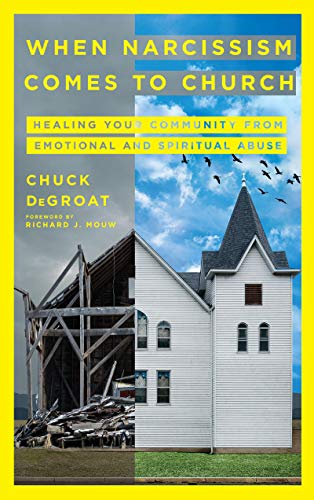
A Surprising Hope: Review of When Narcissism Comes to Church by Chuck DeGroat

To my mind, Chuck DeGroat’s When Narcissism Comes to Church (IVP, 2020) was published at precisely the right time. I say that because it’s a book I would have snatched up a decade ago had it been available, given the situation I found myself in at the time, but I would not have been emotionally prepared to fully appreciate. The intervening years, I realized as I read the book recently, have softened me up to many of the conclusions DeGroat draws and positions he contends for, most notably in calling us all to identify and empathize with the narcissistic personality.

DeGroat, to his credit, sees the narcissist as so much more than a label, and in fact highlights small and large ways that such analysis can dehumanize and—ironically enough—perpetuate the troubling thought and heart patterns at the root of the narcissism we think we despise. Most impressive about DeGroat’s work is that he carefully balances penetrating insight into the nature of narcissism and the damage it does (to individuals and communities) with a generous compassion for all involved. Ultimately, he demonstrates that these two postures are not at odds but are intimately intertwined, given the locus of narcissism in shame and trauma all its own.

Ultimately, the promise of DeGroat’s book is the promise of Christianity applied to what often seems an irremediable condition. If the gospel is true, then no human being is outside the reach of grace, DeGroat compellingly insists and beautifully depicts. If the gospel is true, then redemption is not a zero-sum game, available for only one segment of humanity at the expense of another. And if the gospel is true, we must not deny the reality and destructive power of sin but instead face it squarely and surrender to Jesus as “the living antidote to narcissism” (167), a sentiment that in DeGroat’s hands transcends what might otherwise be dismissed as cliche.

My interest in the book’s topic stems, among other things, from an abusive friendship that ended long ago. I’m no therapist and have no background in psychology or counseling, but “toxic narcissist” is the label I eventually landed on as a way to understand my traumatic experience with this person. All the literature I have read on the subject fits the patterns I endured: the mercurial spirit, the entitlement, the belittling and callous control. It was soul-crushing. The insights offered in the work of experts like Leslie Vernick and Lundy Bancroft provided a means of escape, self-protection, and hope for recovery.

It has been a decade since I broke free from that dysfunctional relationship, and I have experienced much healing during that time. I think, though, the success of that process required a measure of callousing my heart to my abuser. For far too long, I had (unwisely) made myself vulnerable to this (unsafe) person and my empathy for the traumatic childhood she had endured was manipulated to keep me under her thumb. Escaping the clutch of her machinations was possible only by building up strong boundaries, perhaps even overcompensating for my prior lack of them.

So when I picked up DeGroat’s primer on narcissism, especially as it is manifested in the church, I expected more of the same—a rundown of narcissistic personality traits, a guide to recognizing narcissistic abuse, and tips for recovery from such trauma. When Narcissism Comes to Church has all that, and it is particularly helpful for identifying ways in which Christian organizations and churches have specific susceptibilities to narcissistic personalities and dynamics. The spiritual mission can be quite the cudgel, and theological truths like sin and forgiveness are often flattened out to fit an abuser’s agenda. When Narcissism Comes to Church fills in helpful context for better understanding the many ways narcissism sadly finds an easy fit in Christian circles. Born from DeGroat’s twenty-plus years as therapist and church-planting assessor, it offers hard-won and practical wisdom, complemented by myriad examples drawn from his study and practice. This is not merely abstract theoretical knowledge about abstruse psychological categories but guidance for real life.

As DeGroat explains in his introduction, there has been an uptick in narcissistic tendencies on a cultural level, and so his concern in what follows is not simply to nail narcissists to the proverbial wall with a restrictive diagnosis or to separate out the abusers and the victims, the bad guys and the good. No, his goal instead is to “invite each of us to ask how we participate in narcissistic systems while providing clear resources for those traumatized by narcissistic relationships, particularly in the church” (4).[1] He does so through appeal to psychiatric diagnostic tools, to the Enneagram (an approach unique to him), to a wealth of counseling resources, to the Church Fathers, and to scripture.

The book traverses much ground: from defining narcissism (while also complexifying the definition), to showing the tremendous range of the narcissistic spectrum and the myriad ways narcissism can present itself, to unpacking characteristics of the narcissistic leader and system, to diagnosing the wounds and shame at the heart of the narcissistic personality and sketching the contours of abuse, and to offering pathways to healing for the narcissist and those wounded by him or her. DeGroat does all of this in less than 200 pages. It is an accessible book, and the author’s background enables him to wrangle otherwise dense and difficult material into a clearly organized presentation, hitting the most important highlights and illustrating key ideas with memorable and poignant examples.

This is a must-read for anyone interested in learning more about narcissism and emotional and spiritual abuse, and even more so for those in Christian communities. As DeGroat explains, we are charged in scripture to be diligent, to “keep watch” and do what he calls “shadow work” to root out unhealthy strongholds and to inculcate habits of flourishing. The material he provides in this book, though not exhaustive, will certainly be a starting point for anyone wanting to undertake this journey and, in fact, will encourage them to do so.

When Narcissism Comes to Church is not primarily a reference manual, though in some ways it is that; rather, it paints a beautiful picture of hope. Bookended by references to Philippians 2, DeGroat’s volume undermines the theological manipulations often employed by the narcissist in Christian circles. Paul’s call to humility, in imitation of Christ’s kenotic move to dwell among us, could easily be twisted by an abusive personality or system—burdening the disempowered to become even more powerless in service of the authoritarian leader or toxic organization. “Don’t expect to get what you deserve,” such voices might say. “Be obedient and surrender to the leader’s authority, no matter how capricious or unjust.” Those who have been beholden to such figures recognize well how easily truths of scripture can be wielded as weapons.

But by holding the passage from Philippians as a standard for all Christians and especially by emphasizing the promise of the Incarnation depicted there, DeGroat defangs the narcissist’s bite. The humility and condescension of Christ of course stands in stark contrast to the narcissist’s grandiosity and self-centeredness, but it also vividly displays the beauty and love of Christ’s participation in our sufferings and the paradoxical power enacted by his sacrifice. Christ beckons us to love like that. Even more importantly, his love enables us to love the otherwise unlovely and—gloriously enough—to transform the unlovely into someone beautiful and fully alive.

This review cannot do justice to the richness of DeGroat’s conclusions, especially his final chapter and epilogue. As a survivor of narcissistic abuse, to my surprise, I was deeply moved by his generous call to love, to identify with our fellow image bearers no matter where they fall on the narcissistic spectrum, and to seek healing holistically and communally. As DeGroat himself notes, this may be too challenging a charge for the moment for those still dealing with the aftermath of narcissistic trauma.

But for those who can, for those who have done the inner work and can enter in from a position of strength, DeGroat invites us on a journey from slavery to freedom, of death to life, of despair to hope. We would be wise to join him.


[1] This is the kind of thing I would have bristled at a decade ago, especially since I would have had a hard time seeing past the invitation to examine my complicity in my narcissistic relationship. It may even have set back my healing. But this side of that healing process, I can now more than see the wisdom of DeGroat’s call.


5007424.jpg

Marybeth Davis Baggett teaches English at Houston Baptist University. Having earned her Ph.D. in English from Indiana University of Pennsylvania, Marybeth’s professional interests include literary theory, contemporary American literature, science fiction, and dystopian literature. She also writes and edits for Christ and Pop Culture. Her most recent publication was a chapter called “What Means Utopia to Us? Reconsidering More’s Message,” in Hope and the Longing for Utopia: Futures and Illusions in Theology and the Arts. Marybeth's most recent book is The Morals of the Story: Good News about a Good God, coauthored with her husband, David.

Does the Incommensurability of Prudential and Impartial rationality avoid the dualism of Practical Reason?

Does the Incommensurability of Prudential and Impartial rationality avoid the dualism of Practical Reason.png

Editor’s note: This article was originally posted at MandM. It has been posted here with permission of author.


I have been discussing the dualism of practical reason. As I understand it, this is an inference from three premises:

[1] We always have most reason to do what is morally required

[2] An act is morally required if and only if it is impartially demanded: demanded by rules justified from a perspective of impartial benevolence.

 [3] If there are cases where, what is impartially demanded of a person, is an action contrary to their long-term self-interest, then the strongest reasons do not always favour what is impartially demanded.

The conclusion: unless we assume that requirements of self-interest never substantially conflict with impartial demands, we can only coherently affirm [1] and [2]. Seeing [1] is a plausible thesis about the authority of requirements, and [2] is a plausible thesis about their content.  Our fundamental moral intuitions about morality cannot be reconciled.

One response to this argument is to deny [3]. This involves contending that impartial requirements are overriding: If impartial and prudential requirements clash, the former always take precedence. In my last post, I mentioned an argument made by Stephen Layman against this contention.   Layman asks us to consider the case of Ms Poore;

Stephen Layman

Stephen Layman

Ms. Poore has lived many years in grinding poverty. She is not starving, but has only the bare necessities. She has tried very hard to get ahead by hard work, but nothing has come of her efforts. An opportunity to steal a large sum of money arises. If Ms. Poore steals the money and invests it wisely, she can obtain many desirable things her poverty has denied her: cure for a painful (but nonfatal) medical condition, a well-balanced diet, decent housing, adequate heat in the winter, health insurance, new career opportunities through education, etc. Moreover, if she steals the money, her chances of being caught are very low, and she knows this. She is also aware that the person who owns the money is very wealthy and will not be greatly harmed by the theft. Let us add that Ms. Poore rationally believes that if she fails to steal the money, she will likely live in poverty for the remainder of her life. In short, Ms. Poore faces the choice of stealing the money or living in grinding poverty the rest of her life. In such a case, I think it would be morally wrong for Ms. Poore to steal the money; and yet, assuming there is no God and no life after death, failing to steal the money will likely deny her a large measure of personal fulfillment, i.e., a large measure of what is in her long-term best interests[1].

Layman takes this case to illustrate that impartial requirements are not overriding.  If there are cases where impartial demands require us to make a great sacrifice that confers relatively modest benefits on others, the strongest reasons do not support complying with impartial demands.[2] 

Peter Bryne has criticised Layman’s example. He writes:

Layman’s way of approaching his moral argument suggests the following picture: rational agents are aware of a variety of reasons for action. They see prudential reasons vying with moral reasons. They measure whether moral reasons for doing something outweigh prudential reasons for not doing it, and they follow that set of reasons which is stronger overall. Now it is time to ask the question “From what standpoint does Layman’s rational agent weigh or measure reasons for action?[3] 

Bryne thinks this is question raises an important challenge:

The unclarity in the language of weighing reasons for action, and of judging which reasons are stronger than others, lies in the fact that such language implies a common, neutral means of measuring the reasons. The very contrast, however, between morality and self-interest suggests that there can be no such means. The agent is faced with a choice between points of view and perspectives. From within a point of view or perspective, there can be weighing. What remains a mystery is how any agent could measure the relative strengths of the two kinds of consideration from neither the moral or prudential point of view but from a neutral standpoint.[4]

Bryne’s criticism seems to be this. Layman example imagines an agent “weighing” impartial reasons against prudential reasons against each other and attempting to answer the question as to which reasons are stronger or take precedence. This implies there is some rational perspective, which is neutral between prudence and impartial demands, which can weigh and adjudicate them in a conflict. 

Bryne thinks this is misleading. The clash between prudential and impartial reasons involves a clash between requirements justified by incommensurable points of “points of view” or “perspectives”. These points of view are perspectives on what interests to take into account and how much weight to give them. The impartial point of view is a perspective that takes into account everyone’s interests and forms a conclusion based on giving these interests equal weight and consideration. From this point of view, you always have decisive reasons to do what is impartially required. By contrast, the prudential point of view is a view that only gives takes into account the interest of the individual agent and gives equal weight to the future and past interests of this individual agent. From this perspective, you should always act in your long-term self-interest. 

Because these are differing perspectives on what interests to take into account and how much weight to give conflicting interests, there can be no question-begging way of weighing the conclusions of each procedure against each other. You can weigh reasons for and against actions in accord with one or more of these perspectives. You can have allegiance to one or both perspectives, and weigh from that perspective. One can also give up allegiance to one perspective in favour of another. But, when they clash, you cannot accept both perspectives simultaneously and weigh them against each other. 

I am inclined to think Byrne’s response here misses the point. Consider how Ms Poore’s case appears on Bryne’s analysis. Ms. Poore “faces the choice of stealing the money or living in grinding poverty the rest of her life”. However, you analyse this; she still has to choose what to do in this situation; she must act one way or the other. In Bryne’s terms, we can ask Which perspective should she use in making the decision and weighing the relevant factors. Which point of view should she give allegiance to? Which should she give up allegiance to? Bryne’s analysis seems to imply there is no reason one can give for or against either answer. There is no “rational” or “neutral point of view” by which she can make this choice. The implication is that Ms Poore does not have stronger or weightier reasons to do what is impartially required. This isn’t because prudential reasons sometimes outweigh or trump impartial reasons, but because one cannot coherently claim one is weightier than the other without begging the very question at issue. 

Concerns about the dualism of practical reason are concerns about a specific sort of practical dilemma. Suppose it is not always in one’s long-term self-interest to act according to impartial demands. This will mean impartial demands sometimes come into conflict with prudential requirements. When they do, we face the question: What reason is there to act impartially, rather than in one’s self-interest. What reason do we have for assuming that impartial demands are always stronger or weightier than prudential requirements when the two clash? The concern is that no answer to this question is forthcoming. If impartial and prudential requirements cannot be weighed against each other, then its hard to see how the former can always be weightier or take precedence in a clash. If they are incommensurable, we cannot have reasons for preferring one to the other.

Several commentators argue that this is precisely Sidgwick’s point when he agonised over the dualism of practical reason[5]. Note the argument Sidgwick gives for [3]

[U]nless the egoist affirms, implicitly or explicitly, that his own greatest happiness is not merely •the rational ultimate end for himself but •a part of universal good; and he can avoid the ‘proof’ of utilitarianism by declining to affirm this. Common sense won’t let him deny that the distinction between himself and any other person is real and fundamental; so it puts him in a position to think: ‘I am concerned with the quality of my existence as an individual in a fundamentally important sense in which I am not concerned with the quality of the existence of anyone else’; and I don’t see how it can be proved that this distinction ought not to be taken as fundamental in fixing the ultimate goal of an individual’s rational action… If an egoist isn’t moved by what I have called proof, the only way of arguing him into aiming at everyone’s happiness is to show that this gives him his best chance of greatest happiness for himself. And even if he admits that the principle of rational benevolence is self-evident, he may still hold •that it is irrational for him to sacrifice his own happiness to any other end;[6] 

Here, Sidgwick imagines an “egoist”: someone who has “given allegiance” to the prudential point of view and weighs reasons in accord with this perspective. This egoist discovers that an impartial point of view would prohibit some action. Does the egoist have any reason to heed this prohibition? Sidgwick argues that, unless it can be shown that doing so is in his interest, the answer is no. From the egoist’s “perspective” or “point of view,” the effects of the action on his long-term interests is the only factor that carries weight in the decision. Providing does not implicitly give allegiance to an impartial point of view, or he is willing to give up any allegiance he does have to it; he will have no reason to do what is impartially required. Nor does he have any question-begging reason why he should switch allegiance to this point of view. 

On this interpretation: the dualism of practical reason is the problem that impartial and prudential requirements are requirements justified from incommensurable points of view. Because human beings recognise both prudential and impartial reasons for acting in their practical reasoning, they implicitly give allegiance to both. This is not a problem if their requirements are consistent. But if they contradict each other, we will be rationally committed both to both doing and not doing the same action. The incommensurability of these perspectives means there is no rational basis for resolving the contradiction in favour of impartiality. Sidgwick writes:

[W]here we find a conflict between self-interest and duty, practical reason, being divided against itself, would cease to be a motive on either side. The conflict would have to be decided by which of two groups of non-rational impulses had more force. So we have this: •The harmony of duty and self-interest is a hypothesis that is required if we are to avoid a basic contradiction in one chief part of our thought.[7]

We can put it this way: Either prudential and impartial reasons are commensurable, or they are incommensurable. If they are commensurable, then when these requirements clash, we will need some reason for thinking that impartial reasons are always weightier. The Ms Poore case suggests this is not the case. By contrast, suppose that prudential and impartial requirements are incommensurable perspectives, and we cannot weigh them against each other. If they clash, we will have to choose which perspective to follow, and we will have no reason to follow one or the other. It will simply be an arbitrary act of allegiance. Either way, we will lack decisive reasons always to do what is impartiality required.

[1] C. Stephen Layman “God and the Moral Order” Faith and Philosophy, 23 (2006): 307

[2] Layman, “God and the Moral Order” 308

[3] Peter Bryne “God and the Moral Order: A Reply to Layman” Faith and Philosophy, 23:2 (2006): 201

[4] Bryne, “God and the Moral Order: A Reply to Layman” 206-207:

[5] See for example, Derek Parfit On What Matters (Volume 1) (Oxford: Oxford University Press : 2011) 130-134. See also Francesco Orsi, “The Dualism of the Practical Reason: Some Interpretations and Responses” Etica & Politica / Ethics & Politics, 10:2 (2008): 25-26

[6] Henry Sidgwick, The Method of Ethics, 242 available at https://www.earlymoderntexts.com/assets/pdfs/sidgwick1874.pdf accessed 20/3/21

[7] Henry Sidgwick, The Method of Ethics, 284 available at https://www.earlymoderntexts.com/assets/pdfs/sidgwick1874.pdf accessed 20/3/21


Matthew Flannagan

Dr. Matthew Flannagan is a theologian with proficiency in contemporary analytic philosophy. He holds a PhD in Theology from the University of Otago, a Master's (with First Class Honours), and a Bachelor's in Philosophy from the University of Waikato; he also holds a post-graduate diploma in secondary teaching from Bethlehem Tertiary Institute. He currently works as an independent researcher and as teaching pastor at Takanini Community Church in Auckland, New Zealand.

Lord's Supper Meditation: Holy Boasting

A Twilight Musing  

The idea of "boasting in the Lord" (as in I Cor. 1:31) seems a bit contradictory at first, but we should note that it is quoted by Paul from an Old Testament source (Jer. 9:24) to conclude a discourse on how God uses the weak and despised things of this world to show His glorious power.  So it is that "Christ crucified [is] a stumbling block to Jews and foolishness to Gentiles, but to those whom God has called . . . the power of God and the wisdom of God" (I Cor. 1:23-24).  So this "boasting in the Lord" is a way of exulting in what God has done in us, but with the focus on Him, not on ourselves.

"Holy boasting," then, is an antidote to human boasting. As in most cases in which God forbids a behavior, He offers a contrasting alternative that, if followed, will shed the light of God on the forbidden action and drive it out by showing it to be shabby and worthless.  So instead of fleshly boasting which spotlights our puny achievements or our pumped-up status in order to convince others that we deserve their admiration and approval, we focus on the flawless reality of what God has gloriously done, in spite of our weakness and lack of merit. 

Such "holy boasting" is particularly appropriate to our partaking of the Lord's Supper.  We "boast in the cross" (Gal. 6:14), as Paul says, so that in partaking of the Lord's Supper, we relinquish any pretense to our own righteousness and in loving wonder acknowledge Jesus' death that alone can make us righteous before God.

We are thereby released from the inherent insecurity of depending on our own efforts to be successful, which can be achieved only through the continual maintaining of an image and an illusion.  As we "boast" in what God has done with our weakness, we rejoice in the undeserved reflected glory that we share with Christ as His bride.  In embracing what He has done with our weakness, we rejoice at being crucified with Him, because that experience is the avenue to life.

Let us then glory in the cross, which is the unlikely instrument through which God has accomplished our salvation.  He has transformed the broken body and the shed blood of Christ into life eternal for us.


Elton_Higgs+(1).jpg

Dr. Elton Higgs was a faculty member in the English department of the University of Michigan-Dearborn from 1965-2001. Having retired from UM-D as Prof. of English in 2001, he now lives with his wife in Jackson, MI. He has published scholarly articles on Chaucer, Langland, the Pearl Poet, Shakespeare, and Milton. Recently, Dr. Higgs has self-published a collection of his poetry called Probing Eyes: Poems of a Lifetime, 1959-2019, as well as a book inspired by The Screwtape Letters, called The Ichabod Letters, available as an e-book from Moral Apologetics. (Ed.: Dr. Higgs was the most important mentor during undergrad for the creator of this website, and his influence was inestimable.

Elton Higgs

Dr. Elton Higgs was a faculty member in the English department of the University of Michigan-Dearborn from 1965-2001. Having retired from UM-D as Prof. of English in 2001, he now lives with his wife and adult daughter in Jackson, MI.. He has published scholarly articles on Chaucer, Langland, the Pearl Poet, Shakespeare, and Milton. His self-published Collected Poems is online at Lulu.com. He also published a couple dozen short articles in religious journals. (Ed.: Dr. Higgs was the most important mentor during undergrad for the creator of this website, and his influence was inestimable; it's thrilling to welcome this dear friend onboard.)

Forsaken: An open letter to American military veterans as Afghanistan falls

Sunday, August 15th, 2021

Dear fellow Operation Enduring Freedom veteran,

This letter is a “buddy check,” as we call it – the act of reaching out to make sure someone else’s head is still above water. I have turned off the news and hope you have, too. We do not need to see more photos of places we walked, or of our equipment being taken over by terrorists, or of desperate people falling to their deaths as they attempt to hold onto the outside of departing freedom flights. We know what Afghanistan looks like, what it smells like. We were there.

As I watch Afghan towns and provinces tumble to the Taliban like so many dominoes, I vacillate between anger and depression. I feel hopeless. I am resentful that of the thousands of images I keep in my mind, our presence there is now forever symbolized by another Chinook evacuating an embassy. I am in despair over a war that has marked my entire adult life (I received my offer of appointment to the U.S. Naval Academy on September 11th, 2001) ending with ghost faces, names, and places rolling through our collective mind. While we achieved our stated objective of denying a terrorist safe haven, preventing another 9/11 every single day for 20 years, the general public does not understand the importance of that objective, or in any way see victory. I feel isolated from everyone who did not serve in Operation Enduring Freedom (OEF) or a war like ours.

In short, I grieve. We grieve together.

The chaos in which OEF is ending constitutes to many of us a violation of what we believe to be moral obligations. We feel obligation to uphold ideals of freedom and victory, to defend what is right and just. We feel obligation to our brothers and sisters in arms, especially those lost or injured. We feel obligation to our families, left alone so we could go overseas. Most of us report feeling obligation to protect the innocent; not to the extent that we remain in a state of foreign conflict indefinitely, but sufficient to orchestrate our departure from the battlefield in such a way, and on such a timeline, that honors the realities of the situation on the ground and does its best to protect those not a part of atrocities. In a “low-intensity conflict,” as scholars call our 20 years in Afghanistan, troops became more significantly enmeshed with locals than do fighters in more compressed wars. As a result, we all have memories of innocents, usually women and children. They are being slaughtered now, and we know it, and it hurts.

014.jpg

People removed from the war tend to get caught up in political conversations about whether we should have been there in the first place, but once there, none of that matters. This is our war, now, and the outcome is personal. I have spoken with more than a few OEF veterans this week who say in no uncertain terms that they hold the present slaughter of Afghan nationals by the Taliban to be our fault for a seemingly unplanned withdrawal; they use words like “disgrace” to describe the blood they see on our hands. Foreign area officers and linguists who spent years becoming equipped to work in Afghan culture use terms like “absolute guilt” as they offer apologies to the Afghan people on social media. Personal texts are peppered with shared pictures of children we once knew and pictures of us with our interpreters, with comments asking if we think they are still alive. Some of us are hearing directly from our Aghan counterparts; their fear for themselves and their families is thick and comes to rest directly on our hearts.[1]

So, what can we do?

“You have to focus on the cross,” my father told me this morning over breakfast. He has fought in many places, all over the world.

“I know,” I replied. “But it doesn’t help with the sadness or the anger.”

“No, it doesn’t,” he answered. “But focusing on the cross keeps your head above water. Remember how your grandfather fought, first World War II, then Korea, then Vietnam? I’ll never forget 1975. The day the U.S. left Saigon was a bad day. I saw in him every emotion you describe, and the faces of the dead in his eyes. Keep your eyes on the cross, even if that’s the only part of you above water.”

The thing about my father’s advice, frustratingly simple though it may seem at first receipt, is that it is true. From our current position treading water in vast pools of mental, emotional, and spiritual pain, if we look at the cross, we see a man. That man has been tortured, abused, literally crucified. That man, from his own point of view, has been forsaken, and his last human words on this earth are to ask why.

Why would an all-knowing God allow for such pain to be inflicted upon his only begotten Son? Perhaps, perhaps for such a time as this. Perhaps so we know we are not alone. Perhaps so we can walk behind one who knows our sorrows, who will carry them for us. One who, under the weight of pain greater than we can imagine or could bear, rose again. One who felt alone.

Here is the truth, stripped of all pretense, from one veteran to another – the sight and knowledge of Jesus Christ, who felt forsaken, is cause for hope. The might and glory of our Lord is such that he knew we would at times feel abandoned by him, and his son took on the weight of even that pain. You may feel lost now. You may doubt. You may want to scream at God. So, scream. Sob. Curse. Beg. He’s heard it before. Bring all to the feet of him who felt forsaken, as we do now.

Keep your eyes on the cross. Christ’s story does not end there, and neither does ours.

With prayers for Afghanistan, the Afghan people, our allies, our families, and ourselves,


Jan


P.S.  Don’t know what to do? Hydrate. Circle the wagons, watch each other, watch yourselves. Pick up the phone when a brother or sister calls, answer the texts, hit the gym, sleep the best you can, read great books, eat fresh food.

Onward. For the next mission - Joshua 24:15.


[1] I believe that what we are experiencing now, standing together as veterans in common experience of Afghanistan one last time, is a group occurrence of moral injury. The Department of Veterans Affairs (VA) defines moral injury this way: “In traumatic or unusually stressful circumstances, people may perpetrate, fail to prevent, or witness events that contradict deeply held moral beliefs and expectations… Moral injury is the distressing psychological, behavioral, social, and sometimes spiritual aftermath of exposure to such events.”  "Guilt" and "shame" are key words in nearly any working definition of moral injury. Moral injury is something apart from post-traumatic stress disorder (PTSD) and must include consideration of the spiritual and the ethical to heal. More to come on this topic in another article.


Jan Shultis headshot.jpg

Jan Shultis is a Naval Academy graduate, author of two books, and Associate Editor at moralapologetics.com who plans to pursue her DMin at Houston Baptist University. After 14 years in uniform serving around the U.S. and in Afghanistan, she founded a faith-based non-profit focused on veterans, law enforcement, first responders, and families that supports warriors in need throughout Texas, with a special focus on ministry in local courts and jails. Jan brings to the Moral Apologetics team additional professional experience in biotechnology, public relations, and ethics curriculum development. Jan shares that she is extremely excited to spearhead the Center’s innovative exploration of the organic connections between moral apologetics and moral injury, including but not limited to military veterans. She is local to Houston and looks forward to contributing to the Center’s robust on-campus presence at HBU

Book Review of Wade Mullen’s Something’s Not Right: Decoding the Hidden Tactics of Abuse and Freeing Yourself from Its Power

In a dark time in my life, I found myself angered, hurt, and heartbroken by the type of experiences that I had encountered in a previous institution. Like many people, I had been hurt in church before. But I never experienced as much difficulty in finding healing. Drs. David and Marybeth Baggett were God-sent to help me find a pathway to healing. They ministered to me and expressed their concern for the hurt that I was feeling. Marybeth mentioned a couple of books that I might find interesting. One was a work by Wade Mullen entitled Something’s Not Right: Decoding the Hidden Tactics of Abuse and Freeing Yourself from Its Power. The book proved extremely beneficial to me as it explained the hurt that I had experienced. I realized that I was not alone. For the remainder of this article, I would like to provide a review of Mullen’s work. First, I will offer a summary of Something’s Not Right, then I will identify the strengths of the book, before concluding with some personal reflections.


Summary

Wade Mullen writes for those who have suffered from institutional abuse and for those who think they may be currently experiencing it. Mullen writes from his own dealings with it, having suffered from his own encounters with institutional abuse. Mullen reflects that he knew that something was not right (hence, the title of the book), but neither he nor his family had suffered from sexual or physical abuse.[1] Yet it was clear to him that he and his family had suffered some form of abuse. He later realized that he had suffered from institutional abuse—that is, suffering from the oppressive and bullying nature of organizations that permit narcissistic dictators to emotionally harm those under their care.

By Mullen, Wade

Mullen draws his argument from the field of impression management and the research of Erving Goffman. Goffman defines impression management as the process of “creating, influencing, or manipulating an image held by an audience.”[2] Making a comparison to a stage play, the author contends that impression management tactics take on an abusive and unethical nature when “the front-stage persona is used to hide truths that ought not to be hidden.”[3] The actor(s) adjust the performance when problems arise to keep the audience engaged but never attempt to resolve the inner problems, or actors, causing the abuse. Everything becomes much more about image than character.

Mullen further inquires, why do institutions and individuals, though they may have begun with good intentions, operate in such a manner? The answer is simple: power. Mullen contends, “The chief desire of abusive individuals and organizations is to attain or retain power—most often the kind of power gained and held firm through deception.” Through the remainder of the book, Mullen describes the tactics by which abusers use impression management to attain or retain their power. He identifies the use of charm, dismantling the victim’s internal and external world, intimidation used to silence victims, walls of defense,[4] disingenuous apologies to save the image of the abuser or institution,[5] and demonstrations.[6]


Strengths

Mullen’s book is a much-needed resource due to the rising number of institutional cases of abuse. His book features numerous strengths. But for the sake of space, we will consider three. First, Mullen provides compelling examples of institutional abuse. Some may wonder whether institutional abuse even, exists, but, in a clear and winsome fashion, Something’s Not Right exposes the problem of institutional abuse and offers examples to show its malevolent practice. In the pages of Mullen’s book, the reader may find oneself reflecting on personal examples of the very practices that Mullen describes. The book is relevant for those who have suffered from abuse in the church, universities, businesses, and other institutions. Earnest readers will be left with a clear depiction of the reality of institutional abuse.

Second, Mullen exposes the methodology of institutional abuse. The illustration of a stage play is quite telling as it covers the array of organizations that may be guilty of abuse. Quite to the point, institutions that permit abuse do not desire to expose the interior problems. Some may conclude that the institution does not want to expose skeletons in the closet. Yet when those skeletons are permitted to continue to harm, they need to be exposed if institutional healing is to take place, the abuse is to be eliminated, and the victims healed. Abusive institutions are more concerned with image than character.

Finally, the book diagnoses the root moral problem behind institutional abuse. Simply put, the assignment of primacy to self-serving power drives people within institutions to abuse individuals. Such power also drives institutions to permit such behavior as the institution desires to perpetuate its influence in the community. Unrestrained power is not concerned with a utilitarian ethic, neither is it concerned with the wellbeing of others. Rather, Mullen shows that those whose primary or only ethical standard is acquisition and consolidation of power will only be concerned with what others can do to help retain their status or position. Readers should be driven to promote transparency within the establishments with which they are associated. Institutions that have nothing to hide will not mind sharing their internal workings.


Reflections

Two critiques can be offered at this point. First, it is possible that genuine repentance could come while trying to salvage the institution in question. While I fully agree with Mullen’s concerns about institutions trying to sweep former events under the rug, I also believe there comes a point that the institution and person must move on from events that occurred. While the abusive situation should never be forgotten, rehashing scandals of the past can prove harmful to the person who was victimized. Particularly for those suffering from PTSD, continual discussions of past harms and abuses can prove detrimental to the victims, just as much as not discussing them enough. Delicacy and discernment are the needed antidote.

For instance, with the greatest of intentions, I continued talking to a couple who suffered from mental impediments about safeguarding themselves from people who tried to take advantage of them financially. They had previously been persuaded to buy a computer that was well out of their price range and, quite honestly, was not worth the price. While my intentions were noble, my continued discussions brought back the pain of their victimization. Thus, an institution needs to do everything possible to make amends for abusive behaviors and resolve systemic problems permitting abuse to occur. But there might come a point at which further dwelling on past wrongdoings reaches a point of diminishing return.

Second, Mullen’s work raises the matter of forgiveness. It is not his main focus here, although he does end the book with a section on it. It obviously is a highly important matter, as Mullen would be the first to agree. One issue concerning forgiveness is what happens if the guilty party never asks for forgiveness? An abuse victim’s exit from the situation of abuse is important, but what about this matter of forgiveness when there isn’t repentance? Such a scenario is, sadly, not uncommon. Abusers more often make excuses for their abusive behaviors than come clean, repent, and ask for forgiveness.

What can an abused person do spiritually if reconciliation with the abuser doesn’t happen? The biblical answer is that a forgiving stance is still required. Jesus pleaded for the forgiveness of those who were crucifying him (Luke 23:34). This kind of forgiveness does not mean that the abuser and abusive systems are never held accountable for his or her actions. Abusive institutional and systemic systems must be corrected and reformed, as evidenced by Jesus’s overturning of the tables in the temple. Again, forgiveness most certainly does not indicate that a person remains in an ongoing abusive situation. Remember, Jesus told the disciples to wipe the dust off their feet while leaving a town that rejects them (Luke 10:10-11).

Still, forgiveness is vitally important, and it is just as much about one’s walk with God and peaceful mindset as it is for the guilty party. As someone once said, “Holding a grudge is like trying to poison another by drinking the poison yourself.”

In the context of chronic and acidic abuse, however, it is also important to remember that abusers, especially within religious contexts, are often adept at exploiting the rhetoric of forgiveness and “moving on” to conceal their culpability, avoid accountability, and sometimes even perpetuate abuse. So while we must endeavor to retain a forgiving stance, forgiving others as we have been forgiven, we must also resist disingenuous efforts by abusers to wrap the cloak of religious legitimacy around efforts to evade responsibility and continue mistreatment under a new, and perniciously religious, guise.


Conclusion

Wade Mullen’s book Something’s Not Right is a must-read. I give the book five stars out of five. The book effectively illustrates the abusive tactics found in unhealthy organizations while also recognizing the importance of spiritual healing. More cases of institutional abuse are being revealed in churches, universities, and denominations. To counter the abuse, one needs to first recognize unhealthy patterns found within institutions as well as practices by abusive individuals. Mullen’s work will prove to be an essential tool in doing just that. Regardless of whether you have suffered abuse, suspect abuse, or desire to know more about institutional abuse, Mullen’s book is a tour de force on the topic. I would suggest supplementing Something’s Not Right with Diane Langberg’s work Redeeming Power. Additionally, I would also recommend Os Guinness's book God in the Dark along with In Search of a Confident Faith, co-written by J. P. Moreland and Klaus Issler, to learn more about overcoming barriers to faith after being victimized by abusive power structures.

About the Author


Brian G. Chilton is the founder of BellatorChristi.com, the host of The Bellator Christi Podcast, the author of the Layman’s Manual on Christian Apologetics, and a Ph.D. Candidate of the Theology and Apologetics program at Liberty University. He received his Master of Divinity in Theology from Liberty University (with high distinction); his Bachelor of Science in Religious Studies and Philosophy from Gardner-Webb University (with honors); and received certification in Christian Apologetics from Biola University. Brian is a member of the Evangelical Theological Society and the Evangelical Philosophical Society. Brian has served in pastoral ministry for nearly 20 years and currently serves as a clinical chaplain, an editor for the Eleutheria Journal, and an Associate Editor for MoralApologetics.com.

https://www.amazon.com/Laymans-Manual-Christian-Apologetics-Essentials/dp/1532697104


[1] Wade Mullen, Something’s Not Right: Decoding the Hidden Tactics of Abuse and Freeing Yourself from Its Power (Carol Stream, IL: Tyndale Momentum, 2020), 1.

[2] Ibid., 9; Erving Goffman, The Presentation of Self in Everyday Life (New York, NY: Anchor, 2008).

[3] Mullen, Something’s Not Right, 12.

[4] The four walls of defense include denials, excuses, justifications, and comparisons. Ibid., 102.

[5] This includes the unwillingness to condemn the abuser’s actions, appeasing the situation, excusing behavior, justifying one’s own actions by claiming that the victim in some ways bears the burden of guilt, self-promotion, and sympathy. Ibid., 149.

[6] Demonstrations include actions that does only what is necessary to survive that scandal rather than making amends for the abuse that occurred. Ibid., 162.

What Makes Something Morally Good or Bad? Why a Trinitarian Metaethic Better Explains Morality (Part 5)

Editor’s note: Adam Johnson has graciously allowed us to republish his video series, “What Makes Something Morally Good or Bad?” Find the original post here.


Part 1
Part 2
Part 3
Part 4

Adam believes that his Trinitarian Moral Theory is a better explanation for the existence of objective morality than Erik Wielenberg’s theory of Godless Normative Realism. Why does Adam think his theory is better? The Trinitarian Moral Theory contains five elements that are important for moral truth to be objectively real that Wielenberg’s theory lacks. First, the Trinitarian Moral Theory posits the existence of an ultimate moral standard, God, to which humans can be compared. Second, it offers an objective purpose for human beings that contextualizes morality. Third, it provides a social context for moral obligation, since moral obligations arise out of social relationships. Fourth, it recognizes a personal authority at the head of the chain of moral obligation to whom human beings are obligated. Finally, it grounds all moral truth in an ultimate foundation. Taken together, these features of the Trinitarian Moral Theory make it a more plausible explanation for objective morality than Wielenberg’s theory.


Adam-Lloyd-Johnson-pic-2019-2-e1597088389465.jpg

Adam Lloyd Johnson serves as a university campus missionary with Ratio Christi. He also teaches classes for Midwestern Baptist Theological Seminary and spends one month each year living and teaching at Rhineland Theological Seminary in Wölmersen, Germany. Adam received his PhD in Theological Studies with an emphasis in Philosophy of Religion from Southeastern Baptist Theological Seminary in 2020.

What Makes Something Morally Good or Bad? Adam Lloyd Johnson’s Trinitarian Moral Theory (Part 4)

Copy of Untitled.png

Editor’s note: Adam Johnson has graciously allowed us to republish his video series, “What Makes Something Morally Good or Bad?” Find the original post here.


Part 1
Part 2
Part 3

Adam has proposed his own metaethical theory, a theory about where morality comes from, which builds on the foundation of Divine Command Theory. He calls it the “Trinitarian Moral Theory” because it holds that morality is based on the loving relationships within God between the members of the Trinity. God is love, and His love is the source of moral values and duties. Adam believes that his Trinitarian Moral Theory, which is uniquely Christian, is the best explanation for the existence of objective morality. He thinks that the Trinitarian Moral Theory is true for several reasons. First of all, his theory centers on the Trinity, which is a key aspect of who God is. In addition, focusing on the loving relationships of the Trinity explains why the meaning of life is personal loving relationships, it explains how we can be morally good by resembling God, it explains the purpose of God’s commands, and it explains why there are different types of commands from God.


Adam-Lloyd-Johnson-pic-2019-2-e1597088389465.jpg

Adam Lloyd Johnson serves as a university campus missionary with Ratio Christi. He also teaches classes for Midwestern Baptist Theological Seminary and spends one month each year living and teaching at Rhineland Theological Seminary in Wölmersen, Germany. Adam received his PhD in Theological Studies with an emphasis in Philosophy of Religion from Southeastern Baptist Theological Seminary in 2020.

Meditation on Lord's Supper: The Glory of His Appearing

Communion Meditation – Bread of Earth & Bread of Heaven (2).png

A Twilight Musing

In partaking of the Lord’s Supper each week, we are proclaiming the Lord's death "until He comes" (I Cor. 1; 26).   There has always been much speculation about how and when that will happen, and about what will happen between that appearing and the creation of "a new heavens and a new earth in which righteousness dwells" (II Pet. 3:13).  Two things we do know, however:   First, that Jesus' coming again will have been preceded by centuries of testimony to His death and resurrection, so that as many as possible can participate in the wonderful consummation of being "caught up . . . in the clouds to meet the Lord in the air" to "be with the Lord forever" (I Thess. 4:17).

The public response to the film "The Passion of the Christ" has brought the horrors of Jesus' death once more to the fore for many people; and, indeed, we need to be aware of the enormity of what He suffered.  But at the same time, we need to realize that no suffering is an end within itself, and that Jesus invites us to share in the joy of being brought through suffering to the completeness of redemption which will be experienced at His coming again in all His glory, when He will fulfill His promise to receive His disciples unto Himself (John 14:3). 

The coming of the Lord will end the need for Christ's disciples to celebrate His death, because when Jesus comes again, the object of that death will have been fully accomplished.  Just as Jesus's death was swallowed up in the victory of His glorious resurrection, so will ours.


Elton_Higgs+(1).jpg

Dr. Elton Higgs was a faculty member in the English department of the University of Michigan-Dearborn from 1965-2001. Having retired from UM-D as Prof. of English in 2001, he now lives with his wife in Jackson, MI. He has published scholarly articles on Chaucer, Langland, the Pearl Poet, Shakespeare, and Milton. Recently, Dr. Higgs has self-published a collection of his poetry called Probing Eyes: Poems of a Lifetime, 1959-2019, as well as a book inspired by The Screwtape Letters, called The Ichabod Letters, available as an e-book from Moral Apologetics. (Ed.: Dr. Higgs was the most important mentor during undergrad for the creator of this website, and his influence was inestimable.


Elton Higgs

Dr. Elton Higgs was a faculty member in the English department of the University of Michigan-Dearborn from 1965-2001. Having retired from UM-D as Prof. of English in 2001, he now lives with his wife and adult daughter in Jackson, MI.. He has published scholarly articles on Chaucer, Langland, the Pearl Poet, Shakespeare, and Milton. His self-published Collected Poems is online at Lulu.com. He also published a couple dozen short articles in religious journals. (Ed.: Dr. Higgs was the most important mentor during undergrad for the creator of this website, and his influence was inestimable; it's thrilling to welcome this dear friend onboard.)