Different Bodies: Part One

  A Twilight Musing

I have long been intrigued by the question of how things would have developed had Adam and Eve not eaten of the forbidden fruit and been banished from Eden.  One can exercise some inferential imagination by envisioning a world without the known consequences of sin. Attached to those inferences are some questions: Would Adam and Eve and their descendants have lived forever, absent the penalty of death?  Would the innocence of universal nakedness have continued?  If so, it’s hard for us fallen people to imagine there being no sexual desire except for one’s mate.  God arranged the union between Adam and Eve; how would the monogamous coupling of their descendants have been arranged?  Would reproduction be unlimited?  With no need to produce food by the sweat of their brows, would human beings have been engaged in other activities, such as creative, artistic, and scientific pursuits?

These questions may seem to be idle speculation, but I think they lead into matters of some significance.  All of the questions I have posed above are based on the assumption that there existed in the pristine world of Eden an expectation of purposeful and orderly development over a period of time.  God Himself looks in this direction when He tells the newly-created man and woman, “Be fruitful and multiply and fill the earth and subdue it, and have dominion over . . . every living thing that moves on the earth” (Gen. 1:28).  Things in the original creation were expected to change in ways designed by God to fulfill His nascent purposes for this new world of His.   Since any kind of change requires the observed passage of time, it seems legitimate to infer that there was a kind of positive temporality in the prelapsarian world that in the postlapsarian world became a degenerative penalty.

Perhaps the best way of getting some sense of God’s original plan for Edenic fulfillment is to consider the implications of the two trees placed in the Garden, the Tree of the Knowledge of Good and Evil and the Tree of Life (Gen. 2:9).  We find out after Adam and Eve have eaten from the forbidden tree that God took precautions against their also eating from the Tree of Life.

Then the Lord God said, "Behold, the man has become like one of us in knowing good and evil. Now, lest he reach out his hand and take also of the tree of life and eat, and live forever—" 23 therefore the Lord God sent him out from the garden of Eden to work the ground from which he was taken. 24 He drove out the man, and at the east of the garden of Eden he placed the cherubim and a flaming sword that turned every way to guard the way to the tree of life.  (Gen 3:22-24)

To me, this passage implies that, had Adam and Eve not disobeyed God, there might have been a time for them to partake of both trees under God’s direction.  It seems not unreasonable to conjecture that the Lord wanted unfallen mankind, under His timing and direction, to become aware of the presence of evil in the universe so that He could equip them to partner with Him in the final defeat of that evil, and thereby be ready in the full maturity of their existence to eat of the Tree of Life.

At any rate, I think that God created the physical world as a kind of theater in which to do battle with the Devil.  We have some biblical hints of a battle in Heaven between God and his angels and Satan and his cohorts, in which God by His superior power cast a rebellious Satan down from his exalted position in Heaven (see Ezek. 28:11-19; Rev. 13:7-12).  The most familiar literary rendition of this battle is of course in Books V and VI of John Milton’s Paradise Lost.  Although his narrative of the epic battle in Heaven exercises the privilege of poetic imagination, it nevertheless presents a drama that may very well have taken place in some form before the creation of Eden.  This was a victory of God’s power, but it remained to provide a setting in which Satan could be confronted with the moral superiority of God, which could take place only in an arena where God’s love could be triumphant over Satan’s hate.  Exactly how that would have worked out if the Creation had not been corrupted by human sin, we don’t know, of course; but it’s hard to imagine how it could have had more dramatic or emotional impact than God’s “backup plan,” in which He participated in the suffering of the sinful world, even becoming a mortal human being and dying in order to redeem the fallen world.

This little essay (Part One) represents a refinement of ideas I have held in rough form for some time.  My central point here is that God’s created world, both before and after the Fall, is in marked contrast to His eternal being, which has no beginning and no end and is perpetually and always the same, yesterday, today, and all possible tomorrows.  As God’s inherent nature is immutable, so is the place where we will dwell with Him in resurrected form for eternity (see the description of the New Jerusalem in Rev. 21-22).  “Heaven” is where all divine purposes have been realized, and there is no longer the need for change toward an objective.  The catalyst for this refinement of my ideas on original and fallen creation was a rereading of Paul’s discourse on the Resurrection in I Cor. 15, in which he details the radical contrast between the temporal bodies of the first humans and the eternal bodies that we will share with the resurrected Christ.  Part Two is an analysis of this passage, with application of the principles Paul enunciates to the larger matter of the radical difference between the temporal earth and our eternal dwelling place with God.

Part 2

Image: By William Blake - William Blake Archive, Public Domain, https://commons.wikimedia.org/w/index.php?curid=7735228


Elton Higgs

Dr. Elton Higgs was a faculty member in the English department of the University of Michigan-Dearborn from 1965-2001. Having retired from UM-D as Prof. of English in 2001, he now lives with his wife and adult daughter in Jackson, MI.. He has published scholarly articles on Chaucer, Langland, the Pearl Poet, Shakespeare, and Milton. His self-published Collected Poems is online at Lulu.com. He also published a couple dozen short articles in religious journals. (Ed.: Dr. Higgs was the most important mentor during undergrad for the creator of this website, and his influence was inestimable; it's thrilling to welcome this dear friend onboard.)

Faith: Book Reviews - God and Cosmos: Moral Truth and Human Meaning

The folks at Faith have provided a thoughtful review of God and Cosmos. God and Cosmos was co-authored by MoralApologetics.com's Executive Editor, David Baggett.

Excerpt:

The positive points in this book far outweigh the negative. It convincingly argues that the Christian contribution to the moral debate is a way back for society, and especially the younger generation, to appreciate the true value of a Christian belief.

For the full review, click here

What Sort of _______ Is This?


A mystery seized the disciples.  The mystery’s answer unlocks the door to the Book of Matthew; it unscrambles the Gospel itself; and it opens the gate to your life – to its present satisfaction - its eternal future.  The disciples wondered, ‘What sort of man is this that even the wind and the sea obey him?’ On that occasion their boat is caught in a Galilean sea windstorm.  Waves are lapping over their fishing vessel’s sides.  They are being swamped.  They panic.  They fear they are sinking. Then Jesus speaks to the winds telling them to be silent.  The sea hushes.  There is dead calm.  The disciples gasp, ‘What sort of man is this that even the wind and the sea obey him?’ The original language of the text does not have any noun after the ‘what sort of’.  Literally, it’s ‘what sort of____’ is this that even the wind and sea obey him?’.  One has to supply the noun.  That is, the question: what sort of ‘one’, what sort of ‘person’, being, is this to whom the wind and sea are subject?  It’s the same question I want to put to you.  ‘What sort of “one” is this that even the wind and the sea obey him?’  I trust you have already responded to it.  Answering this question is a confession one continually reaffirms.  Answer it for yourself again.

Ancient people answered it similarly.  The weather – rain, wind, thunder, and lightning – said the Canaanites is controlled by Baal, the Canaanite god.  The Egyptians said the weather was controlled by Horus, the falcon-headed god.  The ancient Greeks said it was Poseidon, the god of the sea.  Poseidon controls the oceans and the seas.  The Romans answered it was Jupiter.  The Jews said in Psalm 107 the Lord God ‘made the storm be still, and the waves of the sea were hushed.’

The ancients all agree controlling the weather is the domain of a god – not of a human.  Atheists like Richard Dawkins or theologians like Rudolf Bultmann say ruling the weather is not the work of a god. They do agree it is not the province of a human, either.  Upon this we’re all are agreed:  commanding the weather is not in the province of a human.  The disciples’ rhetorical question, ‘What sort of’, one, person, _?__ , is this that even the winds and the sea obey’ - anticipates the answer.

What sort of person this is again is highlighted just two chapters later in Matthew 10: 34-39.  Jesus says, ‘Do not think that I have come to bring peace to the earth; I have not come to bring peace, but a sword.  For I have come to set a man against his father, and a daughter against her mother, and daughter-in-law against her mother-in-law; and one’s foes will be members of one’s own household.’  This is jarring! The Lord’s anointed has not come to bring peace but a clash.

He declares he will turn son against father; divide daughter and mother; and daughter in law against mother in law.   He will deliberately split life’s most enduring, affectionate and necessary bonds.   Elie Wiesel and his family were Jews who just got off the Nazi train at Birkenau.  A Nazi SS officer wielding a club barked, ‘Men to the left! Women to the right!’  Suddenly, Elie was separated from his mother and sister.  He watched his mother and sister disappear into the horizon.  That was the last time he ever saw his mother.

Jesus separates family members. He claims there is a deeper, more necessary bond than the familial bond.   There is a relationship more primary than family.  The relationship with Him is greater than the familial bond.  Whoever loves father or mother more than me is not worthy of me.  He inserts love for himself between that of son and father; daughter and mother.  Love for Him surpasses the primary human love.  Love for Him is more fundamental and transcendent than human love.  Who ranks above the love for your father?  Who ranks above the love for your daughter? Or your mother?  Jesus says whoever loves mother more than me is not worthy of me.

My late mother Betsy had a college friend in Lynchburg who she kept up with over the years.  They would talk.  My mother inevitably got the conversation around to church.  ‘Claire, come to worship.  You belong there.  We miss you.’  But, Claire would remind her worship was at the time her family went to brunch.  My mother said, ‘Then change the time of brunch.’  Is that what you say? What sort of one even claims preeminence over life’s primary priority?

Jesus was leaving a large crowd.  One from his larger group of disciples said to Him, ‘Lord, first let me go and bury my father.’  (Then I will follow you.)  To bury your father is one of those things you do to fulfill the commandment, ‘Honor your father’.  Some think the disciple was not speaking literally but meant he needed to care for his aged father.  After his father died and was buried, the disciple would be free then to follow Jesus.  Either way, Jesus’ response remains: ‘Follow me and let the dead bury the dead.’  The spiritual dead will take care of the physical dead.  First things first…following Me takes immediate priority.  Nothing – not even burying one’s father - comes before this One.

Jesus demands to be loved preeminently above your human loves.  In fact, if you love your father more than Jesus, you do not deserve Jesus; you are not suited to Him; and you cannot belong to Him.  ‘What sort of’ person is this that demands such exclusive love? 

Perhaps the greatest claim Jesus made was the one in Matthew Chapter Eleven.  He said, ‘All things have been handed over to me by my Father; and no one knows the Son except the Father, and no one knows the Father except the Son and anyone to whom the Son chooses to reveal him.’ (Matthew 11: 27-28).  Here Jesus claims ‘all things’- literal word is ‘all’ – all has been handed over to him by ‘my Father’.   The ‘all’ is inclusive.  Nothing is excluded from the set of ‘all’.  ‘Handed over’ is to turn over, deliver to or entrust to.  At my mother’s death, everything of hers and my late father’s – everything - clothes, address book, furniture, photograph albums, files, bank account, bills, and their 1820 Eli Terry clock – were handed over to my sister and me.  Everything.  What is handed over to Jesus?  Some contemporary scholars say it was John claiming this for Jesus not Jesus Himself.  Really? Jesus defines the Father- who- has- turned-everything-over- to-Him:  He is ‘Father, Lord of heaven and earth’.  What all does the ‘Father, Lord of heaven and earth’ have to entrust to Jesus?  Heaven? The Milky Way?  The Sun?  The earth?  All its inhabitants?  You? What’s not included?  Jesus said plainly, ‘All authority in heaven and on earth has been given me.’

Jesus tells his disciples the reason they know hidden things and the wise and intelligent do not:  ‘no one knows the Son except the Father; and no one knows the Father except the Son and anyone to whom the Son chooses to reveal him.’  The Father and Son share knowing exclusive to themselves.  We expect the Father to know the Son.  What is shocking is that Jesus says ‘no one knows the Father except the Son’.  In the original language, the word ‘know’ is intensified:  knows exactly, knows completely, and knows through and through.  Jesus is claiming He is the only One who knows God through and through; exactly as He is.  Who is it who knows God’s mind exactly?  Who is the only one who knows completely Tom Thomas’ mind? Who is buried in George Washington’s tomb?!

The second part of this is ‘no one knows the Father except the Son and anyone to whom the Son chooses to reveal him’.  Jesus is the only one who mediates and reveals God.  Revealing God is at the Son’s discretion and according to His own prerogative.

Jesus’ claim was on trial in a recent Senate hearing.  Russell Vought was being interviewed for a deputy position in the White House Office of Management and Budget.  Bernie Sanders took him to task for an article Russell wrote for his college newsletter.  Russell said Muslims ‘do not know God because they have rejected Jesus Christ His Son, and they stand condemned.’  Sanders asked him if he was being respectful of other religions.  Vought in his words was echoing Jesus.

Jesus is not disrespectful.  He is making an exclusive but truthful claim.  ‘No one – not the Buddha, Mohammed, the guru, the Imam, or Moses – knows the Father except the Son and anyone to whom the Son chooses to reveal him.’  No one can know the Father who does not first know the Son.  Who is it that makes such an absolute claim?  What sort of person is this?  Who is it the weather obeys? Who demands love surpassing all human love? Who knows completely the inner mind of God?  Who have you said Him to be?  Who do you now say Him to be?  He is the Person to whom I submit my body, my soul, my fame, my fortune, my friends, my reputation, my life, and my all!  You too?


Tom Thomas

Tom was most recently pastor of the Bellevue Charge in Forest, Virginia until retiring in July.  Studying John Wesley’s theology, he received his M.A. and Ph.D. degrees from the University of Bristol, Bristol, England. While a student, he and his wife Pam lived in John Wesley’s Chapel “The New Room”, Bristol, England, the first established Methodist preaching house.  Tom was a faculty member of Asbury Theological Seminary from 1998-2003. He has contributed articles to Methodist History and the Wesleyan Theological Journal. He and his wife Pam have two children, Karissa, who is an Associate Attorney at McCandlish Holton Morris in Richmond, and, John, who is a junior communications major/business minor at Regent University.  Tom enjoys being outdoors in his parkland woods and sitting by a cheery fire with a good book on a cool evening.

Steve Wilkens' Christian Ethics: Four Views, "Introduction"

Though most Christians concede that moral goodness is rooted in and revealed by God, these are also divided on moral theory, particularly as it pertains to how God communicates moral knowledge, anthropological conclusions, and how the body of Christ fits in the moral landscape. As a result, relatively clear distinctions can be drawn between moral theories depending on how they explain these considerations. These distinctions have established named ethical systems that Steve Wilkens believes deserve a properly nuanced introduction. Such introductions must be made before a compelling juxtaposition/debate between these general ethical systems can be entertained. This is the expressed purpose of the first chapter of this collaborative volume.

Virtue Ethics

Wilkens begins his introductions with virtue ethics and distills its essence down to that moral theory which is more concerned about achieving good character than good actions. According to Plato and Aristotle, virtue ethics is teleologically focused on reaching a moral and transcendent “Form” that is consistent with specific impeccable ideals (like moderation, courage, prudence, justice, etc.) in the context of the polis. The context of this enterprise shifted in the medieval period to the church and more divinely-rooted virtues (especially love) were introduced. However, in reaction to corruption within the church, many during the Renaissance wanted to return ethics to the secular and political world. These became more concerned about what was pragmatic for society building. In the 20th century, Anscombe and MacIntyre returned the moral enterprise to its transcendent and teleological foundations. Such foundations, according to Hauerwas and other more current Christian ethicists, are understood in the context of the church and, according to Zagzebski, appropriately rooted in divine virtue.

Natural Law

Like virtue ethics, natural law theory is teleologically focused. However, unlike virtue ethics, natural law theories are more concerned about adhering to an external and preexisting code than they are about developing personal character. Inasmuch as humans possess a nature, natural law is the guide leading to the highest good and subsequent flourishing. Though reason is championed as the way in which natural law is discovered and followed in the secular world, Wilkens acknowledges that natural law is arbitrary unless it is governed by an appropriate authority and people can be helped to it. Enter Aquinas and Suarez who argue (respectively) that God draws the human person to goodness via the laws that govern human life and serves as the originator of the natural law via his perfect will.

Divine Command Theory

Quite unlike virtue ethics and natural law, divine command theory, in one way or another, delimits morality to what is determined by the commands and prohibitions of God. What is moral depends on God’s sovereign will and this, according to Wilkens, is “opaque to reason and ,…most clearly known by revelation.” However, divine command theory must provide a cogent answer to the age-old euthyphro dilemma which tries to render the supposed commander either subservient to a higher moral code or capable of determining otherwise abhorrent acts moral by divine fiat. Thankfully, Wilkens highlights the work of Robert Adams which satisfies the charge of euthyphro in a way that preserves God’s sovereignty and staves off the criticism that his commands are arbitrary. Adams’ iteration of divine command theory argues that ethics is not grounded in God’s commands, but in his character. He and other more recent modified divine command theorists believe that moral law is a natural implication of God’s nature and, as a result, such a God would only command certain things.

Prophetic Ethics

The final introduction Wilkens makes involves what he calls prophetic ethics. The author concedes that while this particular ethical theory endorses the broadest range of expression, prophetic ethics does share several distinct characteristics. First, its foundation is built on ecclesiology and mission rather than divine commands (see divine command theory) or human flourishing (see virtue ethics and natural law ethics). Second, it pays closer attention to the problem of corporate sin than do the other theories represented in this work. Third, prophetic ethics is more interested in engaging the world, especially the world in need, than it is in theory and doctrine. The Anabaptist movement, the social gospel movement of the early 20th century, and liberation theology are mentioned as rough expressions of this ethical formula as each of these movements endorse these and other corresponding characteristics.

Inasmuch as this work is most interested in Christian ethics and the various theories appertaining thereunto, Wilkens is right to demonstrate how each of these systems finds support in the Scriptures. For instance, virtue ethics is consistent with Paul’s encouragement in Philippians 4:8 to dwell on that which is moral and the apostle’s call to mimic the character of Christ (see Phil. 2:5-11). That all possess at least some awareness of a natural law seems to comply with what Paul observes in Romans 2:14-15—“…They show that what the law requires is written on their hearts, to which their conscience also bears witness,…”. Divine command theory appears to enjoy the broadest scriptural support given the copious commands and ordinances that proliferate both testaments of the canon. Even prophetic ethics enjoys support in passages where the needy and “least of these” are being cared for (Lev.19:9-10; 25:10) and where the standard of judgment is connected to one’s response to those less fortunate (Matt. 25:31-46).

The short introductions provided in this first chapter not only give the reader a brief understanding of the salient features of each position, they provide a brief history of the evolution each theory has endured, elucidate a current expression of these systems, and demonstrate how every one of them enjoys Scriptural support. In so doing, Wilkens is successful at setting a sophisticated table for four in which a robust debate can be had between representatives for each of these theories.

Image: By Andreas Wahra - Own work (own photography), CC BY-SA 3.0, https://commons.wikimedia.org/w/index.php?curid=45328000

Freedom in Christ

A Twilight Musing

As on every July 4, we heard a lot earlier this week about “freedom,” which in the context of the holiday refers to the political freedom gained by the American colonies breaking away from an oppressive British government.  The justification for that action was eloquently and nobly expreessed by a Declaration of Independence.  However, “freedom” is often used more for its emotive content than its precise definition.  It frequently embodies a self-congratulatory attitude, as in identifying the U. S. as one of the nations of “the Free World.”  The term also commonly refers to the rights of individuals to do as they wish, being under no legal restrictions in making their choices, as in the popular catch-phrase, “a woman’s right to choose,” referring to abortion.  However, as the founders of our republic understood, the exercise of freedom requites a foundation of moral law.

The Bible has a great many references to freedom, but they are not primarily (and sometimes not at all) concerned with political or civil freedoms.  In fact, the concepts they convey are often counterintuitive to human reason, for, particularly in the New Testament, they are presenting the paradox of people who are apparently politically or personally free being in bondage, while the freedom that God wants to give His people is spoken of as slavery.  In fact, our fallen human condition means that we are enslaved in our natural state, and that our only deliverance from that bondage is to become slaves to Christ:

But thanks be to God, that you who were once slaves of sin have become obedient from the heart to the standard of teaching to which you were committed, and, having been set free from sin, have become slaves of righteousness. I am speaking in human terms, because of your natural limitations. For just as you once presented your members as slaves to impurity and to lawlessness leading to more lawlessness, so now present your members as slaves to righteousness leading to sanctification.  When you were slaves of sin, you were free in regard to righteousness.  But what fruit were you getting at that time from the things of which you are now ashamed? The end of those things is death.  But now that you have been set free from sin and have become slaves of God, the fruit you get leads to sanctification and its end, eternal life.  (Rom 6:17-22)

This is worlds away from the idea of “freedom” as something we have a right to.  Jesus made this distinction clear when he imparted His radical truth to the Jewish leaders:

So Jesus said to the Jews who had believed in him, "If you abide in my word, you are truly my disciples, and you will know the truth, and the truth will set you free."  They answered him, "We are offspring of Abraham and have never been enslaved to anyone. How is it that you say, 'You will become free'?"   Jesus answered them, "Truly, truly, I say to you, everyone who commits sin is a slave to sin.  The slave does not remain in the house forever; the son remains forever.  So if the Son sets you free, you will be free indeed.

Freedom, Jesus tells them, is not something they can claim as a part of their “rights” as Israelites, children of Abraham.  Rather, it is something granted by the Son of God, completely His to give or withhold.  As Paul says, the only thing we fallen humans can claim as our “right” is death, whereas “the free gift of God is eternal life in Christ Jesus our Lord” (Rom. 6:23).

It’s appropriate to celebrate the anniversary of the founding of our “free” country, with its constitutionally defined Bill of Rights.  But no amount of political or personal freedom in the society of mankind can bring us the freedom that we most need, the God-defined and grace-granted freedom “from the law of sin and death” (Rom. 8:2).  Let us principally rejoice in that which makes us “free indeed.”


Elton Higgs

Dr. Elton Higgs was a faculty member in the English department of the University of Michigan-Dearborn from 1965-2001. Having retired from UM-D as Prof. of English in 2001, he now lives with his wife and adult daughter in Jackson, MI.. He has published scholarly articles on Chaucer, Langland, the Pearl Poet, Shakespeare, and Milton. His self-published Collected Poems is online at Lulu.com. He also published a couple dozen short articles in religious journals. (Ed.: Dr. Higgs was the most important mentor during undergrad for the creator of this website, and his influence was inestimable; it's thrilling to welcome this dear friend onboard.)

John Hare’s God’s Command, 6.3.3, “Al-Maturidi”

What’s the relation Al-Maturidi sees between reason and revelation? He claims there are three possible outcomes of reasoning. The first is that the thinker will be led to the knowledge of being created and to see that he has a Creator who will reward him for his good and punish him for his bad deeds, which will inspire him to adopt that which pleases Him. The second is that the thinker will deny all this, and indulge himself in all kinds of pleasure, which will have its consequence in the hereafter. The third is that the thinker will be led to the realization of the incomprehensibility of knowledge and its reality which inspired him to search, but then his heart will rest and the pain will disappear that afflicts him when he tries to think. He doesn’t think the second outcome will happen, and that reasoning, whether on the first outcome or third, will be a gain to the thinker in all of its aspects.

He thinks that God has both given us a sign by way of which we can know God’s command, and He has stirred our mind to thought and reminded us of the various consequences of our actions. So if we disobey God, it’s only because we abandon the pursuit of reasoning and this is our fault. So we’ll be judged by the very thing that could have excused us. This is a result of our own act. Ignorance is no excuse, and that’s because God has given both the sign and the prompting, which are in happy harmony. Reflection will lead to belief in the very God who gives the command.

The important point here is al-Maturidi’s use of the language of “both/and,” in what Hare calls “two methods.” They are both theoretical intuition and the way of revelation. The way of revelation is clear, accessible within the domain of perceptible things. The way of speculative thought is hidden. It may start from something like theoretical intuition, but it requires difficult reflection about things that are beyond the reach of the senses. He makes these partners, though not equal partners.

Al-Maturidi also gives a role to reason in checking the reliability of reports. We need speculative thinking not merely to reflect about that which is beyond the reach of the senses, but also to check the kind of reports that may or may not be erroneous. He accepts the principle of credulity: that human beings have to rely on the reports of others and should therefore give initial credence to what someone tells them, as well as to what they receive through the senses and through reason. But what is received may be true or false, and needs to be tested by a form of knowledge that can discriminate between reliable and unreliable testimony. Al-Maturidi holds that the divine report (the Qur’an) and the Prophet’s personal reports pass this test, and are supported by the consensus of the faithful and by clear miraculous signs. But historical reports in general, and some of the traditions about the Prophet, do not have this degree of reliability.

Reason also has the function of showing that the universe has a purpose, being made by a rational Creator, for whom to act unwisely is a bad thing, who combines that which is properly combined and divides that which is properly divided, and who directs human beings in their different desires, divergent natures, and their various passions. He does, however, acknowledge that our reason has its own proper limits. For example, he thought Aristotle was misled by too ambitious an account of analogy.

We might say that al-Maturidi gives the place of a junior partner to reason in relation to divine command. It’s not, as in al-Jabbar, that revelation merely gives us instruments to what are already known as ends by reason. It’s not, as in al-Ash’ari, that reason simply works out the implications of what is already given by revelation. We could put the matter this way. For both al-Jabbar and al-Ash’ari there is only one final place for access to our proper ends; for the Mu’tazilite it is reason, and for al-Ash’ari it is revelation. But for al-Maturidi there are two, and they are mutually reinforcing. This is not to say that they are equal in status, for our human rational faculties were originated as finite and therefore are short of grasping the absolute reality of things. This is because the rational faculties are parts of the world which is in its entirety finite. The Qur’an is, al-Ash’ari and al-Maturidi agree, God’s own eternal word, received by the Prophet. But in the view of al-Maturidi, God has stirred our minds to be receptive to another source of value, the reason that God himself has for his command, and though we are divided in our nature, and our access to this source of value is not always reliable, we have been given difficult and partial access if we do the necessary hard work.

What can a divine command theorist learn from al-Maturidi? Many things, but here are three. First, it is consistent to hold both that God makes the divine command intelligible to us, even sometimes giving us access to the divine reason for the command, and to say that our access is only partial and difficult. The combination here comes from the fact that our nature is divided. God’s commands are more helpful even than our knowledge of ourselves. Second, it is consistent to hold both that we have the power to act in opposite ways, and that what we do is determined by the divine decree. This decree needs to be distinguished into what God reveals to us as the divine preference, which we can disappoint, and God’s final effective command, which always brings overall good. The three linked distinctions—between two kinds of power, two kinds of divine attitudes, and two kinds of divine decree—start to give us a way to hold together God’s sovereignty with our freedom. Finally, we can see in al-Maturidi an acknowledgment of the authority of both reason and revelation. He refuses to reduce the final authority of revelation to that of reason or vice versa. Reason is a junior partner; the idea is we need both, and not merely instrumentally. This is important for anyone living in a pluralistic culture. To some limited extent (because reason is the junior partner), we can rely on what is common between traditions to adjudicate disagreements between them.

In all three of these ways it’s instructive to compare al-Maturidi with Scotus. The two play some of the same mediating roles in the debates within their own communities. First, like al-Maturidi, Scotus is hesitant to allow a deduction from our nature to the moral law. They both thought there’s a consonance or fittingness of the commandments with our essence, and that our essence is to be pilgrims on the way to a certain relation to God. But our composite nature makes the deduction problematic, even though we can see the fittingness with our reason. Second, Scotus holds that we have the power of opposites, which is like al-Maturidi’s first kind of power. But God’s generosity leads to our good, despite our tendency towards what is not good. This generosity is consistent with the divine justice that punishes us when we fail to do what God commands by the revealed divine will. Finally, Scotus has the same combination of trust in human reason and emphasis on its limitations. He gives what is probably the most complex rational argument for the existence of God in the whole of Christian scholastic philosophy, and he is insistent on the need and capability of “right reason” to work out how we ought to live. On the other hand, he thinks we don’t know our own (individual) essence, or the essence of God, or who the people are that God has elected for salvation [I think that individualist take on election is wrong], and he is hesitant about saying that we know by reason what God must do.

Morality and Christian Theism

"Morality and Christian Theism" by H.P. Owen was originally published in 1984 by Religious Studies. In this thoughtful and engaging work, Owen explores some reasons to think specifically Christian theism best explains morality.

View PDF


John Hare’s God’s Command, 6.3.2, “Al-Ash’ari”

Al-Ash’ari doesn’t reject the use of reason, but he does wish to reject the Mu’tazilite approach, but not to stop doing theology. Rather, he wished to use it for the defense of a more traditional doctrine. He uses reason conspicuously. But the relation between reason and revelation is approximately the opposite way round from how al-Jabbar describes it. Al-Ash’ari operates on the assumption that the Qur’an and the Traditions are to be interpreted literally wherever this is possible. He acknowledges that the Qur’an does also sometimes speak metaphorically, but he thinks the literal interpretation should be used when it isn’t impossible.

His second major criticism of the Mu’tazilites is that they hold the Qur’an to be created, whereas al-Ash’ari holds that it was recorded in time, but is itself eternal. The most important point for our purposes is that al-Ash’ari does not think we are justified in holding revelation to some standard of interpretation external to it. God gives guidance, he says, to the faithful, and not to the unfaithful (infidels). The Qur’an has a verse that teaches that the Prophet warns both the one who follows and the one who does not, the unfaithful one. Al-Ash’ari concludes from this that guidance and warning are different. The revelation warns both faithful and unfaithful, but only guides the faithful, and there are some warnings also that are given only to the faithful. The point is just that al-Ash’ari can’t allow what the Mu’tazilites assert, namely, that the guidance gives all human beings what they then recognize as means to what their reason already prescribed for them.

We can relate al-Ash’ari’s position about the sources of theological knowledge to the four traditional sources of Islamic law: the Qur’an, the Traditions, the consensus of the faithful, and analogical deduction from Scripture. Of these the first two are given by revelation. For al-Ash’ari, the third (consensus), as it applies to theological knowledge, is also given by special divine grace. But this is not because of a general truth about communities of religious believers, but because of a special dispensation given to Muslims. The fourth source, analogy, is likewise strictly restricted in its theological use to what is implied by the revealed texts themselves. Sometimes we can tell from a scriptural prescription what God’s reason is for prescribing in this way, and sometimes we can apply that reason to cases analogous to the original case. But the point is that al-Ash’ari, in accepting these four traditional sources, is not putting them under two mutually independent headings, revelation encompassing the first two and reason the second two. Rather, the second two depend for their authority on special revelation.

John Hare’s God’s Command, 6.3, “Revelation and Reason”

All three of our authors have an important place for both revelation and reason, but they describe the relation between the two sources of knowledge differently. The term ‘revelation’ is a convenience, but is potentially misleading. It would be better, but cumbersome, to talk about God’s deliverances through the Scriptures and the Traditions.

6.3.1 “‘Abd al-Jabbar”

Al-Jabbar makes a distinction between necessary knowledge and acquired knowledge. Necessary knowledge, unlike acquired knowledge, is known immediately and is known by all sane adult human beings. This includes knowledge from sense perceptions and rules of logic and knowledge of one’s own mental states. The most important for present purposes are certain moral truths and reliable reports. An adult with sound mind necessarily knows the evil of wrongdoing, the evil of being ungrateful to a benefactor, and the evil of lying if it is not intended to bring about benefit or to repel harm. One also knows the goodness of compassion and giving. These moral principles are the basis for rational obligations. Knowledge of reliable reports is also necessary for knowledge, and is required for religious obligation, which is a part of obligation not known by reason—like the obligation to pray and fast.

So al-Jabbar gives a kind of priority to reason over revelation. Neither revelation nor reason makes something right or wrong. But the right that revelation indicates, reason sees is instrumental towards a right that reason already knows. We know by necessary knowledge that we should choose our duty, and revelation tells us that prayer is conducive to this end. There is a difference between intrinsic wrongs and things that are wrong by relation to their consequences, such as the wrongs of the Law, which are only wrong inasmuch as they lead to the performance of a rational wrong or ceasing to perform certain duties. This does not mean, however, that revelation is redundant. One may not know, before being told, how to achieve the end in question, and one also may be insufficiently motivated.

The opponents of the Mu’tazilites tended to object that the moral principles that are supposed to be necessarily known, and so known to all sane adults, are in fact not known by all. There is, in fact, widespread disagreement. For example, the nomadic Bedouins of Arabia approve the practice of plunder. But this does not mean that there is disagreement here about the principle that injustice is prohibited; it’s just that Bedouins have a different conception of private property. But it’s hard to see that the objection from disagreement can be overcome in this way. To be sure, ‘injustice’ is named together with the wrong and so anyone who agrees that some act is unjust is going to agree that it is wrong; but the relevant disagreement is surely about what kinds of act are unjust.

So take lying. One might object that this is not something about which all sane adults agree, and indeed many of al-Jabbar’s own opponents disagreed with him, holding that it would be right to lie to save the life of a prophet. But the case of lying is anomalous here, and it may be that the operative conception of lying is already evaluatively laden. There is nothing implausible, Hare writes, about holding that there are very general principles that are very widely shared across human cultures, as long as one does not insist that they generate absolute prohibitions.

According to al-Jabbar, we need to distinguish rational worship and religious worship. Both kinds involve obligations that are assigned by God. This seems to imply that we can worship rationally by obedience to the principles that are necessarily known, even if we do not know about God, and even if the obedience is not consciously directed towards God. On this view, it is only in relation to religious worship that God must be “described with every and each action,” to use al-Maturidi’s terms.

Lord’s Supper Meditation – Food for the Body

A Twilight Musing

(See Num. 11:4-10; John 6:30-34, 48-51)

“We have lost our appetite; we never see anything but this manna!” (Num. 11:5b).

When we read in Numbers 11 the account of the Israelites complaining about the miraculous daily manna from heaven, we are amazed at their perversity in rejecting God’s miraculous daily supply of food for them.  How could they be so quickly desensitized to this miracle of God’s provision?  How could they fail to be thankful, even for the daily task of gathering the manna?  But before we are too critical of the Israelites, let us examine how we regard Christ’s body, the symbolic Bread of Heaven, presented to us in the Lord’s Supper.

There are significant associations in John 6 between the manna in the wilderness and Jesus as the Bread of Life.  He says that He is “the true bread of heaven,” and that His disciples must eat of His body and drink of His blood.  Our partaking of the Lord’s Supper is a symbolic implementation of this truth, for in it we are repeatedly refreshed with spiritual food from heaven.  Have we become blasé about this regular provision by God for our spiritual nourishment?  Are we bored with renewing our thanks for the gifts of God through Christ?  And, if so, are we not as profane and sacrilegious as the Israelites were?

We resent it when our children are not thankful for the food and other daily supplies that are so regular and abundant that, like spoiled brats, they take them for granted.  It is to guard against that kind of insensitivity that we habitually offer thanks at meal times.  One of the traditional names for the Lord’s Supper is Eucharist, meaning “thanksgiving.”  Each time we partake of the Lord’s Supper, we acknowledge and celebrate the supreme gift of Jesus Christ.  If in partaking of this feast we are not acutely aware of the faithfulness and sufficiency of God’s gifts, we, too, become petulant children, turning up our noses at the Bread of Heaven, God’s true, life-giving Manna.

When we partake of the bread, representing to us the body of Christ, we affirm the wondrous fact that our death-bound bodies have been transformed into receptacles of the Spirit of Life.  We have already died, and the life that we now live is Christ in us.  While we reside in this fallen world, His sinless human body becomes ours, too, and the Holy Spirit that dwells in us is our guarantee that we will also share in His resurrected body, after we have “shuffled off this mortal coil.”

We acknowledge our inability to feed ourselves spiritually every time we partake of the Lord’s Supper together, and we admit that we are all needy creatures, not worthy even to have the crumbs from God’s table.  But that attitude puts us in the right frame of mind to realize how privileged we are to be invited to eat and drink with Jesus.

The fare God offers here goes beyond even the miraculous manna in the wilderness and water pouring out of a rock. The new person in Christ must be fed by the Holy Spirit, who will produce in him or her the proper characteristics of the healthy new life: “love, joy, peace, patience, kindness, goodness, faithfulness, gentleness, self-control” (Gal. 5:22-23).  If these qualities are manifested in our lives, we know that we have truly communed together at the Lord’s table.

 Image: By Juan de Juanes - [2], Public Domain, https://commons.wikimedia.org/w/index.php?curid=23065137


Elton Higgs

Dr. Elton Higgs was a faculty member in the English department of the University of Michigan-Dearborn from 1965-2001. Having retired from UM-D as Prof. of English in 2001, he now lives with his wife and adult daughter in Jackson, MI.. He has published scholarly articles on Chaucer, Langland, the Pearl Poet, Shakespeare, and Milton. His self-published Collected Poems is online at Lulu.com. He also published a couple dozen short articles in religious journals. (Ed.: Dr. Higgs was the most important mentor during undergrad for the creator of this website, and his influence was inestimable; it's thrilling to welcome this dear friend onboard.)

John Hare’s God’s Command, 6.2.3, “Al-Maturidi,”

Al-Maturidi’s complex views on human freedom and divine command are best understood through three distinctions that he makes, distinctions between two kinds of power, two kinds of divine attitude, and two kinds of divine decree. Let’s start with the two kinds of power. Of these, the second kind of power is relatively straightforward. It’s the power not definable except as the power to perform the act at the time of the act. But acknowledging this kind of power is consistent with acknowledging a different kind of power, the first kind. What is this kind? It’s the human capacity to act in two opposite ways.

Al-Maturidi says God makes us responsible for things that are hard and easy, steep and level, and gives us principles by which to attain every virtue. He holds that everyone knows that he is the one who chooses to do what he is doing, even though the theological determinists deny this. The picture of the two powers we are given is that the first power precedes the act, and it is a power to choose, and the second power performs the act and is concurrent with the action. Both powers are the gift of God. The action that is taken by the second power must be the action that is chosen by the first power, since al-Maturidi says the action is performed “through” the choice made by the first power.

This brings us to the second distinction, between two kinds of divine attitude. It’s similar to the earlier distinction between decreeing and determining in the sense of producing something and decreeing and determining in the sense of commanding it. But whereas al-Ash’ari resists the implication that there exist things of which God disapproves (because he doesn’t want to attribute weakness to God), al-Maturidi gives us a way to take the distinction inside God’s will, without losing God’s global providential control. This solution distinguishes between satisfaction and will in general. But this isn’t intelligible until we have described the third distinction al-Maturidi makes, namely, the distinction between two kinds of divine decree.

The first decree is the definition with which things come into existence. In something like this sense God has said, “Surely we have created everything by a decree.” About the second kind of decree, al-Maturidi says, “Nor with regard to the second is it possible for human beings to determine their actions with respect to time and place, nor does their knowledge attain this. And so in this respect, too, it is not possible for it to be by them, such that their actions do not come to be from God.

What is the difference between these two kinds of decree, which we can refer to (somewhat imprecisely) as the “absolute decree” and the “detailed decree”? It’s noteworthy that the “absolute” decree is an evaluation that is all good for the object because the decree comes from divine wisdom and knowledge. The “detailed decree,” though, is of the coming-to-be of good and evil, beauty and ugliness, wisdom and foolishness. When al-Maturidi talks of the distinction between satisfaction and will, he has in mind (under “will”) that everything is good that is created by the absolute decree in its final connection with everything else in the history of the universe, and is under God’s working all things together for good. But when each type of action is put together with its results and circumstances, but still isolated from the final disposition of the whole universe, it can be good or evil. [Is the intimation that in ultimate context it ceases being, say, bad when it was bad before? That seems to confuse something being good versus something being used for good. An evil redeemed doesn’t mean it’s not evil.] God chooses to reward in accordance with the “detailed decree” only what satisfies Him and to punish only those “He does not like.” But God by His absolute decree and in His absolute power turns even the evil that we choose into good. [How can evil change into good?] One way to put this would be to use a distinction al-Maturidi does not: a murder can still be wrong even though God turns it to good. [Yes, and this is exactly the confusion: it’s not turned into something good, but it’s rather used to bring about some good.] Hare says if this is al-Maturidi’s picture, he has a way to repair the fissure in the providential circle that would otherwise result. It will still be the case that we can attribute the whole final circle to God’s good care.


Image: "Islam" E. Musiak. CC License. 

God’s Extravagance

A Twilight Musing

We have a politician on the national scene who consistently speaks in superlatives, a practice which leads to some skepticism about when the superlative is really applicable to the thing he’s talking about—sort of the “boy who cried ‘Wolf!’ principle.  We all have some temptation to exaggerate in order to enhance people’s perception of our talents and accomplishments, but we always run the risk of being caught out by doing so.  The only being who can legitimately speak in, or be spoken of, in superlatives is God, and that occurs frequently in Scripture.  Take Eph. 1:17-22 as an example, in which Paul prays for the Ephesians,

that the God of our Lord Jesus Christ, the Father of glory, may give you a spirit of wisdom and of revelation in the knowledge of him, having the eyes of your hearts enlightened, that you may know what is the hope to which he has called you, what are the riches of his glorious inheritance in the saints, and what is the immeasurable greatness of his power toward us who believe, according to the working of his great might that he worked in Christ when he raised him from the dead and seated him at his right hand in the heavenly places, far above all rule and authority and power and dominion, and above every name that is named, not only in this age but also in the one to come.

Note that the greatness of God’s power toward believers is “immeasurable”; that Christ has been seated “far above all rule and authority” and “above every name that is named, not only in this age but also in the one to come,” that is, for all eternity, without end.

A little later in the epistle, Paul prays again that the disciples in Ephesus will be “rooted and grounded in love, [and] may have strength to comprehend with all the saints what is the breadth and length and height and depth, and to know the love of Christ that surpasses knowledge, that you may be filled with all the fullness of God” (Eph. 3:17b-19).  Paul is not one to speak in moderate terms when he refers to what God has done and is doing for those in Christ; he wants all of his  readers  to “comprehend . . . the breadth, and length and height and depth” of “the love of Christ that surpasses knowledge.”  But that understanding is not to be achieved by human effort, but by the superlative “power that is at work in us,” which is able “to do far more abundantly than all that we ask or think.”  The fountainhead of such an immeasurable outpouring of God’s Spirit is the atoning death of Jesus, an unfathomably extravagant gift of the Father, an unbelievably radical act of obedience by the Son.  As Paul says in Romans 8, “If God is for us, who can be against us?  He who did not spare his own Son but gave him up for us all, how will he not also with him graciously give us all things?” (8:31b-32).

In the Apostle’s description of his own response to such extravagant love we see the challenge for all of us to be similarly committed, without restraint or reservation: “Indeed, I count everything as loss because of the surpassing worth of knowing Christ Jesus my Lord. For his sake I have suffered the loss of all things and count them as rubbish, in order that I may gain Christ” (Phil. 3:8).  In another place he describes being fully possessed by the Spirit of Christ, keeping nothing of his former self, so that “It is no longer I who live, but Christ who lives in me” (Gal. 2:20).  Jesus Himself expected an extravagant commitment from those who proposed to follow Him, calling His inner twelve to leave their occupations to become fishers of men, bidding a rich man to sell all he had and give to the poor, and challenging people to put the kingdom of God ahead of all other earthly ties.

I will conclude with a poem that depicts a contrast between moderate, conventional responses to Christ and a radical, all-giving act of love.  In the scriptural account on which the poem is based, Jesus draws a symbolic parallel between her action and Jesus’ own pouring out of Himself on the cross: “She has done a beautiful thing to me . . . .  She has done what she could; she has anointed my body beforehand for burial” (Mark 14:6, 8).  We should remember her when we’re tempted to be merely moderate Christians.


The Broken Jar

(Mark 14:3-9)


The ointment with abandon

Runs down His cheek,

Sweetly joining tears of love

Set flowing by her extravagance.

Beauty and prescience

Are mingled there,

While spare and cautious faces

Grimace at the waste.

They advocate the shorter way—

Slipping pennies to the poor,

And making sure the books are kept.

But Jesus wept

That one should share His sacrifice,

And break the jar to pour out all.


                              --Elton D. Higgs

                                (Jan 9, 1977)

Elton Higgs

Dr. Elton Higgs was a faculty member in the English department of the University of Michigan-Dearborn from 1965-2001. Having retired from UM-D as Prof. of English in 2001, he now lives with his wife and adult daughter in Jackson, MI.. He has published scholarly articles on Chaucer, Langland, the Pearl Poet, Shakespeare, and Milton. His self-published Collected Poems is online at Lulu.com. He also published a couple dozen short articles in religious journals. (Ed.: Dr. Higgs was the most important mentor during undergrad for the creator of this website, and his influence was inestimable; it's thrilling to welcome this dear friend onboard.)

The Risk of Loving

A Twilight Musing

It is best to learn early that we are not loved by other human beings solely because of what we are.  At best, we may be loved for what people perceive us to be or want us to be, but most often we are loved because of the lover’s needs, not our own.  Only God loves because of who He is, and only God can be loved because of who He is.  Only God is capable of loving because of what we need, rather than because of what He needs.  These facts should not make us cynical about human love, but they should make us realistic about the limitations of it.

The Apostle John gives us the proper orientation to love in I John 4, making clear that true, unselfish love is possible only because God went first in loving, providing the foundation and pattern of love between human beings.  “In this is love, not that we have loved God but that he loved us and sent his Son to be the propitiation for our sins.  Beloved, if God so loved us, we also ought to love one another” (1 John 4:10-12).  One could say, “Because God loved us, we also are able to love one another.”  We can take the risk of loving another, trusting that doing so has value, even if it results in disappointment and betrayal. That’s exactly the risk that God took when He loved fallen humankind.  And because “God’s love has been poured into our hearts through the Holy Spirit” (Rom. 5:5), we can take that risk, too.

The danger of loving as humans is that we so easily embrace one of the false loves that commend themselves: Raw sexual passion cloaked as a romantic, transcendent attachment that justifies pushing aside all other obligations.  Possessive love that smothers rather than nourishes the other.  All-absorbing love for an ideal, one’s country, or wealth.  These idolatrous “loves” keep us from exercising the true love that God has poured out into our hearts so that it can spill over into others’ lives, enriching both them and us—love that breaks down barriers and compels us, in humility and gratitude, to love the God who “first loved us” (I John 4:19).  Only thereby can we be delivered from the bondage of idolatrous love and the fear of rejected love.


Image: "Love" by Mikhail Chekmezov. CC License. 


Elton Higgs

Dr. Elton Higgs was a faculty member in the English department of the University of Michigan-Dearborn from 1965-2001. Having retired from UM-D as Prof. of English in 2001, he now lives with his wife and adult daughter in Jackson, MI.. He has published scholarly articles on Chaucer, Langland, the Pearl Poet, Shakespeare, and Milton. His self-published Collected Poems is online at Lulu.com. He also published a couple dozen short articles in religious journals. (Ed.: Dr. Higgs was the most important mentor during undergrad for the creator of this website, and his influence was inestimable; it's thrilling to welcome this dear friend onboard.)

Sophocles and the Doctrine of Sin: A Reflection on Teaching Greek Tragedy

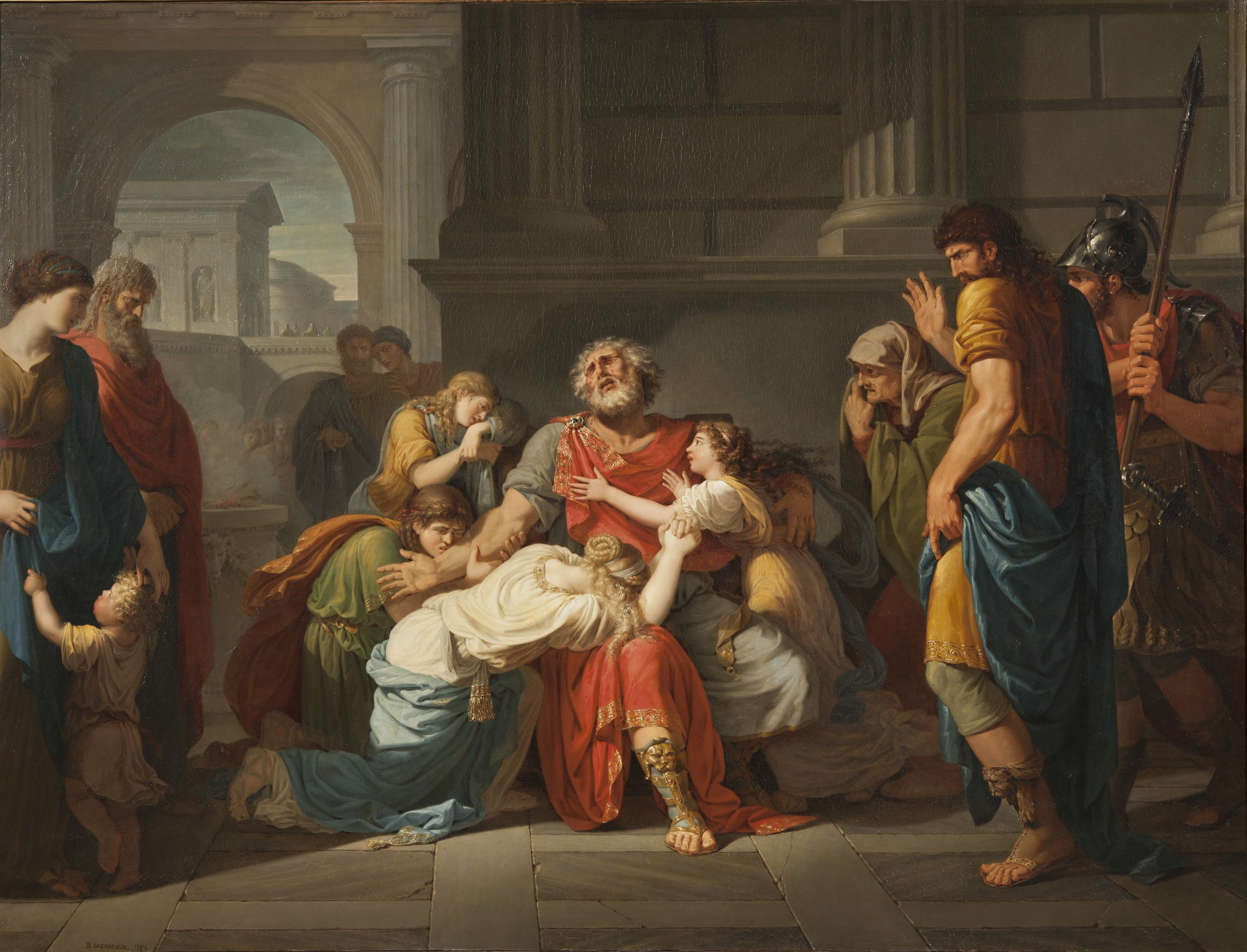
Bénigne_Gagneraux_The_Blind_Oedipus_Commending_his_Children_to_the_Gods.jpg

This past year I taught 9th grade Ancient Literature for the second time. My first year teaching this curriculum I spent too much time in Homer, and did not make it to tragedy; this year, my goal was to pace the course correctly and work through the most significant plays of Aeschylus, Sophocles, and Euripides. Along the journey, I discovered an unexpected blessing of teaching Greek tragedy: no other literature I have taught highlights quite so well the reality, the unavoidability, and the consequences of sin. I spent seven weeks with sixty 9th graders discussing questions of justice, inherited guilt, atonement, reconciliation, and grief. As a Christian educator in a secular school, I feel a burden to urge my students to consider topics I believe will prepare them for the gospel, and teaching Sophocles led to just such a discovery.

In setting the context for Oedipus Rex, I explained the play’s basic assumption that the plague in the city of Thebes resulted from a violation of the universe's moral law; the action of the play then, is a mystery solving the crime and rooting out the perpetrator. When the story unfolded and Oedipus’ guilt became increasingly plausible, I learned one of my students was a fervent relativist. He asserted adamantly that every person has a value system and that no one value system is preferable to another. People are good or bad based on how well they achieve their chosen values. This student left me scratching my head; how could I steer him towards truth without coming right out and telling him he is wrong? How do I guide him dialogically to discover that his thinking is insufficient? Fortunately, Sophocles himself resolved my dilemma.

That night, the students read a section of Oedipus Rex which made the incestuous relationship between Oedipus and Iocaste unmistakable; my student came in the next afternoon with a new declaration: “Mr. Herring, that’s wrong!” “Whether it fits his value system or not?” I responded. “Yes - that, that right there, is wrong.” Leave it to the Greeks—their licentiousness notwithstanding—to enshrine moral rock bottom in their literature. The battle for truth is in no way won; I suspect this student and I will go back and forth on the nature of truth for the next three years. But his declaration of “wrongness” struck me: Sophocles reached for a universal category in his drama, and in so doing he communicates down through the ages to our own “secular age.”

There is a sense in which it is harder to teach virtue than it used to be; teachers of years past could frame their moral instruction capitalizing on a common biblical literacy. Today, the idea of “loving your neighbor” because “God first loved you” simply does not compute without lengthy preparation. If we have lost the common cultural framework of biblical literacy, however, we are not left to our own devices to begin re-establishing the categories of sin and guilt. These are universal human experiences, and they underpin the best literature.

Sophocles can teach us moral fundamentals; sleeping with your mother and producing children offends the universe, human sensibility, and civic law. In Antigone, Sophocles has the title character appeal to the “unwritten laws of God” to justify her actions. In this line lies the glory of human literature as a moral teacher. On the other hand, therein also lies its insufficiency. Poets can discern sin, just as Paul calls the law the teacher of sin. Incest, pride, atheism, child murder: the tragedians illustrate the wrongness of these things. And yet, they can point to nothing more certain than the “unwritten laws of God” to prove the wrongness of these actions. These tragedies pull on a common human awareness of wrong actions, but fail to answer the desire for something clear, certain, and definitive.

Wouldn’t it be wonderful if the divine wrote down the rules? And then clarified them for us? This of course is exactly what we have in the Bible. We have the clarity of the Ten Commandments and the extensive development of practical outworkings all grounded in the nature of a loving God who created all things and knows our best interests. Suddenly, we have a sense of why hubris is dangerous: because God made us humans for a certain place, and the man of pride reaches for more than God intended. In the overreach lies the dangerous fall. Incest, too, offends the created order, wherein God intended human beings to form new covenant communities to diversify across the earth so that new facets of his image are revealed across creation. Scripture also shows us an alternative for guilt. We run not away from the angry Greek gods of Sophocles but to the loving God who through bloodshed atones for our wrongdoing. The Bible looks to the same universal problems and longings Greek tragedy addresses, but with hope.

After seven weeks in the wonderful poetry of Aeschylus, Sophocles, and Euripedes, I reached three conclusions. First, tragedy operates in a pre-evangelistic manner. The stories are simple, but so well-crafted that the reader becomes imminently mindful that he may have committed some great evil unawares just like Oedipus. Second, tragedy highlights a missing certainty in 21st century post-postmodernity. Reading Oedipus Rex worked to “blow the roof off” of my student’s assumptions that morality is completely relative, beginning a further conversation about the existence of moral truth. Third, tragedy is like a cancer diagnosis without chemotherapy; it provides no hope. Without the gospel, without the real word from a real God, we are left with Oedipus in despair over what our understanding reveals. Unless God is real and the Bible is true, we stand with Nietzsche gazing into the abyss of existence with no authentic response but despair.

Pascal famously wrote of a “God-shaped void” in every human heart; Greek tragedy can illuminate this void, but does nothing to fill it. In seeking some sort of atonement, Oedipus blinds himself, Iocaste commits suicide, and (in a later play) Antigone ends the evil of her existence by hanging herself. Tragedy looks at the human experience, sees the reality of sin, and concludes that nothing but despair remains. Where the tragedians despair, the gospel proclaims hope. Christ himself enters our tragedy and in the greatest eucatastrophe in human history reverses the tragic into the salvific.


Image: Bénigne Gagneraux, The Blind Oedipus Commending his Children to the Gods, Public Domain

The Most Reluctant Convert: C. S. Lewis Onstage, Part III

Image credit: Jeremy Daniel

Image credit: Jeremy Daniel

We had been told to wait in the lobby of the second floor for Max McLean to arrive, which he did about fifteen minutes later. After one performance and before another, with a Q&A sandwiched in between, I marveled in advance at his generosity of time. We didn’t want to waste his energies, so we dove right in after quick introductions. He’d freshly turned 64 a week before, as it happens, which happened to be the age Lewis was when he died, but McLean exudes vitality and shows every appearance of being able to keep going like this for quite a while.

To prepare to interview him, we’d read all the interviews he’d done we could get our hands on, and in so doing we discovered that, from a young age, he’d suffered from a fear of public speaking, a severe form of social anxiety, sociophobia. As a certified introvert I wanted to ask about this because, seeing him on the stage performing, nobody would ever imagine this. He had actually turned to theatre originally in college to overcome his fears; we wanted to know if the fears were gone or if he’d simply learned to manage them.

“I think that if I’m not prepared the anxiety will come back. The fear makes you really prepare. I find that there’s an enormous fear of failure. I don’t think I’ve gotten over that.” Asked whether he considered himself an introvert or extrovert, he said he is definitely an introvert, getting his energy from reading and his quiet time. “Absolutely,” he added for emphasis.

After college McLean studied acting in London, always having been impressed by British actors and their use of language. Interesting to note, too, are the various English thinkers and writers who have left an impression on McLean—from Shakespeare to Shaw, Eliot to Chesterton, Spurgeon to Lewis. He will be returning to England this summer for Oxbridge, a triennial Lewis conference held at Oxford and Cambridge Universities, and doing some of this performance there.

Prior to McLean’s conversion to Christian faith, he admitted that he’d tried to read the Bible but it made no connection; he couldn’t find a way of getting into it. “It was just a flat book. It could have been an engineering book, but it wasn’t a book that captured my imagination. Once Jesus became alive to me, I read the Bible differently. I read John’s Gospel; I thought Jesus was going to come out of the pages. He was a story, a human being that was a hero and an overwhelming one. So my emotions were engaged.”

So why are theatre and story so powerfully effective at capturing the imagination of people, and why is that important? McLean replied, “Well, that’s the critical thing, because the imagination serves up the raw material of what we think about. Romans 1 tells us we all have the knowledge of God. There’s that thing about how we all have eternity in our hearts. And these things are intact—like I mentioned in the Q&A that people want to talk about these things but they don’t know how to talk about them—so I think that the theatre captures people’s imagination and stirs the imagination—which then asks, could this be true? And then a person is more willing to invest intellectual capital. You know, you’re not going to invest intellectual capital unless your imagination is engaged, unless you want to know more. So I think theatre is an extraordinary tool for that.”

In pursuing this goal, by what intentional steps does the FPA strive to engage a diverse audience? “People make their own choices about their entertainment options. So essentially we don’t do it in a church. We do it in a theater. We advertise in the New York Times, we advertise in the subway. We advertise at NPR. I think the main thing is this: our best audience is somebody . . . who’s able to use relational capital to say, ‘Okay, come with me to see this play, because you’re not going to be embarrassed. It’s going to be a safe space, and you’re going to enjoy it.’ And if they don’t want to engage, no harm done. You know, you go out to dinner, and when they have questions, that’s great, and when they don’t have questions, that’s great too.”

McLean thinks the theatre can do great good, but only if it’s done well. We’d been struck by the plethora of rave reviews his work had consistently garnered, by reviewers both sacred and secular. Accolades and awards are commonplace—from the DC Metro Arts to the Washington Post, the Chicago Critic and Splash, the Indianapolis Monthly to World Magazine to Stagebuddy and The Weekly Standard. Adjectives among reviewers describing his work abound like “fascinating,” “smart,” “brilliant,” “masterful,” “winsome,” “delightful,” “captivating,” “satisfying,” and “moving.” We asked him to talk about the importance of striving for excellence in his work.

“Doing it in New York . . . New York is kind of hyper in that way. To do theatre in New York is such a challenge, and if you make it known that it comes from a Christian worldview the bar just gets really much, much higher. And then to consider doing it in such a way as to engage a diverse audience in this highly polarized world that we’re in right now, it’s almost impossible. So you depend on these kind of things: the writing, the acting, the stagecraft . . . you don’t want it to be turned off at that level or you won’t get a fair hearing. And a fair hearing might be ‘I’ve heard it, I listened to it, I think it’s rubbish, but it was really well executed.’ As opposed to what mostly happens: the execution is terrible, and nobody even bothers . . . or the message is so trite that it’s just immediately dismissed. So what we do, in order to accomplish our mission, we spend a lot of time thinking about what material has the best possibility to reach a diverse audience, then we have to execute it to the highest levels that our budgets will allow. Which means that we hire all our designers. They’re professionals. Just like you go to the best doctor, the best dentist, we hire the best sound designer, the best set designer . . . because you don’t want it to be dismissed at the execution level. You want the message to be heard, and you don’t want anybody to say, ‘Oh, I’m not going to listen to the message because the messenger just doesn’t care.’”

We thought it particularly interesting that one of the most recurring descriptions we’d read of his work was “funny,” and especially all the references to self-deprecating humor. Why, we asked, does this seem to function so well as an ice breaker and bridge builder with his audience?

“Well, humor is a reaction. It doesn’t lie. I mean, there are things you can do to create it, depending on your sense of humor. So much of modern comedic humor is based out of anger, and putting somebody down. Lewis’s humor is based on wit, and surprise, and also his own making fun of himself. He didn’t take himself that seriously. He did, but he tried to act like he didn’t. So I think that humor does tear down barriers, that if you can get to it, that if you’re good enough to find the humor, theatre is built on it. . . . I do think it’s a very high priority. Chesterton thought humor was the bloom of his argument.”

Having seen McLean at work, I must say: if anybody can demonstrate that life is a comedy and not a tragedy, McLean’s channeling Lewis can. Still, he admits to mixed results among certain atheist reviewers. Plenty of “generous atheists” have accorded his work accolades because they enjoy a good time. Still, particularly among those who seem to think they have a stake in the game, there’s resistance. “A real true blue atheist is one for whom the possibility of the supernatural world breaking into the material world is just considered impossible. So any other possibility is more probable than the supernatural. That’s really hard core.”

When up against that level of settled conviction that theism isn’t so much as possibly true, perhaps McLean’s work is exactly what’s needed to chip away at the wall. Rather than just more discursive argument that only heightens defense, something that’s engaging, entertaining, and aesthetically pleasing might be what’s needed to break down the barriers. McLean agrees, adding: “People have these moments of joy, moments where the supernatural breaks in. Because there are two spheres. There’s the sphere of love, which isn’t just biochemistry.”

Using performance art to wake people up, stir curiosity, and generate conversation is what McLean and the FPA are all about. This summer this show will hit the road; readers are encouraged to find out if it’s showing near you; and if so, sell all you have and see it! It’s a world-class production, and it’s eminently worth it, irrespective of your worldview. And this fall in New York a new production will begin, again based on Lewis: “Shadowlands.” I think this may necessitate another death-defying trip to the City.

McLean has written, “I’m keenly aware that, despite the best of intentions, as soon as the word ‘Christian’ appears within an artistic context, red flags go up. That, obviously, creates a challenge.” He continues:

During our first season of four plays in New York City, several reviewers expressed misgivings. Realizing that the work was from a Christian perspective, one critic wrote “my heart sank.” Another made the understatement that “presenting what is unequivocally come-to-Jesus fare to a general audience is no easy thing.”

In both cases, it was the play itself that turned them around. The first declared, “I expected a preachy bore, not the deliciously witty, theatrical treat that still resonates and amuses the day after.” He went on, “I expect that, like the first, [the next production] will be entertaining, very well staged, canny, and imbued with serious Christian thought and an earnest invitation to introspection.”

The second reviewer began by clarifying his background: “I’m Jewish by birth, liberal by conviction, and an atheist by observation and introspection.” He went on to say “how much I admire the approach of Fellowship for Performing Arts. . . . They do their work through a careful combination of good story-telling—craft comes first—and avoiding overt preachiness, allowing any message implicit in the material to take care of itself.”

Such feedback is reassuring. Art hints at the deeper structures of reality. FPA desires to create theatre that contributes to a better understanding of it. To do that requires honest, clear-eyed storytelling that entertains and engages its audiences. If a work doesn’t do that, regardless of intent, it really doesn’t matter what else it does.

It’s inspiring to see a faithful worker in this field, laboring in the hardest of venues, speaking truth and spreading light. He and the FPA deserve our admiration, support, and prayers. He’s someone who knows, like Orson Welles knew, the power of story and the importance of the imagination to wake people up, evaluate their assumptions, and generate conversations worth having. For McLean, though, the message to look up is not one of fear, but of soaring hope.

In that connection, one might wonder what C. S. Lewis was doing in jolly England when Welles did his radio performance. I don’t know. But I do know that, just hours before, Mars came up in some of his correspondence. Evelyn Underhill, famous for her works on mysticism and a convert to Anglicanism in 1921, had written a letter to Lewis that arrived on October 26th of 1938. He replied to her on October 29th, the day before Welles’ American broadcast. Here is what Underhill had written to Lewis:

May I thank you for the very great pleasure which your remarkable book Out of the Silent Planet has given me? It is so seldom that one comes across a writer of sufficient imaginative power to give one a new slant on reality: & this is just what you seem to me to have achieved. And what is more, you have not done it in a solemn & oppressive way but with a delightful combination of beauty, humour & deep seriousness. I enjoyed every bit of it, in spite of starting with a decided prejudice against “voyages to Mars.” I wish you had felt able to report the conversation in which Ransom explained the Christian mysteries to the eldil, but I suppose that would be too much to ask. We should be content with the fact that you have turned “empty space” into heaven!

In chapter 5 of Out of the Silent Planet, Ransom is in the spaceship on the way to Mars: “He had read of ‘Space’: at the back of his thinking for years had lurked the dismal fancy of the black, cold vacuity, the utter deadness, which was supposed to separate the worlds . . . now . . . the very name ‘Space’ seemed a blasphemous libel for the empyrean ocean of radiance in which they swam . . . it was the womb of worlds, whose blazing and innumerable offspring looked down nightly even from the earth with so many eyes—and here, with how many more! No: Space was the wrong name. Older thinkers had been wiser when they named it simply the heavens.”

Lewis’s reply to Underhill, written on October 29th, after expressing his alarm and delight at hearing from such a notable writer as she, went like this: “I am glad you mentioned the substitution of heaven for space as that is my favourite idea in the book. Unhappily I have since learned that it is also the idea which most betrays my scientific ignorance: I have since learned that the rays in interplanetary space, so far from being beneficial, would be mortal to us. However, that, no doubt, is true of Heaven in other senses as well!”

True to form for a guy who recognized that a convert must gravely count the cost.

Part 1
Part 2

The Ministry of Reconciliation

A Twilight Musing

Then I consider the difficulty of mending broken human relationships, I’m reminded of the nursery rhyme about how “all the king’s horses and all the king’s men/ Couldn’t put Humpty together again.”  Any professional counselor is able to relate cases of marital or other interpersonal conflicts where the alienation of the parties from each other is so deep as to seem irreparable.  In such cases, the counselor will try to help each party to understand how the matter appears to the other person or persons, since the conflict developed in the first place and deepened because each side assumed that its way of seeing things is the norm.  Therefore, each one interprets every action and argument of the other to be either dishonest or perverse.  If the two are to come together again (that is, be reconciled), one or both of them must take the risk of reaching out toward the other.

Matt. 5:23-25 lays out the importance of reconciliation among humans who are spiritual siblings: “So if you are offering your gift at the altar and there remember that your brother has something against you, leave your gift there before the altar and go. First be reconciled to your brother, and then come and offer your gift.”  These words are addressed to people who purport to be followers of Jesus and therefore are expected to respond to His words as a spiritual command.  In that light, it is significant that the person who knows he is alienated from his brother has an obligation that goes beyond whether the “something against you” is valid or not.  Even if (in the honest opinion of the one being accused) the brother who has taken offense is wrong, it is so important to take steps toward reconciliation that one is not even to participate in a worship service until every effort is made to bring about reconciliation.  This is a step that goes beyond the common sense of trying to settle a dispute out of court, rather than run the risk of losing a lawsuit.  What Jesus commands in this case is in the same spirit of not insisting on one’s own right that is commonly referred to as “going the extra mile” (see Matt. 5:28-32).

There is no way in human terms to understand the basis of Jesus’ teaching about selflessness in the Sermon on the Mount without reference to a much larger and more significant reconciliation that has been brought about by God’s initiative.  It is only as a reflection of that move of God toward us that we can effectively carry out reconciliation between humans.

But God shows his love for us in that while we were still sinners, Christ died for us. Since, therefore, we have now been justified by his blood, much more shall we be saved by him from the wrath of God.  For if while we were enemies we were reconciled to God by the death of his Son, much more, now that we are reconciled, shall we be saved by his life.  More than that, we also rejoice in God through our Lord Jesus Christ, through whom we have now received reconciliation. (Rom. 5:8-11)

Paul uses this truth as a rationale for how we as believers are to act:

Therefore, if anyone is in Christ, he is a new creation. The old has passed away; behold, the new has come.  All this is from God, who through Christ reconciled us to himself and gave us the ministry of reconciliation; that is, in Christ God was reconciling the world to himself, not counting their trespasses against them, and entrusting to us the message of reconciliation. (2 Cor. 5:17-19)

John pointed out that we love (indeed, are even able to love) only because God has first loved us (I Jn. 4:7-12), even to the extent of sacrificing His Son when we didn’t deserve it.   In the same way, we also seek reconciliation with others because God has first gone more than “the extra mile” to be reconciled with us, even while we were fallen creatures.  Another aspect of basing our response to others on what God has done for us is demonstrated in the parable of the ungrateful servant who, though forgiven an unpayable debt by his master, refused to forgive a much smaller debt owed by a fellow servant (Matt. 18:21-25).  Jesus pronounces God’s judgment on the unforgiving servant, and He states this condemnation even more bluntly in a comment attached to His giving of the Lord’s Prayer (Matt 6:14-15): “For if you forgive others their trespasses, your heavenly Father will also forgive you, but if you do not forgive others their trespasses, neither will your Father forgive your trespasses.”

Loving our siblings in Christ, even beyond what is reasonable, forgiving them beyond what they deserve, and seeking them out for reconciliation beyond what seems justified are God-enabled reflections of His unlimited desire to be in fellowship with us.  These principles are especially difficult to apply in a culture and a society which places a very high value on standing up for our rights, but if we are to have the privileges of fellowship with God, the price is a willingness to give up our “rights,” if necessary, in order to be reconciled with our brothers and sisters in Christ.


Note: A word of caution is in order about applying the normal principles of reconciliation outlined above.  A desire for reconciliation should never become a means of enabling an abusive person to continue his or her behavior.  Nor should an abusive person be allowed to use emotional blackmail to pressure a tender-hearted reconciler to submit to abuse. Being a willing victim of physical or emotional abuse is never an acceptable price to be paid for some kind of surface reconciliation.

Elton Higgs

Dr. Elton Higgs was a faculty member in the English department of the University of Michigan-Dearborn from 1965-2001. Having retired from UM-D as Prof. of English in 2001, he now lives with his wife and adult daughter in Jackson, MI.. He has published scholarly articles on Chaucer, Langland, the Pearl Poet, Shakespeare, and Milton. His self-published Collected Poems is online at Lulu.com. He also published a couple dozen short articles in religious journals. (Ed.: Dr. Higgs was the most important mentor during undergrad for the creator of this website, and his influence was inestimable; it's thrilling to welcome this dear friend onboard.)

The Most Reluctant Convert: C. S. Lewis Onstage, Part II

Image credit: Jeremy Daniel

Image credit: Jeremy Daniel

Like others who have been privileged to see what next transpired, I was thrilled and transported. It was as if C. S. Lewis himself walked onto the stage. The makeup was exquisite, and the resemblance to Lewis uncanny. Even the voice was near perfect—I remember having listened to one of the few extant recordings of Lewis a year ago. McLean intentionally didn’t aim at enunciating quite so thick an accent as Lewis actually had, explaining why after the play in a Q&A session. For an American audience, in particular, this was a smart decision to avoid it becoming a distraction. McLean’s classical training in voice paid its dividends.

Most people are likely familiar with what happens when watching an inferior performance, show, or movie; it’s hard not to hold it at arm’s length because there’s something mildly insulting and off-putting about the shoddy craftsmanship. In patent contrast, we also know what it’s like when we watch a particularly excellent performance: we’re drawn in, we lose ourselves in the story, we become thoroughly engaged. This was my experience as I sat and watched FPA’s production. A virtuoso performance, it was by turns instructive and convicting, insightful and hilarious, poignant and memorable.

The crisp monologues by the pipe-wielding Lewis recounted the tale of his conversion, chronicling how, step by methodical step, he traversed a path from skepticism to belief. Included in the account were the seminal figures of his life: his father, his brother, his teacher the “Great Knock,” and literary influences from Yeats to Chesterton to George MacDonald, whose Phantastes “baptized” Lewis’s imagination prior to his conversion.

Lewis’s aversion to Christianity was hard for him to square with the fact that so many of his favorite writers, whose writing tasted most real, were Christians. His hard-thinking friend Owen Barfield’s conversion to Christianity upset Lewis, yet Lewis found Barfield’s logic unassailable. Too many aspects of life, to be taken seriously—from consciousness to morality to reason itself—require rock bottom reality to be intelligent. Coghill helped Lewis see the virtues as relevant to understanding reality; Tolkien enabled him to see that Christianity is the True Myth; and gradually Lewis became open to the Absolute, then to Spirit, then to God, then to the Incarnation, each incremental step ineluctably inching toward greater and greater concreteness. Acutely mindful that it took God’s initiative to draw him, Lewis finally relented to the Hound of Heaven, admitting defeat, allowing himself to be vanquished by love, and not the least bit happy about it.

In contrast with any theology of “cheap grace,” or an accommodating Christianity that readily capitulates to swirling cultural whims, blithely smearing the name “Christian” on views conditioned by secularity rather than scripture, Lewis seemed intuitively to grasp from the start that real Christianity would be costly, that its implications were radical, that its demands were all-encompassing. Little wonder he counted the cost, and, after finally relenting—first to theism, then to Christianity—he was, by his own admission, the most reluctant and dejected convert in all of England. Far more quickly than most, he was able to apprehend the paradox of Christianity: to find life we must lose it, to live we must die, and that ultimately we can’t hold anything back.[su_pullquote align="right"]Lewis seemed intuitively to grasp from the start that real Christianity would be costly, that its implications were radical, that its demands were all-encompassing.[/su_pullquote]

The play was simply spectacular, and we loved it. Most of the audience stayed for the Q&A, and about ten or fifteen minutes after the play was done, McLean re-emerged, this time as himself rather than Lewis. It was a remarkable metamorphosis! Donning salmon slacks and a coal shirt, his hour as Lewis was clearly over, and now it was time to hear from the actor and writer himself. He joked about his pants, exuded confidence, showed relaxed body language, sat in the chair, and patiently fielded questions from the audience. His answers were perspicacious and trenchant, revealing him to be well read and often quite eloquent and erudite.

Asked about obstacles doing a play like this in New York, he said that theatre is a great venue to have these sorts of conversations. He’s convinced that people want to have such dialogues, but are often unsure how to do it. He spoke of his admiration for Lewis, despite admitting that some of Lewis’s writings were an acquired taste, demanding effort to apprehend them well. He had largely relied on Lewis’s own words for this play, but had to work hard to thin out some of Lewis’s diction and elaborate explications to make the ideas more widely accessible and understandable.

The result, to my thinking, was a veritable “greatest hits” woven together masterfully. I had enjoyed the play immensely, and the Q&A only enhanced my appreciation for McLean, and in a few moments Marybeth and I would get the chance to speak with him personally.

Part 1
Part 3

What Women Want

King Arthur’s Queen Guinevere baffles him.  Like Arthur every other man is perplexed too.  We don’t know what makes her tick or what she wants.  In the Broadway play ‘Camelot’ King Arthur muses to himself.  He cannot figure Guinevere out.   I so identify with him.  King Arthur remembers Merlin the Magician teaching him about the animals.  Merlin turned him into a beaver to teach him about beavers.  Arthur says, ‘I should have had the whirl to change into a girl to learn the way the creatures think’.  ‘How to handle a woman?’  he wonders.  ‘Ah, yes’ he remembers.  Merlin said, ‘The way to handle a woman is to love her, love her, merely love her…’

The prolific crime and mystery novelist Ruth Rendell knew what woman want.  The hero in her novels is Chief Inspector Reginald Wexford.  Chief Inspector Reginald Wexford exemplifies what woman want in man.  She used to get tons of female fans telling her they wanted to marry Chief Inspector Wexford.   Ruth knows the reason: Chief Inspector Wexford answers what woman want (1) he makes them laugh (2) he ‘likes women very much and always has time for them’. (W Post, Obituaries, May 3, 2015)

Jesus fulfills a woman’s deep want and need more than any man.  Why have so many women over history followed Him?   He did what Ruth Rendell said:  he shows he likes women.  A revolution occurred because He dignifies them.  He accepts women as having standing.  As men, Jesus gives women access to Himself.  He always has time for them.  He pays them attention.  I want to try to show how the account of Martha, Mary and Jesus makes this clear.   How their want of Him made Him the one thing necessary in their lives.

Jesus entered Martha and Mary’s village of Bethany.  Bethany is just over the crest of the Mt. of Olives.  Martha ‘welcomed’ Jesus into her home.  Martha is the only woman I can think of who invited Jesus into her home.  Taking the initiative to do so took self- confidence.  It tells us she was friendly toward Jesus and his ministry.  Jesus did not decline Martha because she was a woman.  Perhaps Martha could do it because her home was large enough to accommodate Jesus and his disciples.

Martha’s sister Mary was also there.  When Jesus entered, Mary followed the Lord.  She took her place at His feet.  She begins listening to what he was saying.  This is radical.  Jewish teachers were generally opposed to women learning.  Jesus not only lets her sit at his feet. As we shall see, he expects her, a woman, to listen and learn.  This is still controversial in 2017.  The Taliban says the Moslem Quran does not allow women to be educated.  If Jesus entered your house, would you be sitting there with him?  Where was Martha?

Martha was ‘distracted.  She is overburdened by the various tasks of hosting guests.  She is anxious to provide a fine dinner and comfortable hospitality for her special guests.  Every host knows the tension between being with your company and attending to the ongoing preparation for dinner.  Guest’s hands and feet need washing; heads need oil; towels for drying;  fire for cooking tended; meat prepared and cooked; the vegetables, the bread, the deserts, and water drawn.  The tables have to be set with your best utensils and crockery/china.  The candles filled with oil and lit.  Flowers put in vases.

Our first Thanksgiving dinner as newlyweds Pam and I hosted my parents.  It was nerve-wracking for Pam.  Pam had never prepared a turkey in her life.  This was her first dinner for the in-laws.  She knew none of the recipes my parents enjoyed.  She baked a cake from scratch.  It was three layers.  When I cut the cake, it crumbled into bread crumbs.  She had iced the outside, but forgot to ice between the layers!

After all, Martha is entertaining Jesus!  The Prophet who taken the world by storm!  Martha is just plain stressed out.  She wants to give him an impressive dinner.  But she is feeling put upon.  With all that needs to be done, her sister is sitting there with Jesus.   Martha leaves her preparations and makes her way to Jesus.  If she appeals to Jesus, Jesus will tell Mary to help.  Mary will listen to the Master.  The Holy One will enlighten Mary to her injustice and selfishness. ‘Lord, do you not care that my sister has left me to do all the work by myself?’ Tell her then to help me’.  ‘Tell her to do her share.’  Tell her to pitch in.  ‘Many hands make work light’ my mother would say.

But the Lord answered her, ‘Martha, Martha’.  Saying her name twice shows his strong interest in her.  There are many people around him but He considers her.  ‘Martha, Martha, you’re worried and distracted about much.’  You’ve been thrown into undue disorder and trouble.  These ‘worldly’ matters are too much oppressing you.  Things have gotten out of perspective.   You’re in overload.  For a lot of people, life moves at a chaotic clip.  It’s an all too typical woman’s – yes, man’s too – but particularly a woman’s concern today.  She is working a stressful job; she’s trying to be a good mother/wife. Women typically bear the brunt of the responsibilities of family and home.  Maybe she is also taking a night class to work on her degree.  I heard of a single woman holding two jobs; her father had Alzheimer’s in a care facility; her mother who lives with her has a health issue; and she is raising children.  ‘Martha, Martha’.

Was Martha ‘multi-tasking’?  She was trying to juggle multiple tasks.  ‘Multitasking’ is our word for today for juggling the overload of many duties.  ‘Multitasking’ is doing two or more cognitively complex things at the same time.  Dr. Frances E. Jensen, a U of Penn neuroscientist, says ‘multitasking’ is a myth.  Yes, you can chew gum and watch the baby at the same time.  That’s not multitasking.  But you cannot make cordon Bleu and solve a problem with your boss on the phone at the same time. If you try to do them at the same time your brain has to switch back and forth constantly.  You do neither well.  Focusing on more than one complex task is virtually impossible.  If you’re a teen – or Tom Thomas – it is impossible!

‘Martha, Martha, you’re worried and distracted about much.’  Are you too? Jesus continued. ‘But one is necessary’; ‘there is one need; ‘there is need of only one thing’.  Simplify.  ‘Mary has chosen the good portion’.  The word ‘portion’ connotes ‘food’.  Jesus puns, ‘Mary has chosen the better food.’    What food did Mary choose?  Jesus…the bread of life.  She chose to sit with and listen to Him.  What food did Martha choose?  The bread…of the kitchen.  Given the choice between life’s duties, responsibilities, vocations, and avocations and Jesus, Jesus  ranks above them all.  Which are you choosing?  Which is your practice?  Which is your first priority?   Is everything else second to Him?    What if Martha had done that? Driven, Type A people are asking who would have provided the beautiful arrangements of food and drink?  Better to have Jesus and a peanut butter and jelly sandwich than a Better Homes and Garden banquet without him.   Jesus consistently messages this: to the rich young ruler: sell everything, give to the poor, then come and follow me; to the man who wanted to bury his father before following Jesus.  Jesus said, ‘Let the dead bury the dead, follow me.’ Martha doesn’t realize who is in her midst.  Few people do.  In him is ‘the fullness of deity dwelling bodily’…the One who is before all things… ‘the one who is to have first place in everything’ .

Here is the man women want – the man women need; a man who likes women; loves women; wants them to learn from Him, to be with Him and He with them.  He would rather have Martha than a well- appointed home; He would rather have Martha than appetizing cuisine; He would rather have her than fine hospitality.  He wants Martha for herself; not for anything she can give him.  Where have you heard of such a man? Where have you heard of such a holy man, or spiritual leader?  Take the holy one the Buddha as an example.  The Buddha said to his disciple Ananda: ‘Women are stupid, Ananda; that is the reason, Ananda…why women have no place in public assemblies…’

Jesus shows as much interest in her as a man.  He invests in her worth: invites her to join his circle; wills her to be his disciple; believes she is just responsible as a man to God; just as capable of hearing, understanding and learning as a man.  This is a watershed for woman in history.

Women respond to Jesus.  He’s what they want.  He’s what they need.  They’ve heeded his word to Martha.  They have made Jesus their first portion –the one thing necessary.  He has fulfilled their deep want and need.  Probably in greater numbers in church history than men…in different ways: as wives…as mothers…a martyrs…as activists…as writers…as teachers…as evangelists…in mission…to great effect.  Perpetua was a 22 year old new mother.  She was imprisoned by the Romans with her infant for declaring she followed Christ.  The proconsul told her he would release her if she said, ‘Caesar is lord’.  Her father begged her to lie. She would not.  She said, ‘Jesus is Lord’.  She so wanted Jesus, when made to decide, she chose him above her father, her child, and her own life. Her witness lives on today.

Mademoiselle De La Mothe, better known as Madam Guyon, was a teenage girl in Paris.  She was smart and beautiful.  She was tall and well built.  She had a Grecian countenance, high forehead and brilliant eyes, and a noble sweetness.   She thought a lot of herself.  She spent a good part of the day in front of the mirror.  At 17, she fell deathly sick.  She was not expected to live.  As she languished, her sins haunted her.  She realized her self had been her religion.  She knew she was out of favor with God.  She recovered.  See sought God.  The only way she knew to try to get God’s acceptance was earn it:  she began to do good works.  It didn’t take away her sorrow for her sin.  Then she came to understand loving Jesus Christ is a matter of the heart.  Then she came to know personally Jesus Christ not by doing righteous works, but by faith.  Now, she said, ‘For I had now no sight but of Jesus Christ’ .  She was sorrowful of her wasted past.   Why was she so late in finding Jesus?  ‘Why’ she wondered, ‘have I known thee so late?  Alas, I sought you where you were not, and did not seek you where you were!’  She wrote the name of her Saviour in large characters and attached it to her person.  She wanted to be reminded continually of Him. She wrote poems and letters for Christ.  She influenced circles of Christians and mystic theologians like Francis Fenelon.

What do women want?  What do you want?  They want the One who accepts and honors them; the One who wants to be with them; who wants them to be in his company and they in his;  the One who loves them - they want Jesus Christ!  He is the one thing necessary.  Is He for you the One necessity?


  Image by Georg Friedrich Stettner († 1639) - Van Ham Kunstauktionen, Public Domain, Link

Tom Thomas

Tom was most recently pastor of the Bellevue Charge in Forest, Virginia until retiring in July.  Studying John Wesley’s theology, he received his M.A. and Ph.D. degrees from the University of Bristol, Bristol, England. While a student, he and his wife Pam lived in John Wesley’s Chapel “The New Room”, Bristol, England, the first established Methodist preaching house.  Tom was a faculty member of Asbury Theological Seminary from 1998-2003. He has contributed articles to Methodist History and the Wesleyan Theological Journal. He and his wife Pam have two children, Karissa, who is an Associate Attorney at McCandlish Holton Morris in Richmond, and, John, who is a junior communications major/business minor at Regent University.  Tom enjoys being outdoors in his parkland woods and sitting by a cheery fire with a good book on a cool evening.

The Most Reluctant Convert: C. S. Lewis Onstage, Part I

It was Halloween Eve, Mischief Night as it’s often dubbed, the penultimate day of October in 1938. At a time when the radio was the main source of news and entertainment, the big draw that evening was the legendary Edgar Bergen and his ventriloquist dummy Charlie McCarthy. Popular lore says that a musical interlude in Bergen’s performance led many radio listeners to surf the channels and tune in to what would subsequently be called the most famous radio broadcast of all time.

Perched high in the Columbia Broadcasting Building on Madison Avenue, a precocious 23-year-old impresario Orson Welles was orchestrating a coup of the airwaves. Already reputed as Broadway’s most brilliant rising star, Welles made this particular Sunday anything but restful, directing the terrified eyes of his rapt listeners to quite the ominous October sky. It was a scant nine years before, almost to the day, that Black Tuesday had initiated the Great Depression, whose painful ripple effects were still felt. With Hitler’s foreboding rise to power and Europe so susceptible to his domination and imminent encroachment, the future was uncertain; people were already on edge and accustomed to hearing bad news.

Image credit: Jeremy Daniel

Image credit: Jeremy Daniel

That night, by the time they started listening to this storied adaptation of H. G. Wells’ War of the Worlds (1898), much of the audience had missed the opening introduction identifying it as a dramatization. Welles’ magisterial depiction of an alien invasion in Grover’s Mill, New Jersey induced panic in lots of quarters, accounts varying as to its extent. The show was strategically punctuated by realistic breaking “news bulletins”; by a sudden impromptu and pregnant, protracted and deafening silence initiated by Welles himself; and by another voice actor emulating the rhythm and cadence of Herbert Morrison’s immortal heart-rending eyewitness radio report of the Hindenburg’s fiery destruction just a year before.

For a few hours, the show simply terrified a nation already fraught with fear. Amidst subsequent media outrage and furious calls for greater FCC regulation, Welles feigned shock and dismay over the tumult his broadcast had produced. In truth the whole scenario would catapult him into the stratosphere of international fame, issuing him his ticket to Hollywood.

On the one hand, the remarkable episode furnishes a cautionary tale against the power of propaganda; on the other, more positively, it’s a reminder of the remarkable ability of drama and story to capture and mesmerize the imagination and move the will. The broadcast was a production of the Mercury Theatre, founded by Welles and John Houseman (later of Paper Chase fame as Professor Charles Kingsfield), located on West 41st Street in New York City, a mere half mile from where my wife and I recently watched a different drama unfold—one more tethered to actual history.

H. G. Wells wrote War of the Worlds in 1898, forty years before the Mercury Theatre’s radio adaptation. The year of Wells’ book in England also marked the birth of C. S. Lewis in Belfast, Ireland, and it just so happens that the play that we recently saw was a one-man show about the great Oxford don’s reluctant conversion to Christian faith.

Inexplicably navigating the frenetic, frantic Manhattan traffic by sheer force of will and a deft defiance of physics, our taxi driver dropped us off at the Acorn Theatre on West 42nd Street. Until then we’d assumed the Amtrak train hurling along in northern Virginia at breakneck speed might be the most terrifying part of our journey, feeling suspiciously like the Knight Bus in Harry Potter’s London. The Acorn Theatre is part of “Theatre Row,” headquartered in the heart of NYC’s Theater District.

Surviving that harrowing freak show of vehicular congestion made receptive our hearts to the transcendent and miraculous, and indeed a magical afternoon at the theatre was about to ensue. It was less than an hour to the matinee show time. We were excited to relish the performance we’d heard so much about already, and just as enthused at the prospect, afterwards, of meeting its star, Max McLean, who co-directed the show with Ken Denison. His publicist had neatly arranged our post-show interview.

After procuring our tickets, we made it to the third floor theatre, its set smartly arranged as a cozy book-lined office replete with desk, virtual pictures on the back wall, and a requisite cushy chair—just the sort of environment for the bookish Lewis to make an appearance. The ostensible location is Lewis’s study at Magdalen College, Oxford, 1950. While we admired the décor and became acclimated to the surroundings—feeling more than a little giddy as quite the sophisticated NYC theatre-goers—I perused the play’s brochure.

The performance, it was explained, is a production of the Fellowship for Performing Arts (FPA), which was founded by McLean in 1992, and which aims to create theatre from a Christian worldview that engages a diverse audience. It has developed and presented award-winning plays such as The Screwtape Letters, which I saw in North Carolina some years ago, never imagining at the time I’d later get to meet McLean personally, aka Screwtape. Other productions—staged in theatres and performing arts centers in New York, London, and across America—have included The Great Divorce, Mark’s Gospel, Martin Luther on Trial, and of course this one: C. S. Lewis Onstage: The Most Reluctant Convert. The outfit has also produced critically acclaimed audiobook narrations of classic Christian works, predicated on the power of not just reading scripture, but hearing it.

I read with particular interest the brochure’s “Note about the Play,” which helpfully explains the subtitle. In 1950, Lewis received a letter from a young American writer expressing his struggle to believe Christianity because he thought it “too good to be true.” Lewis responded, “My own position at the threshold of Christianity was exactly the opposite of yours. You wish it were true; I strongly hoped it was not. . . . Do you think people like Stalin, Hitler, Haldane, Stapledon (a corking good writer, by the way) would be pleased on waking up one morning to find that they were not their own masters . . . that there was nothing even in the deepest recesses of their thoughts about which they could say to Him, ‘Keep out! Private. This is my business’? Do you? Rats! . . . Their first reaction would be (as mine was) rage and terror.”

The Note goes on to say that this was Lewis’s mindset before he “gave in,” as he put it. Lewis had embraced ideologies like materialism, atheism, naturalism, determinism, and reductionism—views that hold in common the conviction that all of life, every action, emotion, or perception, is susceptible to deflation. Each can be reduced to pre-existing physical causes all the way back to the Big Bang. There is no need to appeal to a supernatural source. God is not required to explain or define origin, meaning, ethics, or destiny. “For many years, Lewis was a defender of this view. And given his rhetorical gifts and love of debate one could see him fit into the ‘New Atheist’ camp with the likes of the late Christopher Hitchens or Sam Harris.”

This play, it was explained, would explore Lewis’s dramatic conversion from this position to Christianity. McLean, the author of the Note, adds that he thinks Lewis’s vibrancy and resonance as a Christian apologist is rooted in this experience. The primary sources for the play, the Note continues, would be Lewis’s autobiography, Surprised by Joy, as well as his Collected Letters, a three-volume veritable treasure trove of insights and rich historical nuggets. McLean wrote the script by carefully cobbling together Lewis’s disparate words into a seamless tapestry and compelling narrative with a readily discernible and inherently fascinating trajectory. In addition to the primary sources, McLean also relied on several of Lewis’s books and essay collections, including The Problem of Pain, The Weight of Glory, Mere Christianity, God in the Dock, Present Concerns, and Christian Reflections. And he acknowledges his debts to various biographies and critical insights by Douglas Gresham (Lewis’s stepson), Walter Hooper (editor of Lewis’s literary estate), Devin Brown (from Asbury University), Tim Keller (whose church McLean attends in NYC, a church that has several pastors with specific ministries for the artists in the congregation), Alan Jacobs (Wheaton), Jerry Root (who’s written a book on Lewis and the problem of evil), Andrew Lazo, George Sayer, David Downing, Oxford’s Alister McGrath, Armand Nicholi (author of a book comparing and contrasting Lewis and Freud), Sheldon Vanauken, Kenneth Tynan, and A. N. Wilson, among others.

Finally, I read that the play takes place prior to the publication of Lewis’s first Narnia story and well before he met his wife, Joy Davidman—which introduces the tantalizing possibility of a sequel. My appetite thus whetted, I was primed to see the show.

Part 2
Part 3

Bishop S. I. Newman at the Gate of St. Peter

Guest article by Dr. Livingston Greystoke

Bishop S. I. Newman stood at the Gate of Heaven.  There Saint Peter met him.  We are privy to their conversation which I report just as it occurred.

St. Peter: Who are you?

Bishop Newman: Who are you? Where am I?

St. Peter: I am Peter, the Lord’s apostle.  You are at the very entrance of heaven. I can tell, Mr. Newman, you are surprised to see me.  Did you think that what we now see extending out through that Gate to eternity was a myth?  You did teach, quite consciously, the Lord Jesus was a mental projection of the needs and hopes of us disciples.  Certainly, you did not expect to meet Him – or me - here, did you?  I assure you, Mr. Newman, we are quite real.

Bishop Newman: You can understand why I made such an assumption.  Our most brilliant scholars in the most esteemed academies using the most contemporary historical analysis convinced me.   I was just using my God-given reason to consider the texts.  God would not want me to commit ‘intellectual suicide’ in reflecting on what people wrote about him – or her – or it- whoever.

St. Peter: Reason is one thing, prejudice another.  And, isn’t reason exercised together with faith?  After all, ‘without faith it is impossible to please God’.  Let me ask you.  Why should you be admitted through these gates?

Bishop Newman: Since you asked, all modesty aside,  I rose to the top of the clergy ranks; colleague among colleagues; leader of leaders; most devout of the devout, esteemed by clergy and lay; viewed to have an unusual set of leadership skills; an apt expounder of relativizing the Scriptures for our day; and passionate for the issues which oppress.  What might have been my most important attribute, I was recognized as having the gift of being able to make myself acceptable to all.  I strove to fulfill Jesus’ greatest passion - unity in the Church!  This was no easy task.  Glory be to God what God inspired in me!

St. Peter: Were you not like brother Paul?  He regarded ‘everything as loss because of the surpassing value of knowing Christ Jesus my Lord?’  He determined to ‘never boast of anything except the cross of our Lord Jesus Christ’.  Didn’t you hold back from preaching the cross? You thought it foolishness so you didn’t preach it! Though it is foolishness to the pagans brother Paul preached it anyway! You should have known the cross is the power of God to those being saved.  You thought talk of the cross as a necessary, objective substitutionary sacrifice for sin a crass antiquarian throwback to medieval days. 

Bishop Newman: But I was so moved when I administered the Eucharist and passed the cup, saying, ‘The blood of Christ given for you. Amen’.  It was a numinous experience.

St. PeterBut you lived as an enemy of the cross.  You promulgated the rejection of the authority of God’s Word by urging persons to indulge their lusts and make their god the belly. You, of all people, the ecclesial leader of God’s people, have led the weak into licentious ways.  You have encouraged extra-marital sex by advocating the right to homosexual practice.  You ought to know unrepentant ‘fornicators’ will not be at home here!  You promised freedom but gave slavery!

Bishop Newman:  I was extremely passionate on behalf of those upon whom the shadow of the cross falls.  I stood with the oppressed and the ‘have-nots’ against ‘the haves’.  I challenged systems of discrimination and injustice.  I politicked for the care of creation and climate justice.  I struggled against the criminalization of abortion.  I supported the absolute right of a woman to choose to abort a fetus at any stage in her womb.  I fought hard against the erection of structures of homophobia and heterosexism.  I have protested against discrimination based on gender identity – transvestites should be welcomed in every pulpit! Prejudice against any chosen, loving sexual practice must not be indulged.

St. Peter:   Bishop S. I. Newman, your compassion for the humble, the lowly, the poor in body and spirit is admirable. Nonetheless, for you, what is bitter is sweet; what is dark is light; what is false is true. You have the form of religion but not the power.  You know the politic but not the Person.  You are a teacher of the law without understanding either what you say or the things about which you assert.  You have come to the wrong Gate.  Your own words speak against you.  You will neither fit nor be happy here. Adieu.

********************